So, you've just collected the keys to your new BTO flat. Congratulations! It’s a huge milestone. Now comes the exciting part: turning that blank canvas into a place that feels like your home. For many new homeowners, this is where a BTO renovation package comes into the picture.
Understanding the BTO Renovation Package

Think of a renovation package as a "set menu" at a restaurant. Instead of deciding on every single item (or in this case, every single renovation task), you get a curated bundle of essential services for one clear price. It’s a practical approach designed to get your home move-in ready without the typical chaos and guesswork.
This is especially helpful for first-time homeowners who might find the sheer number of choices overwhelming. A package provides a predictable path forward, removing much of the decision fatigue.
The Core Concept: A Bundled Solution
At its heart, a renovation package gives you clarity and control over your budget. By bundling services, interior design firms can offer a more competitive price than if you were to source every plumber, tiler, and carpenter individually.
These packages are built to cover the foundational work every new BTO flat needs.
Typically, you’ll find these essentials included:
- Basic Carpentry: Standard kitchen cabinets and bedroom wardrobes.
- Masonry Work: Tiling for the floors and walls in your kitchen and bathrooms.
- Plumbing & Electrical: Laying out the essential wiring points and plumbing hookups.
- General Painting: A fresh coat of paint for the whole unit.
The biggest benefit? You’re not juggling a dozen different contractors. You have a single point of contact who manages the whole project, which makes the entire process feel much smoother. To get a better idea of what goes into these packages, it helps to understand the key elements of a kitchen renovation, as this is often a major component.
Package vs Custom Renovation
Of course, the alternative is to go fully custom, or "à la carte." This path gives you total creative freedom to pick and choose every single detail, from the tile grout colour to the exact finish on your cabinet handles. But that level of customisation often comes with a higher price tag and demands a lot more of your time and energy to manage.
So, which one is right for you? It really depends on your priorities.
Package vs Custom Renovation at a Glance
Here’s a practical comparison to help you see the fundamental differences between a standard package and a fully customised renovation.
| Feature | BTO Renovation Package | Custom (À La Carte) Renovation |
|---|---|---|
| Budgeting | Fixed, upfront pricing provides cost certainty. | Flexible budget, but prone to cost overruns. |
| Decision-Making | Simplified choices within a pre-selected range. | Unlimited options, requiring more decisions. |
| Timeline | Generally faster due to standardised processes. | Longer duration due to unique requirements. |
| Customisation | Limited to package scope and material options. | Complete freedom to design every detail. |
| Ideal For | First-time homeowners, budget-conscious individuals. | Homeowners with specific design visions and larger budgets. |
Opting for a BTO renovation package is a choice for predictability and convenience. It lays a solid foundation, helps you stick to a budget, and gets you into your new home faster. From our experience with clients, about 70% of new BTO owners choose a package because it hits that sweet spot between cost, speed, and getting all the essential work done right.
So, What's Actually in a BTO Package?
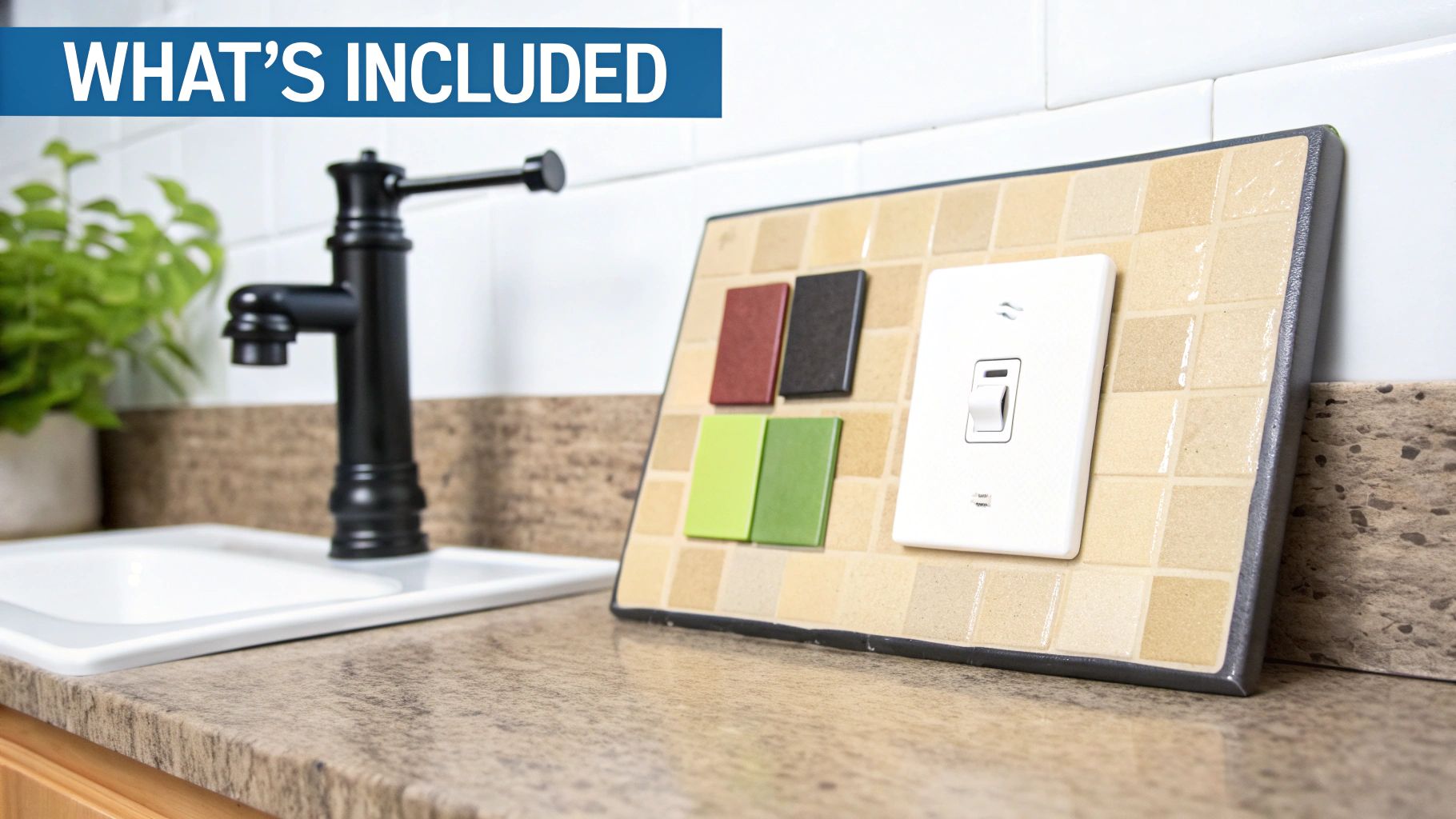
Trying to figure out what a BTO renovation package includes can feel a bit like reading a foreign language. You're hit with a list of technical terms, but what do they really mean for your future home? Simply put, these packages bundle all the essential, foundational work needed to turn a bare BTO unit into a liveable space.
Think of it as building the skeleton of your home. This is about getting the non-negotiable structure right so everything else—like statement lighting or a comfy sofa—can fall into place.
Let's break down what you can typically expect.
The Foundation: Masonry and Tiling Work
Masonry is usually one of the first things to happen. In most BTO packages, this means tiling your "wet areas"—the kitchen and bathrooms. Why? Because these high-traffic spots need durable, water-resistant surfaces to stand up to daily life.
Here's what's usually covered:
- Kitchen Floor and Wall Tiling: This includes supplying and laying tiles for the floor and up to a certain height on the walls, especially around the stove and sink where splashes are inevitable.
- Bathroom Floor and Wall Tiling: For bathrooms, full tiling on both the floor and walls is standard. It creates a waterproof shell that's crucial for such a high-moisture zone.
- Waterproofing: Before any tiles go down in the bathrooms or service yard, a waterproofing membrane is applied. This is a must-do step to prevent leaks and water damage down the road.
One thing to keep in mind: the tiles included in the package are usually from a curated selection of ceramic or porcelain options. If you have your heart set on something specific like marble or intricate mosaic tiles, that will almost certainly be an add-on cost.
The Workhorse: Carpentry Services
For most new homeowners, carpentry is where the magic really happens. This is the part of the package that delivers the built-in storage solutions that are so critical in Singaporean homes where every square foot counts.
A standard package will usually specify fixed lengths for your built-ins. Based on our experience across hundreds of BTO projects, here’s a practical example of what a 4-room flat package might include:
- Kitchen Cabinets: Typically around 20 feet (or 6 metres) of top and bottom cabinets. This isn't a 20-foot-long kitchen; it's the combined length (e.g., 10 feet for upper cabinets + 10 feet for lower ones). This is generally enough for a standard BTO kitchen.
- Wardrobes: Expect a 6-foot (or 1.8-metre) full-height wardrobe for the master bedroom. This is a starting point, and many clients choose to upgrade for more closet space.
- Countertops: The package will come with a standard countertop, usually a solid surface or a quality laminate. Premium materials like quartz or granite are popular upgrades.
Actionable Tip: We make a point to spell this out clearly. It's a common mix-up when homeowners see "20 feet of kitchen cabinets" and assume it refers to the length of their kitchen wall. It's the total linear length of the cabinetry itself—a small but important detail for space planning.
The Essentials: Electrical and Plumbing
A home isn't a home without power and water. Every BTO package covers the basic setup to get your utilities up and running safely. We're not talking about complex smart home systems here, just the fundamental connections that make daily life possible.
For electrical work, packages often specify a set number of points. For example, a package might cover 30 electrical points, which you can use for lights, power sockets, and switches. If you need more, they'll be charged per point.
Plumbing is a bit more direct and usually includes:
- Connecting your kitchen sink and tap.
- Installing bathroom essentials like the toilet bowl, sink, and shower set.
- Running new stainless steel pipes for hot and cold water.
The Finishing Touch: Painting and General Works
Finally, the package ties everything together with the finishing touches. This nearly always includes a full paint job for the entire unit—walls and ceilings—using a standard brand with a set palette of colours to choose from.
General works also cover the less glamorous but essential tasks: clearing all the renovation debris, doing a chemical wash to get rid of construction dust, and protecting your floors during the renovation. These steps ensure your brand-new home is sparkling clean and ready for you to move in. Knowing what's inside these packages is the first step to comparing quotes and making a choice you'll be happy with for years to come.
Budgeting for Your BTO Renovation Cost

Alright, let's talk about the elephant in the room: the budget. This is often the trickiest part of the whole renovation journey. The big question every new homeowner asks is, "So, how much is this really going to cost me?"
Getting a handle on the finances for a BTO renovation package is the most important first step. It helps you plan properly and saves you from nasty surprises later on. The final figure isn't just one number; it’s the result of all the little decisions you'll make, from the size of your flat to the type of countertop you choose.
Typical Cost Breakdown by Flat Size
The most straightforward factor driving your renovation cost is the size of your BTO. More floor space means more materials, more labour, and naturally, a bigger budget. After managing hundreds of BTO projects, we've got a pretty clear picture of what new homeowners can realistically expect.
In Singapore, costs can swing quite a bit depending on how simple or complex you want the renovation to be. For a standard 4-Room BTO, you’re typically looking at S$35,000 to S$55,000. But if you're planning on hacking walls, doing a full electrical overhaul, and giving the bathrooms a major facelift, that figure could climb to between S$70,000 and S$85,000. You can find more detailed insights on HDB renovation cost breakdowns at 9creation.com.sg.
Here’s a practical guide to give you a baseline:
- 2-Room Flexi (Approx. 36-46 sqm): Renovation packages usually fall between S$18,000 and S$28,000. The main focus here is smart carpentry and making the most of a compact layout.
- 3-Room (Approx. 60-65 sqm): You should probably budget between S$25,000 and S$40,000. This covers the foundational work for the kitchen, two bathrooms, and bedrooms.
- 4-Room (Approx. 90 sqm): This is the most common flat size, and packages generally land between S$35,000 and S$55,000, which is enough for a solid scope of work for a family home.
- 5-Room (Approx. 110 sqm): For these larger flats, the budget typically starts around S$45,000 and can go up to S$65,000+ for a standard package to cover the extra living space and third bedroom.
Key Variables That Influence the Final Price
Beyond the flat's size, a few other key factors can really move the needle on your budget. Knowing what they are helps you decide where to splurge and where to save.
1. Material Choices
This is where costs can really start to differ. A standard package might include basic laminate countertops, but if you’ve got your heart set on quartz or sintered stone, that upgrade will add to the bill. The same logic applies to your flooring (vinyl vs. tiles) and the finishes on your carpentry.
Practical Example: Let's say you're debating countertops for a standard 20-foot kitchen cabinet. Opting for a premium quartz over a standard laminate can easily add another $1,500 to $3,000 to your final invoice. It all comes down to balancing aesthetics, durability, and what your wallet can handle.
2. Scope of Hacking and Masonry
Are you thinking about changing the layout? Knocking down a wall to create that dreamy open-concept kitchen is a popular move, but it's not free. This adds costs for demolition, hauling away the debris, and then making the affected floors and walls look good again.
3. Complexity of Design
A clean, minimalist design will always be friendlier on the budget than a home full of intricate custom features. Things like fluted panels, curved carpentry, concealed "invisible" doors, or complex false ceilings demand more skilled labour and time, which naturally bumps up the price tag.
Standard vs Premium Package: A 4-Room Flat Example
To put it all into perspective, let's compare two different renovation packages for a typical 4-Room BTO.
| Feature Included | Standard Package (~S$45,000) | Premium Package (~S$70,000) |
|---|---|---|
| Kitchen Carpentry | 20ft with laminate finish and solid surface top. | 24ft with premium finish, quartz top, and Blum hinges. |
| Layout Changes | No hacking of walls. | Hacking of kitchen wall for open-concept design. |
| Flooring | Overlaying vinyl in bedrooms only. | Hacking existing screed and laying new tiles throughout. |
| Electrical Works | Basic lighting and 30 power points. | Additional points, smart home wiring, and feature lighting. |
| Bathrooms | Standard vanity cabinet and shower screen. | Full overhaul with new tiling, premium fittings, and niche walls. |
As you can see, the 'premium' package isn't just about fancier materials—it involves more labour-intensive work like hacking and a much higher degree of customisation. When you understand exactly where your money is going, you can build a budget that truly reflects your vision without breaking the bank.
Why BTO Renovations Differ from Resale Flats
One of the first questions we get from new homeowners is, "Why does renovating a resale flat cost so much more than a new BTO?" It's a great question. When you see two flats of a similar size with wildly different renovation quotes, it’s only natural to wonder what’s going on.
The answer isn't about the fancy finishes or the final look. It’s all about the hidden groundwork that has to happen before we can even start talking about design.
Think of a brand-new BTO flat as a fresh, clean canvas. It comes straight from HDB with untouched walls, brand-new electrical wiring that's up to the latest safety codes, and plumbing that’s never seen a drop of water. This pristine state means we can jump straight into bringing your vision to life.
A resale flat, on the other hand, is more like an old painting. It has layers of history—years of daily life, previous renovations, and systems that might be decades old. Before we can create a new masterpiece, we first have to carefully strip everything back to its core.
The Hidden Costs in Resale Renovations
This stripping-back process is where the costs really add up for resale flats. The biggest budget-eater is all the preliminary work: the hacking, the demolition, and the prep work that you simply don't need in a BTO project. These foundational steps involve a ton of labour and, naturally, a much higher price tag.
This is exactly why a BTO renovation package almost always feels more straightforward and light on the wallet. The numbers back this up, too. On average, you can expect a BTO renovation to be about 40% cheaper. A typical BTO reno might cost around S$44,000, while a resale of the same size could easily hit S$67,000.
Why the huge gap? It's all because of the added complexity of hacking down old work, completely rewiring the unit, and updating the plumbing to meet today's safety standards. If you want to dive deeper, you can discover more insights on HDB renovation costs on MoneySmart.sg.
Before we go further, here's a simple table to give you a clearer picture of how these costs break down room by room.
Estimated Renovation Cost by Room BTO vs Resale
The table below provides a general cost comparison, showing why starting with a "blank canvas" BTO is typically more budget-friendly than tackling a resale flat that needs significant prep work.
| Room / Area | Average BTO Renovation Cost | Average Resale Renovation Cost |
|---|---|---|
| Living Room | S$4,000 - S$7,000 | S$6,000 - S$10,000 |
| Kitchen | S$8,000 - S$15,000 | S$12,000 - S$25,000 |
| Master Bedroom | S$3,000 - S$6,000 | S$5,000 - S$9,000 |
| Common Bedroom | S$2,500 - S$5,000 | S$4,000 - S$7,000 |
| Master Bathroom | S$5,000 - S$8,000 | S$8,000 - S$15,000 |
| Common Bathroom | S$4,500 - S$7,000 | S$7,000 - S$13,000 |
As you can see, the need for demolition, re-wiring, and re-plumbing in resale flats consistently pushes the costs higher across every part of the home.
Key Differences in Renovation Work
To really understand the price gap, let’s look at what actually happens on-site.
- Hacking and Demolition: In resale flats, we often have to hack away old floor and wall tiles, tear down existing built-in wardrobes, and sometimes even remove walls to open up the space. BTOs? They need little to no hacking.
- Electrical Rewiring: An older flat's wiring is often not cut out for our modern, power-hungry appliances. More importantly, it might not meet current safety standards. A full rewiring is a massive, labour-intensive job, but it's non-negotiable for safety. BTOs come with fresh wiring, ready to go.
- Plumbing Overhaul: Old pipes in resale flats are a ticking time bomb for leaks. We almost always recommend replacing them entirely, which is a complex job that BTOs get to skip.
- Making Good: After all that hacking, the walls and floors in a resale flat are a mess. They need extensive plastering and smoothing just to get them ready for new tiles or paint.
Practical Example: A simple kitchen overhaul. In a BTO, we walk in and start installing cabinets on clean, ready surfaces. In a resale, we first spend days hacking old tiles, dismantling cabinetry, moving plumbing points, re-plastering the walls, and pulling new electrical lines—all before the first new cabinet box even enters the flat.
This intense prep phase is why the exact same design can have such different price tags. Starting fresh in a BTO doesn't just save you money; it also shaves a significant amount of time off the project, getting you into your new home much faster.
Choosing the Right Renovation Partner

Let's be direct—picking your interior design firm is the single biggest decision you'll make in this renovation journey. This is the partner who will turn your Pinterest boards into a real home, manage your budget, and handle all the construction details. Get it right, and the process is exciting. Get it wrong, and you're in for a world of stress and expensive fixes.
Think of your ID like a project manager for your dream home. You need someone with a solid track record who you can trust. Your relationship has to be a partnership built on open communication and confidence.
Vetting Potential Firms
Before you even start looking at quotations, it's time to do your homework. A slick Instagram feed is nice, but it tells you nothing about a firm’s reliability or experience with the unique challenges of a BTO renovation package.
Start by shortlisting three to five firms. Then, it’s time to vet each one with this practical checklist:
- Scrutinise Their Portfolio: Don't just look for pretty pictures; look specifically for BTO projects. A firm that specialises in sprawling condos might not understand the specific constraints and smart solutions a BTO layout demands.
- Confirm Their HDB Licence: This is non-negotiable. Only HDB-licensed contractors are legally allowed to work on HDB flats. You can quickly check any firm's status on the official HDB portal.
- Read Real Client Reviews: Dig deeper than the glowing testimonials on their website. Check out third-party platforms like Google Reviews or Qanvast for unfiltered feedback from other homeowners.
It's also worth understanding the tools and techniques designers use to bring your vision to life. For example, knowing more about how they use advanced software with a guide to 3ds Max interior design can help you appreciate the level of detail that goes into creating those realistic 3D mock-ups.
Analysing the Quotation
Once your shortlist is locked in, it’s time to compare quotations. This isn't about just skipping to the final number at the bottom. A detailed, transparent quotation is the hallmark of a professional firm.
Watch out for vague descriptions. A line item that just says "Kitchen Carpentry - $8,000" is a red flag. A proper quote will break that down, detailing the exact length of the cabinets, the materials for the internal carcass and external doors (e.g., laminate finish), and the specific countertop material included.
Actionable Tip: Lay the quotations out side-by-side and compare them item by item. If one firm’s price for something like tiling is much lower than the others, ask why. They might be using cheaper materials or, worse, leaving out essential steps like waterproofing, which will sting you with hidden costs later on.
Asking the Right Questions
That first consultation is your chance to see if you "click" with the designer. Are they genuinely listening to your ideas, or just trying to fit you into a pre-made template? The right partner will feel like a collaborator.
Make sure you come armed with these crucial questions:
- What’s the project timeline? A professional team will give you a detailed work schedule with key milestones. This way, you always know what’s happening and when.
- What is the payment schedule? Payments should be progressive and tied to completed stages of work, not a huge upfront sum.
- How are changes handled? Surprises can happen. Ask about their process for Variation Orders (VOs) so you know how changes and any extra costs are managed once work begins.
- Who is my main point of contact? Will you be dealing with the designer you’re meeting now, or will your project be passed to someone else? Clarity on this is key.
Choosing your renovation partner is a mix of credentials, transparency, and simple gut feeling. This is a relationship that will last for months, so make sure you pick a firm that gives you total confidence and peace of mind.
Common Mistakes to Avoid with BTO Packages
A BTO renovation package can feel like a godsend—a straightforward path to getting your new flat move-in ready. But we’ve seen how a few common missteps can turn that dream into a real headache.
Learning from the mistakes others have made is the secret to a smooth renovation. It’s what helps you end up with a home you love, without the stress and surprise costs.
The Lure of the Lowest Price
We all love a good deal, but when it comes to renovations, an unbelievably low price tag should set off alarm bells. More often than not, that "bargain" package is a trap.
It’s tempting, I get it. But a quote that’s way below the market rate usually means corners are being cut somewhere. Think shoddy workmanship that shows up a year later, or materials that just don't last—like cabinet doors that start to warp or vinyl floors that scratch the moment you move in furniture.
Even worse, some firms use a rock-bottom price to get you in the door, then hit you with endless "top-ups" for things that should have been included from the start. A transparent, professional firm prices their packages fairly from the get-go, reflecting the quality of materials and craftsmanship you’re actually paying for.
Uncovering Hidden Charges in the Fine Print
Hidden charges are the number one cause of budget blowouts. These are often for essential work that’s been conveniently left out of the main package, only to pop up later as non-negotiable add-ons.
You need to be a hawk when reviewing your quotation. Look for these common omissions:
- Haulage and Debris Removal: Getting materials to your unit and carting away all the renovation waste is a big job. It’s absolutely essential and should be in the contract.
- Chemical Washing: This isn't just a quick wipe-down. It’s a crucial final clean to get rid of all the stubborn construction dust and grime before you can move in.
- Floor Protection: Your brand-new HDB floor screed needs to be protected while electricians, plumbers, and carpenters are walking all over it. This must be listed as a service.
Actionable Tip: A detailed quotation is your best defence. We believe in itemising everything. If a service is necessary for the project's completion, it should be in the contract from day one, not a surprise charge halfway through.
Misunderstanding Customisation Limits
Another classic mistake is thinking a "package" means you can change anything you want. The whole reason BTO renovation packages are cost-effective is because they’re built on standardisation. You get a curated menu of materials, finishes, and layouts to pick from.
For instance, your package might include a standard 20-foot kitchen cabinet setup. But what if you’ve been dreaming of a tall pantry unit or a chic breakfast counter? That’s extra. Anything outside the standard offering becomes a "Variation Order" (VO), which comes with its own price tag.
Have a frank conversation with your interior designer right at the beginning. Ask them to clearly walk you through what's included and what will be considered an upgrade. Knowing these boundaries upfront keeps expectations realistic, protects your budget, and ensures you aren't disappointed down the line.
Got BTO Renovation Questions? We’ve Got Answers.
Stepping into the world of renovation for the first time? It’s completely normal to have a million questions running through your mind. Over the years, we’ve found that most new BTO homeowners circle back to the same few key concerns. Let’s clear those up for you right now.
How Long Does a BTO Renovation Actually Take?
Once the work begins on-site, a standard BTO renovation package typically wraps up in about 8 to 10 weeks. This window covers the essentials—masonry, carpentry, electrical work, and painting.
But here’s a pro-tip: the real work starts before you even get your keys. We always advise homeowners to start discussions with an interior designer 3 to 6 months before their key collection date. That lead time is crucial. It’s when we finalise the design, select materials, and create the 3D visuals, so the moment you unlock your door, we’re ready to begin work immediately.
Can I Pay for My Renovation Package with CPF?
This one trips up a lot of people, but the short answer is no. Your CPF Ordinary Account (OA) funds are reserved strictly for the purchase of your HDB flat, not the renovation.
So, how do you fund the project? You'll need to use cash or look into a renovation loan from a bank. HDB offers renovation loans too, but they have their own set of rules, like specific loan caps and eligibility criteria, so be sure to check those details first.
What’s the Real Difference Between an Interior Designer and a Contractor?
Getting this right is crucial. A contractor is a builder—you hand them a detailed plan, and their job is to execute it precisely. They’re fantastic at their craft, but they don’t typically get involved in the design, space planning, or overall project management.
An Interior Designer (ID), on the other hand, is your partner for the entire journey. An ID firm handles everything from start to finish:
- Developing design concepts and figuring out the best way to use your space.
- Sourcing the right materials and finishes that fit your style and budget.
- Managing the entire project—scheduling the tilers, plumbers, and electricians, and ensuring everyone works together seamlessly.
When you choose a renovation package, you're essentially hiring an ID firm to take all that complexity off your shoulders. For new homeowners who want an expert guiding them and a single point of contact, it’s honestly the most straightforward and stress-free way to bring your dream home to life.
Ready to turn that brand-new BTO flat into a space that’s uniquely yours? The team at KIVO combines skilled craftsmanship with transparent project management for every home we build. Let's create something amazing together.