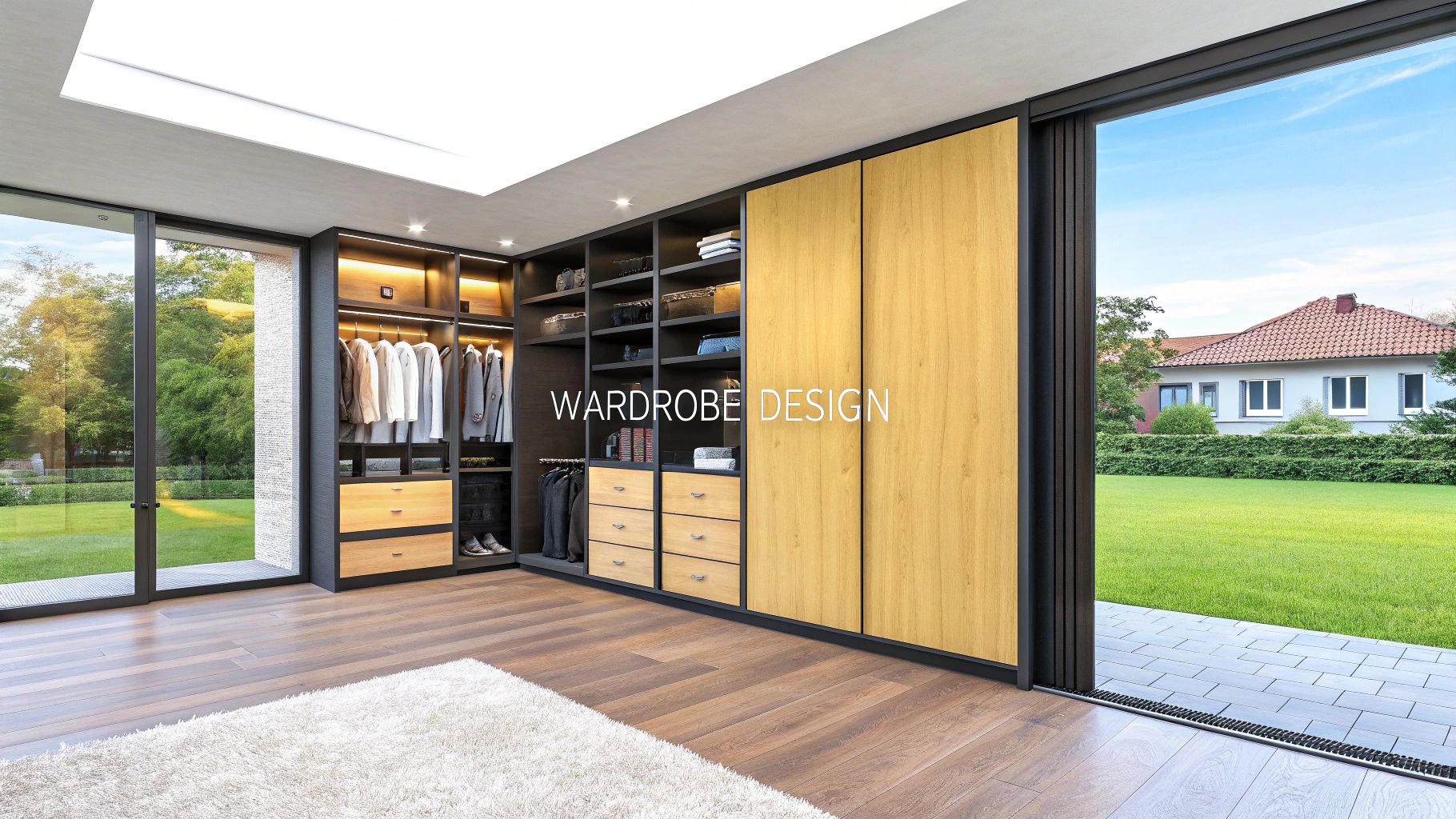
A great built-in wardrobe is more than just storage; it’s a piece of custom architecture that transforms a room, especially in Singapore’s often-compact homes. This practical guide moves beyond generic advice on shelves and racks to give you actionable insights into planning, material selection, and creating a built in wardrobes design that is entirely your own.
Why Built In Wardrobes Are Essential for Modern Singapore Homes
Think of a built-in wardrobe as an investment in your daily routine and your property's value. Unlike a freestanding piece, a built-in uses every centimetre of available space. It turns awkward corners, odd nooks, and plain walls into functional storage that feels like it was always meant to be there. This is a game-changer in HDBs and condos where maximising floor space is critical.
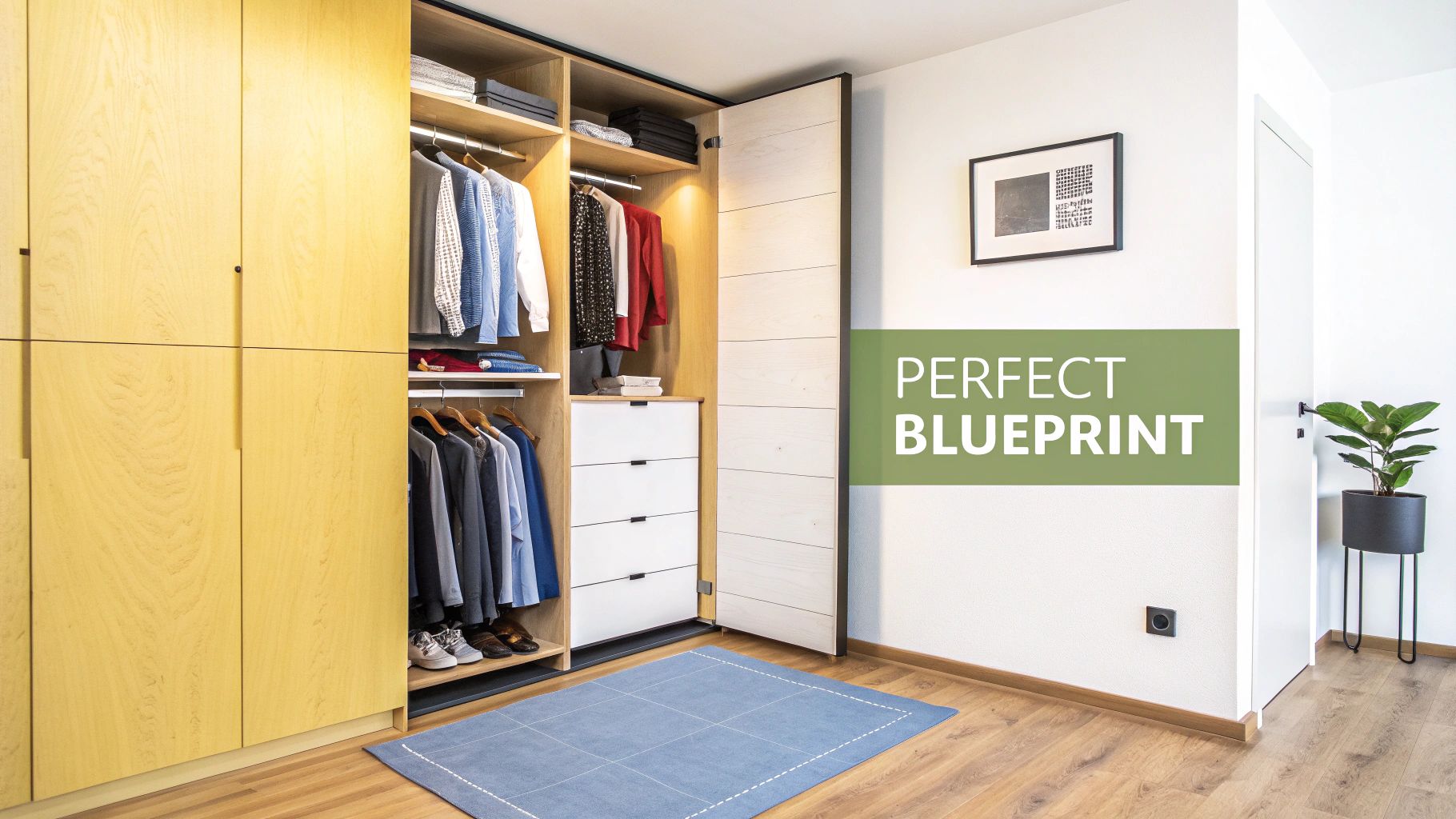
It’s no surprise that custom solutions are in high demand. Singapore's interior fit-out market reached USD 2,872.2 million in 2023, with bespoke wardrobes forming a significant part of residential projects. Based on our experience with property valuations, a well-executed custom wardrobe can increase a home’s resale value by 5-7%. It’s a smart financial move. Want to dive deeper? Explore more details on Singapore's interior furniture trends.
The Real-World Benefits of a Custom Design
Opting for a bespoke built-in wardrobe over an off-the-shelf model offers practical advantages that simplify your daily life and provide long-term satisfaction.
Here’s what you gain:
- Zero Wasted Space: A custom wardrobe is built to your room's exact dimensions—floor to ceiling, wall to wall. This eliminates those useless, dust-collecting gaps.
- Storage That Fits Your Life: The interior is designed around your specific items. Need space for 30 pairs of shoes? Require more long-hanging sections for dresses? You dictate the ideal mix of rails, drawers, and shelves.
- Seamless Style Integration: Materials, colours, and door styles are chosen to complement your home's existing aesthetic. The result is a polished finish that elevates the entire room.
A truly effective built-in wardrobe doesn't just store your belongings; it improves the entire room. When you approach it as a piece of functional design, your wardrobe becomes a beautiful statement piece.
This guide provides the practical knowledge needed to bring your ideas to life, helping you make every decision with confidence.
Planning Your Space for a Perfect Fit
The secret to an impressive built-in wardrobe isn’t just about beautiful finishes; it starts with meticulous planning and precise measurements. Before any materials are ordered, it's crucial to understand the unique characteristics of your room. Get this foundational step right, and your wardrobe won't just fit—it will complete the space.
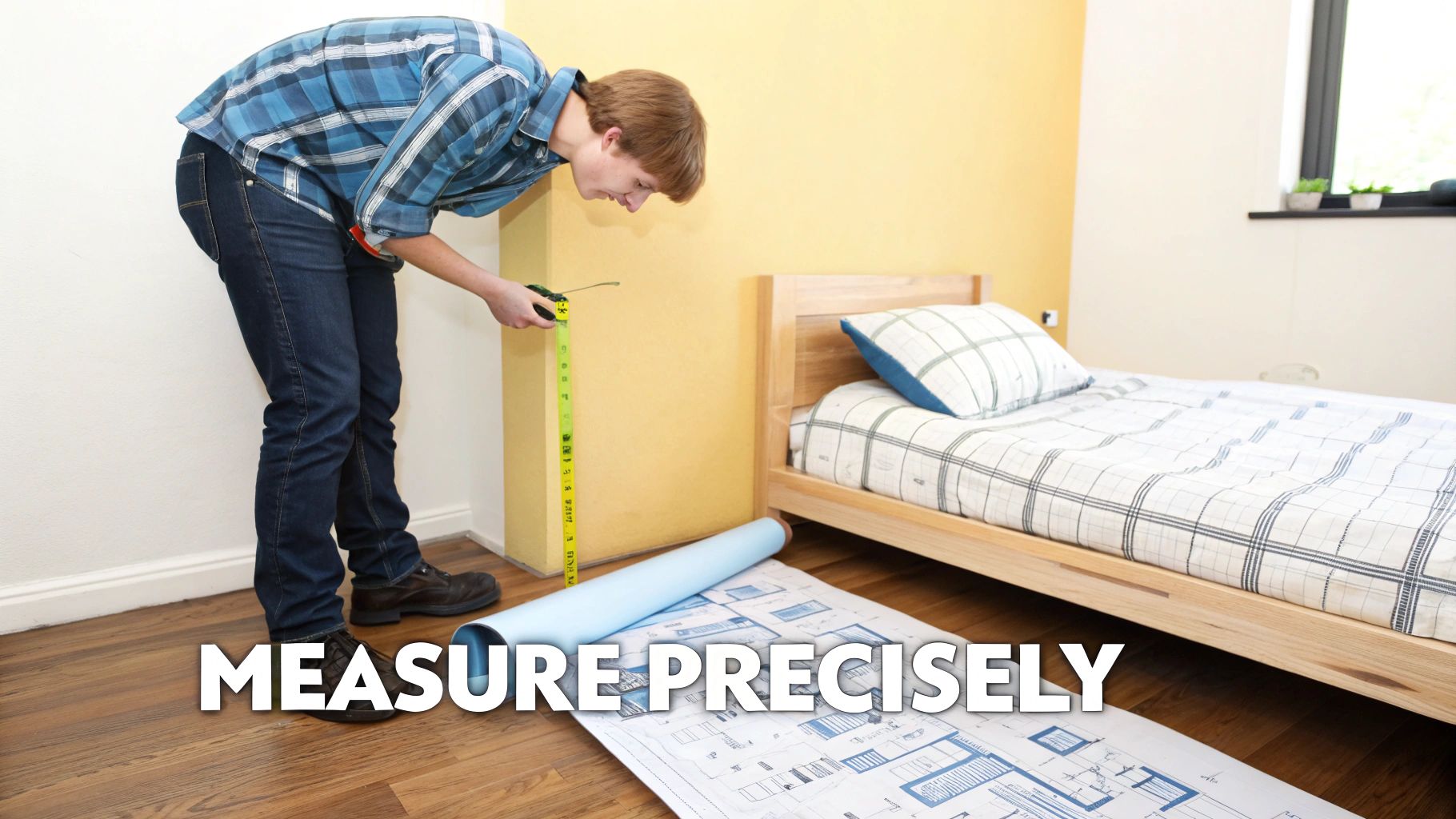
Think of this stage as a site investigation. Your mission is to map out every detail that could complicate the installation process. This goes far beyond noting the basic width and height.
Mastering On-Site Measurement
Accurate measurements are the bedrock of custom carpentry. A few millimetres off can mean the difference between a seamless fit and a costly mistake. Start with the basics—height, width, and depth—then account for the room's real-world imperfections.
Here are the critical details we always triple-check:
- Floor-to-Ceiling Height: We measure this at three points—left, centre, and right. Floors and ceilings are rarely perfectly level, especially in older HDBs.
- Wall-to-Wall Width: Similarly, we measure the width at the top, middle, and bottom. Walls can bow slightly, and multiple measurements reveal the true dimensions we need to work with.
- Obstructions: This is crucial. We note the exact location and size of skirting boards, cornices, window frames, power sockets, and light switches. A true professional builds around these elements for a genuinely integrated finish.
Forgetting to account for a skirting board can leave an ugly gap at the base or force last-minute cuts on-site. Planning for these from the start ensures a clean, wall-to-wall result.
Analysing Room Flow and Door Choice
Once dimensions are locked in, consider how you move through the room. The type of wardrobe door you choose has a huge impact on the space's functionality. Your two main options are swing doors and sliding doors, each with specific pros and cons for different layouts.
- Swing doors require clear space in front of the wardrobe to open fully. In a small room, this can easily obstruct a walkway or clash with your bed.
- Sliding doors glide along a track and require zero outward opening space, making them ideal for smaller Singaporean bedrooms or narrow corridors.
To make the right choice, map out your room's traffic flow. Will an open door create a bottleneck? Is there enough clearance to stand comfortably in front of the wardrobe when the doors are open? Answering these questions helps you pick a style that enhances your daily routine, not hinders it.
Practical Comparison: Sliding vs. Swing Doors
To help you choose the best door type for your space, here's a practical comparison:
| Feature | Sliding Doors | Swing (Hinged) Doors |
|---|---|---|
| Space Required | Minimal; ideal for tight spaces as they don't swing outwards. | Requires clear space in front to allow doors to open fully. |
| Accessibility | Only one section of the wardrobe is accessible at a time. | Provides full, unobstructed access to the entire wardrobe when open. |
| Aesthetic | Offers a sleek, modern, and minimalist look. | Provides a more traditional and classic appearance. |
| Maintenance | Tracks can accumulate dust and may require regular cleaning. | Hinges may need occasional tightening or adjustment over time. |
| Best For | Small bedrooms, narrow corridors, or rooms with limited floor space. | Larger rooms where opening space is not a concern. |
Ultimately, the choice comes down to balancing the practical needs of your space with the look you want to achieve.
Taking a Practical Clothing Inventory
The final planning step is the most personal: figuring out what you actually need to store. A wardrobe that looks incredible but doesn’t fit your collection is a design failure. This is why we guide clients through a simple ‘clothing inventory’.
Take stock of your clothes and sort them into categories. How many long coats or dresses need full-length hanging space? What's your ratio of folded items (like t-shirts and sweaters) to hung ones? Do you have 20 pairs of shoes or a collection of bags that need a dedicated home?
Be honest about your habits. If you always fold your jeans, your wardrobe should have shelves or drawers, not hanging space for them.
This inventory directly informs our design. Knowing you have 20 pairs of shoes means we design dedicated shoe shelving. A closet full of formal shirts tells us to prioritise standard-height hanging rails. This tailored approach ensures every centimetre of your new wardrobe is put to good use.
Designing the Perfect Wardrobe Interior
A stunning exterior is only half the battle. The real value of a bespoke built in wardrobes design lies in its internal layout. A well-organised interior can transform your daily routine from chaotic to calm by giving every item a dedicated home. This is where we move past generic configurations and map out a system tailored to your lifestyle.
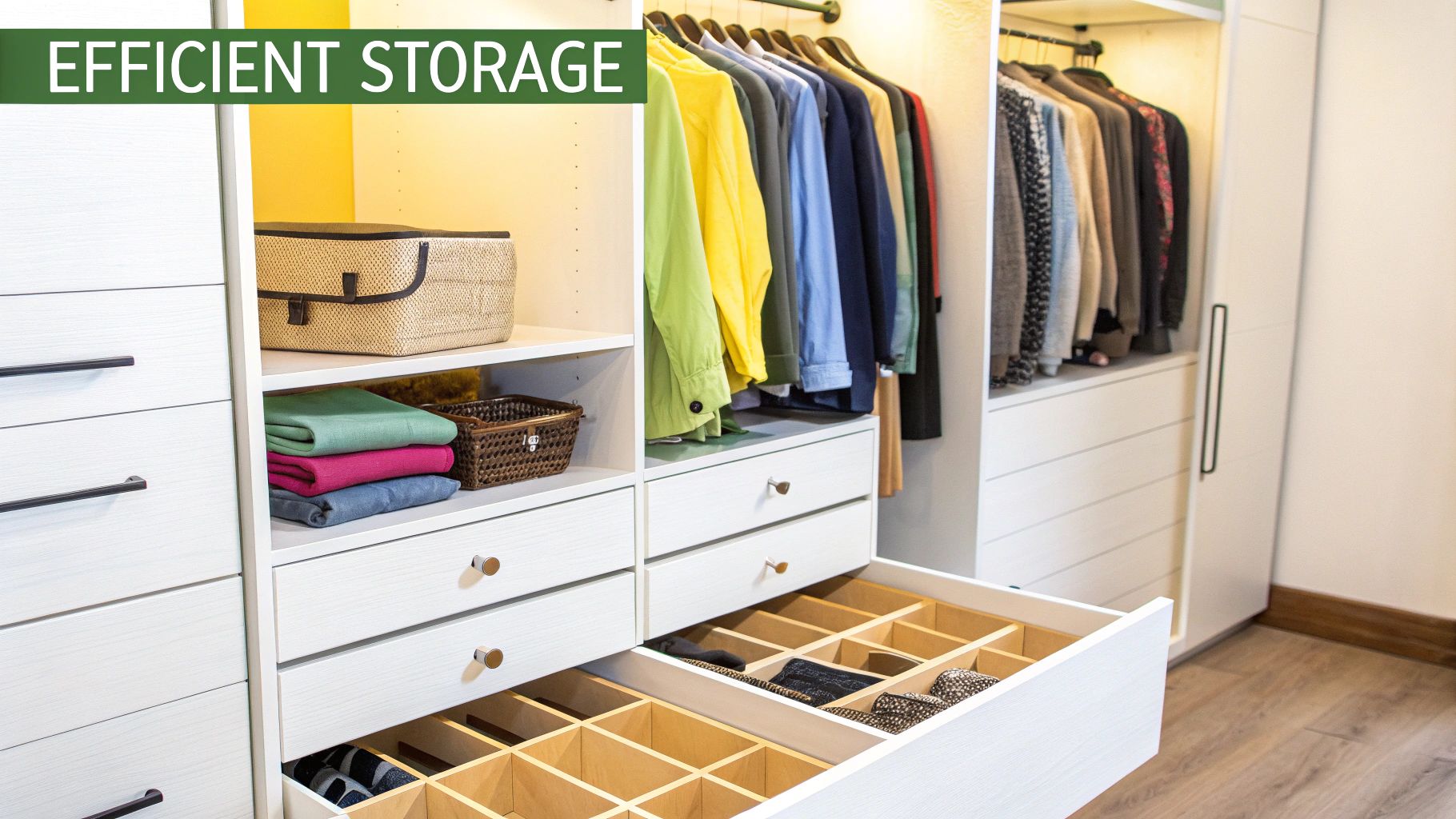
The goal is to create a system so intuitive it feels like your storage has doubled. By strategically allocating space and using smart solutions, we unlock maximum efficiency, turning your personal clothing inventory into a blueprint for success.
Creating Dedicated Zones with Practical Measurements
The first step is dividing the interior into practical zones. This goes beyond a simple 'hanging' vs 'folded' split. We allocate specific vertical and horizontal sections based on your clothes, using standard ergonomic measurements as a starting point.
Here are some practical measurements we use as a guide:
- Long-Hanging Space: For dresses, long coats, and jumpsuits, allocate a vertical height of 150cm to 160cm to prevent garments from crumpling at the bottom.
- Double-Hanging Space: This is the most efficient use of space for shirts, blouses, and folded trousers. We create two rails, one above the other, each with 90cm to 100cm of height.
- Shelf Depth: For folded items like sweaters and t-shirts, a shelf depth of 35cm to 40cm is ideal. Any deeper, and items get lost at the back.
- Drawer Height: Vary drawer heights based on their purpose. Shallow 10cm drawers are perfect for accessories, while deeper 20-25cm drawers are better for bulky knitwear or activewear.
These dimensions are a foundation, not rigid rules. A client with an extensive collection of formal gowns might need more long-hanging space, while someone who lives in casual wear will benefit from more shelving and double-hanging rails.
Think of your wardrobe interior like a well-organised kitchen. You wouldn't store cutlery in the same drawer as pots. Similarly, your wardrobe needs distinct zones for different clothing types to function smoothly.
Intelligent Storage Solutions That Solve Problems
Once zones are mapped out, we integrate specialised hardware and accessories that elevate your wardrobe’s functionality. These details solve common storage headaches and add a touch of everyday luxury. Based on what we see clients requesting most in Singapore, these solutions deliver the biggest impact.
For example, instead of digging through a pile, a pull-out trouser rack keeps trousers neatly hung and crease-free. Every pair is visible and easy to grab, speeding up your morning routine.
Another game-changer is the pull-down hanging rod. This mechanism brings high-up hanging space down to an accessible level with a simple pull, making it essential for maximising floor-to-ceiling wardrobe designs without needing a step stool.
Maximising Every Nook and Cranny
Even with a well-planned layout, small spaces can be overlooked. This is where we get creative with accessories designed for ultimate organisation.
Consider these practical additions:
- Sectioned Accessory Drawers: Customisable dividers for shallow drawers are perfect for organising ties, belts, watches, and jewellery, keeping small items protected and easy to find.
- Integrated Shoe Storage: Whether you prefer angled shelves, pull-out racks, or simple cubbies, dedicating a specific area for footwear keeps them off the floor and in good condition.
- Corner Solutions: In L-shaped or walk-in wardrobes, corners can become dead space. We use units with carousels or curved hanging rails to ensure no inch is wasted.
By combining precise zoning with intelligent hardware, your wardrobe’s interior becomes a highly efficient system tailored to you. This thoughtful internal planning is what creates a wardrobe you’ll love using every single day.
Selecting Materials That Withstand Singapore's Climate
Choosing materials for your built-in wardrobe is where the design truly comes to life. This decision goes beyond aesthetics; it's about selecting materials that can handle Singapore’s humidity without warping, swelling, or deteriorating over time. This section is our practical, experience-based guide to balancing style, budget, and durability.
Start with a Strong, Moisture-Resistant Core
Before you consider colours and textures, focus on the wardrobe’s internal structure, or carcass. This is the most critical decision for longevity. In our humid climate, a weak core material will inevitably fail.
From our years of experience building wardrobes in Singapore, the best material for the core structure is high-quality, moisture-resistant plywood. Unlike MDF (Medium-Density Fibreboard), which can absorb moisture and swell, plywood is made from thin layers of wood veneer bonded together. This cross-grained construction gives it superior strength and resistance to moisture and warping.
Think of your wardrobe's core like a house's foundation. You can have a beautiful exterior, but if the foundation is weak, the entire structure is compromised. Plywood is that solid, reliable foundation.
While solid wood has a certain appeal, it naturally expands and contracts with humidity, which can cause issues unless it is perfectly treated and sealed. For this reason, we consistently recommend a plywood core as the most practical and durable choice for lasting value.
Choosing Finishes: The Style Layer
Once the solid core is established, you can select the surface finish. This is the layer you see and touch every day, defining your wardrobe’s style. Here are the most popular and practical finishes we work with.
- Laminates: The most popular choice in Singapore, and for good reason. High-pressure laminates (HPL) are incredibly durable and available in a vast range of designs—from solid colours and realistic wood grains to textured fabrics and glossy surfaces. They are easy to clean and highly resistant to scratches and moisture.
- Veneers: For those who love the authentic warmth of real wood, veneers are an excellent choice. A thin slice of real hardwood is bonded to the plywood core, giving you the natural grain and character of solid wood without the high cost or risk of warping.
- Glass and Mirrors: A mirrored door is a classic solution to make a small room feel larger and brighter. For a contemporary look, we often use fluted or back-painted glass panels on wardrobe doors to add elegance and break up a solid wall of cabinetry.
Matching Materials to Your Design Vision
The right combination of materials is what realises your design vision. For a minimalist bedroom, you might choose handle-less doors with a matte white laminate to create a seamless effect. For a cosy, Scandinavian vibe, a light oak veneer or wood-grain laminate will bring in that essential touch of nature.
The Southeast Asian furniture market, which reached USD 13,978 million in 2023, is shifting. Wood remains popular, with a 55% preference, but we are seeing a significant trend towards hybrid designs in Singapore. From our own projects, nearly 40% of new wardrobes now mix materials like glass, metal, and wood, reflecting a desire for more modern and sophisticated styles. You can explore these regional furniture trends with this detailed market analysis.
Practical Comparison of Wardrobe Materials
This table breaks down the common choices, focusing on their performance in our local climate.
| Material | Pros | Cons | Best For |
|---|---|---|---|
| Plywood with Laminate | Highly moisture-resistant, durable, vast design options, easy to maintain, cost-effective. | Can look less premium than real wood if a low-quality laminate is used. | The most versatile and practical choice for almost any built-in wardrobe design in Singapore. |
| Plywood with Veneer | Offers the authentic look and feel of real wood, more stable than solid wood in humidity. | Higher cost than laminate, can be scratched or damaged more easily. | Homeowners who desire the natural beauty of wood grain with better climate stability. |
| Glass/Mirrored Panels | Makes rooms feel larger and brighter, offers a sleek, modern aesthetic, easy to clean. | Prone to fingerprints, can be fragile, and may increase the overall cost. | Small bedrooms, contemporary interiors, and creating a sense of spaciousness. |
| Solid Wood | Unmatched natural beauty and character, extremely durable if properly treated. | Expensive, susceptible to expanding/contracting with humidity, can be very heavy. | Luxury projects where budget is not a primary concern and a classic, timeless look is desired. |
By starting with a strong, moisture-resistant plywood core and finishing it with a surface that reflects your personal style, you’re not just getting a beautiful piece of furniture—you're making a smart investment built to last.
Integrating Your Wardrobe with Your Room's Design
An exceptional built-in wardrobe doesn't just sit in a room; it becomes part of the room's architecture. This is how we elevate the built in wardrobes design from a simple storage unit to a sophisticated feature that can blend in seamlessly or even solve tricky layout problems common in Singapore homes.
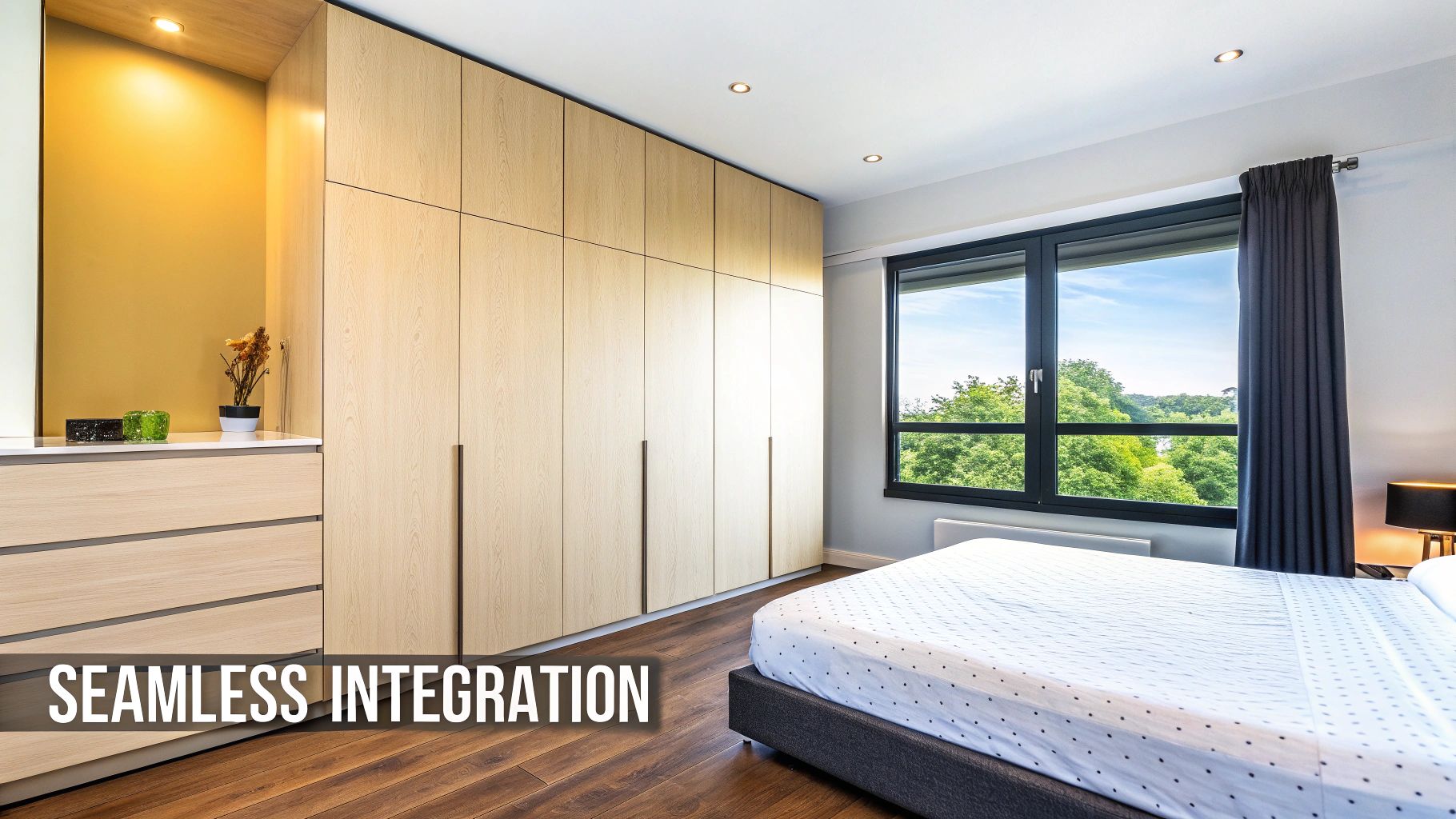
The goal is to create a cohesive space that feels bigger, brighter, and more intentional. This intelligent integration is the difference between simply adding furniture and thoughtfully designing a space.
The 'Hidden' Wardrobe Concept
A popular request we receive is for a 'hidden' or 'invisible' wardrobe. The idea is to make the storage blend so perfectly with the walls that it almost disappears, creating a clean, uncluttered, and minimalist look.
We use a few key techniques to achieve this:
- Handle-less Doors: Push-to-open mechanisms or recessed finger pulls eliminate the visual clutter of handles, creating a flat, uninterrupted surface.
- Matching Wall Colour: We finish the wardrobe doors in the exact same colour as the surrounding walls. This visual trick makes the wardrobe recede into the background, opening up the sense of space.
- Full-Height, Wall-to-Wall Construction: By extending the wardrobe across an entire wall and up to the ceiling, we eliminate all gaps. It stops looking like furniture and starts looking like part of the room’s structure.
This approach is particularly effective in smaller bedrooms, where a bulky wardrobe can feel visually heavy and dominate the space.
Working with Your Room's Architecture
Every room has quirks—a structural beam, an awkwardly placed window, or an odd nook. A custom wardrobe turns these challenges into design opportunities. Instead of trying to ignore these features, we build around them.
View your room's existing architecture not as a limitation, but as a parameter for a creative solution. A custom wardrobe can wrap around a window to create a cosy window seat or frame a bed to form a built-in headboard feature.
This is where bespoke carpentry shines. An unavoidable structural beam can be concealed within the wardrobe's frame or integrated with shallower shelving. In a long room, building a wardrobe around the bed can create a distinct sleeping alcove, adding architectural interest.
This approach is essential in Singapore, where making every square metre count is paramount. The local wardrobes market is growing at a 4.2% CAGR, a trend driven by renovations in a city where the average HDB flat is just 90 square metres. Sliding doors are preferred in 65% of new projects for their space efficiency, and mirrored doors can make a room feel visually 20% larger. Discover more about the Singapore wardrobes market and its trends. In these spaces, intelligently integrated wardrobes are a necessity, not a luxury.
Creating Multi-Functional Zones
A well-integrated wardrobe can do more than just store clothes; it can create new functional zones within your bedroom. By extending the carpentry, we can carve out dedicated spaces for other activities, making your room far more versatile.
Consider these popular integrated solutions:
- The Vanity Nook: A section of the wardrobe is designed as an open recess with a countertop, mirror, and dedicated lighting, creating a perfect, clutter-free station for grooming.
- The Integrated Desk: For those needing a workspace in their bedroom, we can build a desk and shelving that flows seamlessly from the wardrobe, maintaining a consistent design.
- The Entertainment Hub: We can design a central section to house a television, complete with concealed wiring and storage for media devices, keeping the room tidy.
By planning these multi-functional elements from the start, your built in wardrobes design becomes a central piece of your room's overall functionality. It evolves from just a place for clothes into a hard-working feature that supports your entire lifestyle.
The Design-to-Installation Process: From Concept to Completion
Bringing your perfect built-in wardrobe to life should be an exciting and straightforward journey. Our process is designed to be transparent and collaborative, ensuring your vision is perfectly realised from our first conversation to the final installation. It’s all about clear communication and a shared goal: turning your idea into a beautiful, functional reality with minimal disruption.
Step 1: Initial Consultation and Needs Analysis
It all starts with a conversation. We sit down with you to understand your needs, lifestyle, and aesthetic goals. This meeting is our opportunity to learn about your storage frustrations and discover what you envision for your ideal built in wardrobes design. We’ll discuss everything from your clothing collection and daily routines to your must-have features. This allows us to move beyond generic solutions and start sketching a concept that’s uniquely yours.
Step 2: Detailed Design and 3D Visualisation
Next, our design team translates our conversation into a detailed plan. We create technical drawings that map out every shelf, drawer, and hanging rail with millimetre precision. But drawings only tell half the story. To help you truly picture how the final piece will look and feel in your room, we build a detailed 3D model. If you want to fully visualise your built-in wardrobe design before a single piece of wood is cut, you might consider professional 3D Architectural Rendering services, as they can bring the concept to life with photorealistic detail. This step is crucial for making confident decisions on materials, colours, and finishes.
Our commitment is to ensure you are 100% confident in the design before we start building. The 3D model eliminates guesswork, guaranteeing the final product is exactly what you envisioned.
Step 3: Off-Site Fabrication and On-Site Installation
Once you approve the final design, our skilled carpenters begin crafting each component in our workshop. Using the detailed plans, they meticulously craft your wardrobe from high-quality materials chosen for our local climate. By fabricating everything off-site, we keep the dust, noise, and disruption in your home to an absolute minimum.
Finally, our professional installation team brings the finished components to you. They work cleanly and efficiently, assembling your new wardrobe with expert precision. They ensure a perfect fit, paying close attention to every detail—from aligning the doors to installing the hardware. The result is a beautifully integrated wardrobe, ready to transform your space.
Your Built-In Wardrobe Questions, Answered
Embarking on a custom wardrobe project is a significant decision, and it's normal to have questions. To provide clarity, we've answered the most common queries we receive from homeowners.
How Long Does a Custom Built-In Wardrobe Project Take?
From our first design chat to final installation, the entire process typically takes 4 to 8 weeks. This timeline can vary slightly depending on the complexity of your design and the materials selected.
Here’s a typical timeline:
- Design & Visualisation (1-2 weeks): This includes our initial consultation, detailed design work, and creating 3D renderings for your approval.
- Workshop Fabrication (2-4 weeks): Once approved, our carpenters craft every component of your wardrobe in our workshop.
- On-Site Installation (2-5 days): Our team assembles and installs the wardrobe in your home, bringing the design to life.
What Is the Typical Cost for a Built-In Wardrobe in Singapore?
The investment for a custom wardrobe varies based on size, materials, and internal features. As a general guide for budgeting, a standard 6-foot, full-height wardrobe built with quality plywood and finished with a durable laminate typically costs between S$2,200 to S$3,500. For larger wardrobes or those with premium finishes like real wood veneers or specialised hardware (like pull-down rods), the price can move upwards of S$5,000. We provide a detailed, itemised quote after our first meeting, so you will know exactly where every dollar is going.
Can I Move My Built-In Wardrobe to a New Home?
The short answer is no. Built-in wardrobes are designed as permanent architectural features. They are custom-measured and crafted to fit the unique dimensions of a specific room—snugly against the walls, floor, and ceiling.
Think of a built-in wardrobe less like furniture and more like a part of the room itself. Because it is so precisely integrated, it is not designed to be dismantled and moved. The good news is that it’s a significant home improvement that adds tangible value and appeal to your property for future buyers.
How Should I Care For My New Wardrobe?
Maintaining your new wardrobe is simple. For most surfaces like laminates and veneers, a quick wipe with a soft, damp cloth is all that’s needed. Avoid harsh chemical cleaners, as they can damage the finish over time. Given Singapore's climate, good room ventilation is also important for managing humidity. Periodically check that hinges and drawer runners are moving smoothly. A little care will ensure your wardrobe serves you beautifully for years.
Ready to create a space that’s perfectly organised and uniquely yours? At KIVO, our team of expert designers and carpenters is here to bring your vision to life with precision and style. Start your design journey with us today!