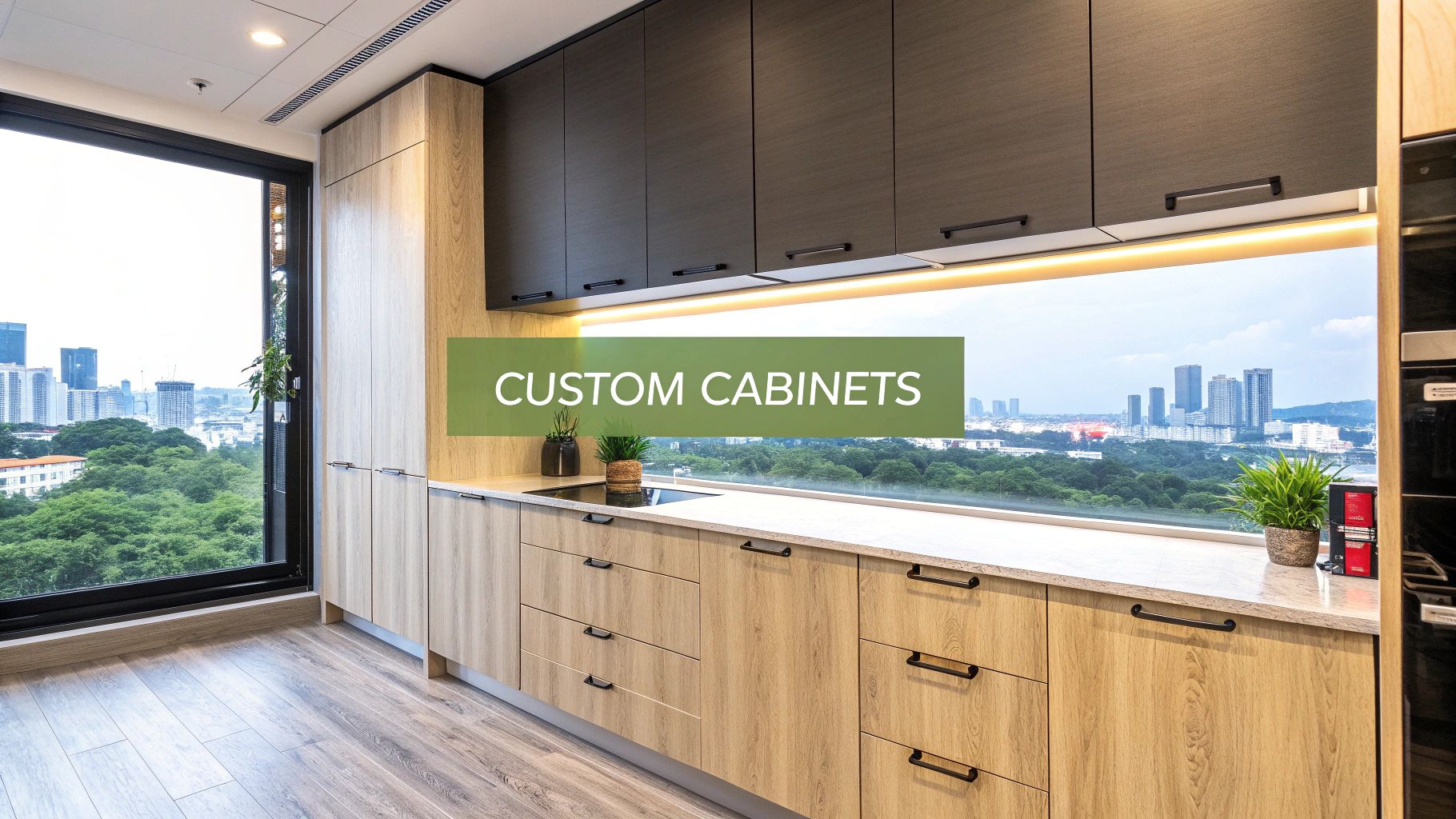
A custom cabinet singapore project is the most effective way to maximise your living area, particularly with the unique layouts found in HDB flats and condos. This is more than just creating storage; it's about crafting a solution that integrates perfectly with your home's architecture and your daily life. The goal is to get precisely what you need, exactly where it's needed, without compromise.
Your Custom Cabinet Journey in Singapore
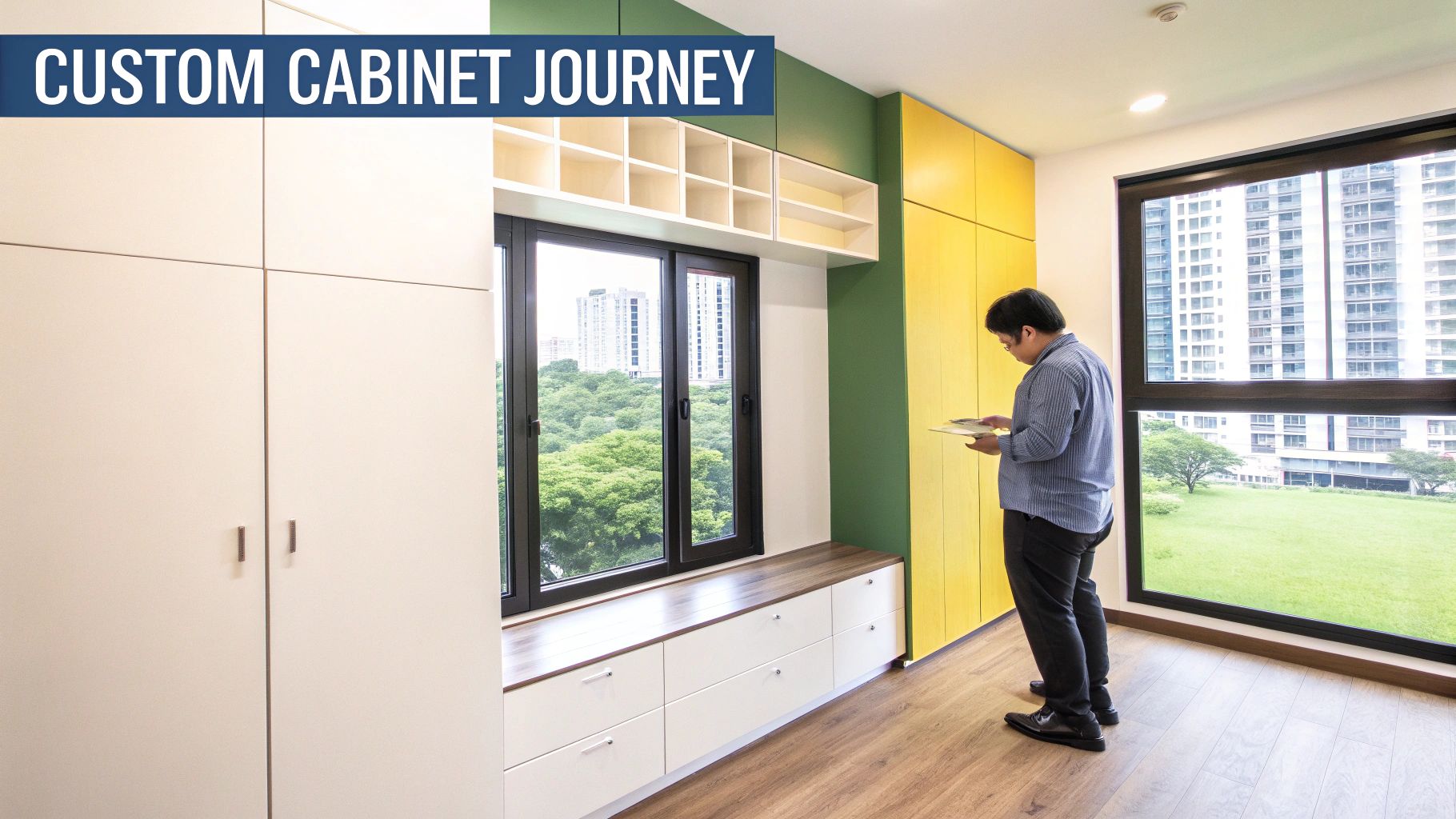
Starting a custom cabinet project can seem complex, but it's a logical, step-by-step process that delivers significant rewards. The primary benefit of bespoke cabinetry is its ability to solve the challenging storage puzzles common in Singaporean homes, where every square metre is valuable. Forget off-the-shelf options that leave awkward gaps or fail to meet your functional needs—custom solutions are engineered for a perfect fit.
Consider it a partnership between your vision and our practical expertise. We're not just building cabinets for your space; we're crafting them for the way you live.
Why Singaporeans Are Choosing Customisation
Custom cabinets aren't a passing trend; they're a practical necessity in Singapore’s dynamic renovation scene. Homeowners are increasingly investing in personalising their spaces, particularly kitchens and living rooms. The Kitchen and Dining segment, which relies heavily on cabinetry, represents a significant portion of the local furniture market, driven by high spending on home improvements.
We see this shift in client expectations daily. They aren't just looking for a place to store things. They demand intelligent solutions that reflect their personality and streamline their daily routines. Here’s why so many are making the switch:
- Maximising Awkward Spaces: Many HDBs and condos have odd corners, structural beams, or unconventional layouts. A practical example is building a full-height cabinet around a structural pillar, turning a previously unusable corner into a seamless pantry or display unit.
- A Perfect Aesthetic Match: You are in complete control. From the materials and colours to the handles and hinges, every detail is selected by you. For instance, you can match the wood grain of your cabinet to your dining table or choose a laminate colour that perfectly complements your wall paint, ensuring a cohesive interior.
- Unmatched Functional Design: Do you need a drawer deep enough for your stand mixer or a pull-out accessory tray for your watch collection? Customisation allows you to design the interior of your cabinets to fit your specific items and lifestyle, a level of detail that generic furniture cannot offer.
At its core, commissioning custom cabinets is an investment in your home's functionality and long-term value. It’s about creating a space that feels organised, intentional, and uniquely yours.
As you begin planning, it’s helpful to familiarise yourself with the available options. Understanding different styles and materials will enable you to communicate your ideas more clearly. For instance, exploring resources on stylish and durable cabinet options can provide a solid foundation. A small amount of research upfront simplifies the entire process and sets the stage for an outstanding result.
Choosing Materials Built for Singapore's Climate
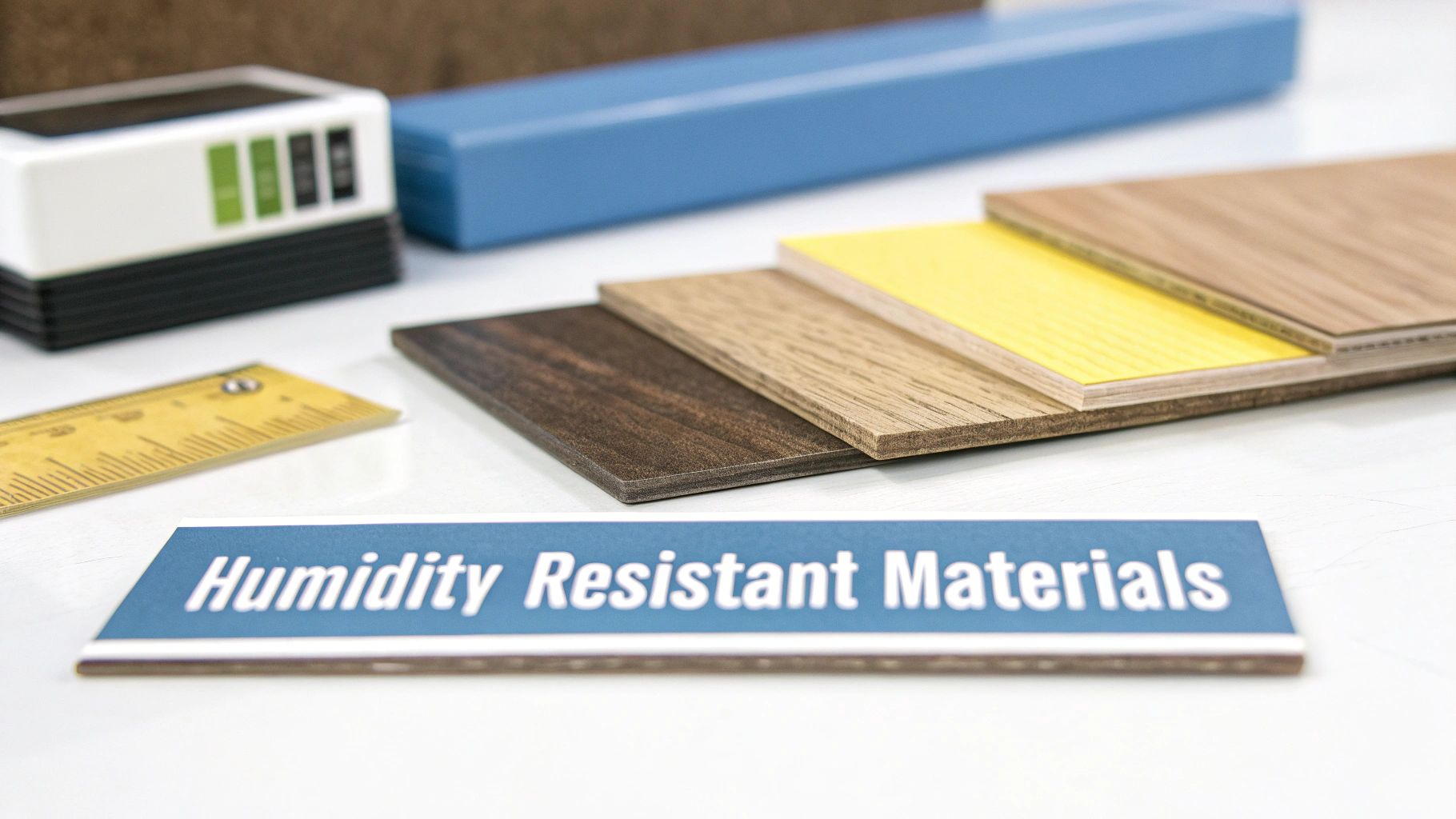
In Singapore, the primary threat to your new cabinets isn't daily wear—it's the constant high humidity. An incorrect material choice can lead to warped doors, swollen panels, and mould growth within a few years.
This is why the core of your cabinetry, the unseen internal structure or carcass, is arguably the most critical decision. This foundation supports everything else. Get this right, and your investment is protected for years.
The Best Carcass Materials for a Humid Climate
When clients ask for the most reliable material for a cabinet's internal structure, our recommendation is almost always high-quality, moisture-resistant plywood.
Unlike Medium-Density Fibreboard (MDF) or particleboard, which can absorb moisture like a sponge, plywood is constructed from thin layers of wood veneer glued together. This cross-grain construction provides excellent structural stability and inherent resistance to moisture. We always specify plywood with a low-formaldehyde rating (E0 or E1) to ensure better indoor air quality. It is the essential component that keeps your cabinet doors perfectly aligned and functioning smoothly over time.
A common misconception is that solid wood is the ultimate choice. While beautiful, solid wood naturally expands and contracts with changes in humidity. This movement makes it less suitable for the main cabinet box, though it remains a great option for aesthetic elements like doors if properly sealed.
Selecting Finishes That Look Good and Last
The finish is the visible surface of your cabinet. It defines the style and acts as a protective barrier against moisture, stains, and daily impact.
High-Pressure Laminates (HPL): For high-traffic areas like kitchens and children's rooms, HPL is our top recommendation. It is exceptionally durable, scratch-resistant, and available in a vast range of colours and textures, including realistic wood grains. A practical benefit is its ease of cleaning—a significant advantage for any busy household.
Wood Veneers: If you desire the authentic look of real wood, veneer is an excellent solution. It consists of a thin slice of actual timber applied to a stable plywood core. This provides the beauty of wood without the stability issues of solid timber, creating a sophisticated look for a home office or a feature wardrobe.
Polyurethane Paint Finish: For a seamless, high-end aesthetic, a spray-painted finish is unmatched. It allows for any custom colour and creates a perfectly smooth surface, ideal for modern, minimalist designs. However, it requires a highly skilled painter and can be more susceptible to chipping than laminate.
The right finish seals the core material from ambient moisture. The longevity and appearance of your cabinets are heavily dependent on the choice of materials and appropriate coatings, which is especially critical in Singapore's climate.
Our Takeaway: Choosing a finish involves balancing your desired aesthetic with your practical needs. For a family with young children, the durability of HPL in the kitchen often outweighs the luxurious feel of a paint finish.
Material Showdown for Singaporean Homes
Navigating cabinet materials can be complex. This table provides a clear, at-a-glance comparison to help you decide what's best for your home, lifestyle, and budget.
| Material | Best For | Durability in SG | Est. Cost / sq. ft. | Maintenance |
|---|---|---|---|---|
| Moisture-Resistant Plywood | Carcass construction, high-moisture areas (kitchens, bathrooms) | Excellent. Resists warping and swelling. | S$15 - S$35 | Low. Very stable and long-lasting. |
| High-Pressure Laminate (HPL) | Cabinet fronts, countertops, high-traffic zones | Excellent. Scratch, heat, and stain resistant. | S$10 - S$25 (for finish) | Low. Easy to clean with a damp cloth. |
| Wood Veneer | Feature walls, wardrobe doors, living room cabinetry | Good. Offers the look of real wood without stability issues. | S$20 - S$40 (for finish) | Moderate. Needs gentle cleaning; avoid harsh chemicals. |
| Solid Wood | Doors, decorative elements, statement pieces | Fair. Can expand/contract with humidity. Requires proper sealing. | S$40 - S$100+ | High. Prone to scratches and requires periodic sealing. |
| MDF / Particleboard | Budget-friendly projects, dry areas (e.g., walk-in closets) | Poor. Highly susceptible to swelling and water damage. | S$5 - S$15 | Low, but easily damaged and hard to repair. |
The best solution often involves a combination of materials. A moisture-resistant plywood carcass paired with a durable HPL finish is a proven formula for a Singaporean kitchen that will look great and function perfectly for decades.
Don't Overlook the Hardware
Hardware—hinges, handles, and drawer runners—is what you interact with daily. Cutting costs here is a common mistake that often leads to regret. Low-quality hardware results in sagging doors, jamming drawers, and daily frustration.
We strongly advise clients to invest in reputable brands known for durability. Soft-closing hinges and runners are no longer a luxury but a standard for quality custom cabinetry. They prevent slamming, reduce wear and tear on the cabinet frame, and add a touch of quiet refinement to your home.
The demand for quality cabinetry is clear. In Singapore, custom cabinet work is part of over 80% of HDB renovation projects. Globally, kitchen cabinets alone make up 69.39% of the demand. While various options exist, fully bespoke designs like ours dominate the premium market, particularly in commercial spaces where wood materials are used 71.84% of the time. This highlights a clear preference for quality, durability, and a perfect fit, all of which begin with selecting the right materials.
Getting Real About Cabinet Costs and Timelines
One of the first questions we receive is, "How much will this cost?" It is a critical consideration for any renovation. The straightforward answer is: it depends. The advantage of custom carpentry is that you control the choices that directly influence the final cost.
A quotation should be viewed not as a single number but as a transparent breakdown of where your money is going. From the specific laminate chosen to the brand of hinges, each decision has an associated cost. Our role is to guide you through these choices to establish a budget that meets your needs without unexpected expenses.
What Goes into a Custom Cabinet Quote?
A quote from a reputable firm should be clear and itemised. A single lump sum without details is a red flag. Here’s what you should expect to see broken down.
- Materials: This is typically the largest portion of the cost. Using quality moisture-resistant plywood for the core is essential in Singapore and costs more than standard MDF. The finish is another significant factor—a wood veneer will be more expensive than a durable high-pressure laminate.
- Design Complexity: A simple, straight run of kitchen cabinets is straightforward. However, if you desire curved doors, intricate pull-out pantry systems, or custom-fitted internal organisers, the cost will increase. These features require more material, specialised skills, and more time in the workshop.
- Hardware: This includes all functional components: hinges, drawer runners, and handles. It is tempting to save money here, but we advise against it. Opting for high-quality, soft-closing hardware from brands like Blum or Hettich may add 5-10% to the total cost, but it significantly improves the daily user experience and ensures longevity.
- Workmanship and Installation: This covers the skill of the carpenters crafting your pieces and the precision of the team installing them. Achieving a seamless, perfect fit requires experience, and this expertise is factored into the price.
A transparent, itemised quote is the foundation of a trusting relationship. It empowers you to ask informed questions and make confident decisions about your investment.
What to Budget: Real-World Scenarios in Singapore
To provide a better understanding of potential costs, here are some ballpark figures for common projects in Singapore. While every home is different, these ranges offer a solid starting point for your budget.
| Project Type | Typical Scope | Estimated Cost Range (SGD) | Key Factors Influencing Cost |
|---|---|---|---|
| 4-Room HDB Kitchen | Top and bottom cabinets (approx. 20-24 ft total length) | S$8,000 - S$15,000 | Laminate finish, standard hardware, quartz or solid surface top. |
| 5-Room HDB Kitchen | More extensive cabinetry, possible island, tall pantry unit | S$12,000 - S$22,000 | More complex layout, upgraded finishes (e.g., FENIX), premium hardware. |
| Condo Wardrobe System | Full-height, built-in wardrobe (approx. 8 ft wide) | S$4,000 - S$9,000 | Internal configuration (drawers vs. shelves), door finish (glass, mirror, veneer). |
| Full Home Carpentry | Kitchen, wardrobes, TV console, feature wall | S$25,000 - S$50,000+ | Scope of work, consistency of materials, level of design intricacy across all items. |
From First Chat to Final Fix: The Project Timeline
The project timeline is as important as the budget. Rushing carpentry is never a good idea, as it leads to mistakes and compromises in quality. Here is a realistic overview of how a typical project unfolds.
Phase 1: Consultation & Design (1-2 Weeks) This is where we discuss your lifestyle, preferences, and functional needs. Our designers then translate this information into initial concepts and 3D visuals to help you see the ideas come to life.
Phase 2: Selections & Confirmation (1 Week) With a design direction established, we finalise the specifics—laminates, hardware, and countertop materials. This is a critical step, as these materials are ordered for fabrication once you sign off.
Phase 3: Site Measurement & Fabrication (3-5 Weeks) Our team conducts a final, precise measurement at your home. The project then moves to our local workshop, where our carpenters build each component based on the approved designs.
Phase 4: Installation & Handover (3-7 Days) Our installation team carefully brings all finished pieces to your home. They work meticulously to ensure every door aligns perfectly and the fit and finish are flawless before we hand the space over to you.
This methodical approach ensures quality control. The Singapore Cabinet Market is expanding, partly fuelled by a 10.84% import growth rate as more homeowners seek bespoke, high-quality storage. You can read more about these market trends and the shift towards custom solutions. This data suggests that it is wise to plan ahead and engage a reliable carpentry team well in advance.
The Cabinet Design and Fabrication Process
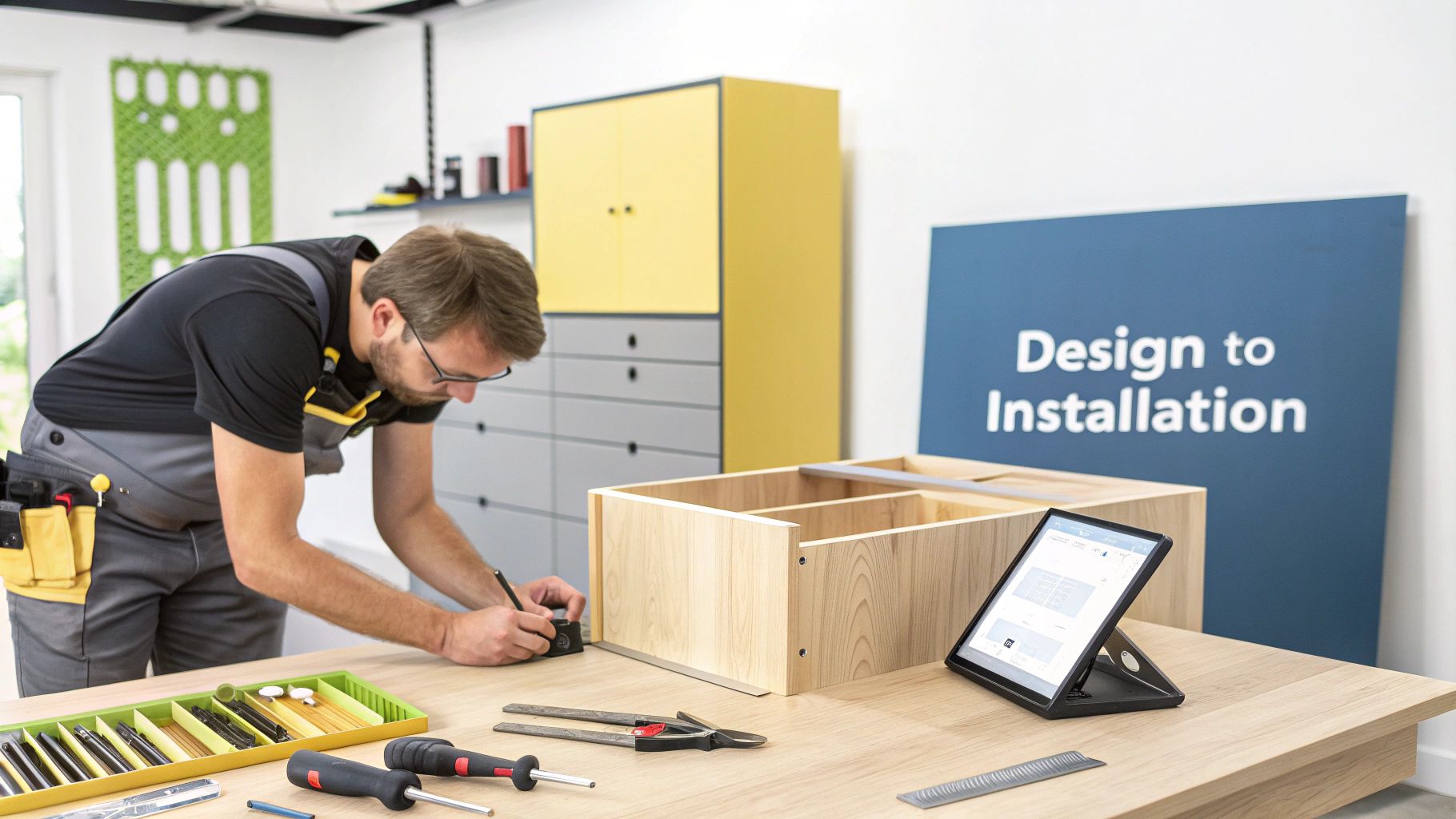
This is where your ideas become tangible. Transforming a design concept into a finished cabinet is a meticulous process that combines modern technology with traditional craftsmanship. It is the journey from a sketch to a functional piece in your home.
Understanding these stages helps you appreciate the skill involved and know what to expect.
The Foundation: On-Site Consultation and Measurement
Every serious custom cabinet project in Singapore must begin with an on-site consultation. This allows us to understand the room's flow, lighting, and architectural quirks beyond what a floor plan can show.
During this visit, we take hyper-precise measurements, checking for level floors and ceilings, straight walls, and the exact locations of power points and pipes. These details are critical for a flawless, gap-free installation.
This is also a practical planning session. We analyse your lifestyle to ensure the design is functional for you. For example:
- In a kitchen: We'll ask practical questions like, "Are you right-handed? Where do you want your spices? Where will your coffee machine go?" This helps us design a layout that supports your cooking habits.
- In a wardrobe: We'll ask, "Do you have more long dresses or folded sweaters?" This informs the ratio of hanging space to shelving, ensuring every item has a designated spot.
This detailed approach ensures the final cabinet is not just visually appealing but genuinely enhances your daily routine.
Bringing Your Vision to Life with 3D Visualisation
Once we have the measurements and a clear brief, our designers use 3D visualisation software to create photorealistic mock-ups of your proposed cabinets.
This allows you to see exactly how the finished piece will look in your room, complete with chosen colours and textures. This step is invaluable for several reasons:
- It eliminates guesswork. You can immediately assess if the cabinet proportions work in the space or if a chosen colour is too overpowering.
- It facilitates adjustments. Changes can be made before any material is cut. For example, we can quickly show you the difference between flat-panel and shaker-style doors.
- It builds confidence. Seeing a realistic preview provides peace of mind and ensures we are aligned on the final outcome.
We’ve had clients who were initially set on a dark wood finish. After seeing the 3D render, they realised it would make their room feel too small and dark. The visualisation allowed them to pivot to a lighter option they ultimately preferred, saving them from a costly mistake.
Precision and Craftsmanship in the Workshop
With the 3D designs approved, detailed drawings are sent to our carpenters. Here, skilled hands and precision machinery take over. Each component is cut to exact specifications, with tolerances often less than a millimetre.
Edge banding is meticulously applied to all raw plywood edges. This is a crucial step in Singapore’s humid climate, as it seals the core material from moisture, preventing swelling and ensuring longevity.
Our carpenters then pre-assemble the cabinet boxes and install hardware in our controlled workshop environment. This guarantees a perfect fit on-site and reflects the artisan quality of high-end custom carpentry.
Flawless Installation: The Final Step
The completed cabinet parts are carefully transported to your home for installation. This phase requires the same level of precision as the fabrication. Our team works methodically to secure the cabinets, align every door and drawer, and ensure a seamless fit against your walls.
This attention to detail during installation creates the polished, integrated look that defines custom work. With residential projects making up around 65% of the custom cabinet demand in our region, clients rightfully expect this level of quality and a tangible experience. You can discover more insights about furniture market trends in Singapore on statista.com.
Finding the Right Carpenter and Avoiding Pitfalls

Choosing your partner—whether an independent carpenter or a full-service firm—is the most critical decision in your custom cabinet project. This relationship determines the quality of the process and the final outcome.
A good choice leads to a smooth, stress-free experience and a product that enhances your home. A poor choice can result in frustration, unexpected costs, and disappointing cabinetry.
Vetting Potential Partners: A Checklist
To protect your investment, look beyond portfolio photos and assess the substance behind the work.
Here is an actionable checklist to help you make a confident choice:
- Scrutinise Their Portfolio: Look for consistency and experience with projects similar to yours. Zoom in on details like door alignment, joint seamlessness, and finishing precision.
- Confirm Their Workshop: Ask, "Where will my cabinets be built?" A firm with its own local workshop has direct control over quality and timelines. This is a significant advantage for any serious custom cabinet Singapore provider.
- Verify HDB Licensing and Insurance: Your contractor must be an HDB-registered renovation contractor and carry public liability insurance. This protects you from potential damages during the renovation.
- Ask for Client References: A reputable company will readily connect you with past clients. Speaking to someone who has gone through the process provides invaluable, unfiltered insight.
How to Decode a Quotation
A quotation is a reflection of a company's transparency. An unusually low bid should be a major red flag.
"Too good to be true" offers often indicate the use of subpar materials (like standard particleboard instead of moisture-resistant plywood) or a plan to add hidden costs later.
A professional quote should be detailed and itemised, clearly specifying:
- The exact materials for the carcass and finishes.
- The brand and model of hardware (e.g., Blum soft-closing hinges).
- All costs for fabrication, delivery, and installation.
- A clear payment schedule and terms.
A clear, comprehensive quote builds trust from the start. It empowers you to understand exactly what you are paying for and eliminates ambiguity.
Key Questions to Ask Before You Commit
Before signing a contract, have a frank conversation. The answers to these questions will reveal a lot about their process and commitment.
- What's your communication process like during the project? You need a single point of contact and regular updates. Clear communication is the backbone of a successful project.
- What warranties do you offer on workmanship and materials? A firm that stands by its work will offer a solid warranty. Look for at least a one-year guarantee on structural integrity.
- How do you handle unexpected issues or delays? Problems can arise in any renovation. A good company responds proactively, honestly, and with solutions.
- What does your post-installation support look like? Great firms value long-term relationships and provide support long after the final payment.
Choosing the right partner ensures your investment pays off in beautiful cabinetry and increased property value. Homes with high-quality custom interiors often command higher prices. This is why a transparent partnership and ongoing support are crucial. You can read the full research on the cabinet market outlook for more details.
Common Questions We Get About Custom Cabinets
As you move closer to starting your project, practical questions are likely to arise. Here are straightforward answers to the most common queries we receive from homeowners in Singapore.
Do I Need an HDB Permit for Custom Cabinets?
For most standalone custom cabinets, such as wardrobes or TV consoles, you will not need a permit from the Housing & Development Board (HDB).
Permits become necessary for more involved work. You will need one if your plans include:
- Hacking or Demolishing Walls: This definitely requires HDB approval.
- Altering Structural Elements: Any work involving structural beams or columns is not allowed without a permit.
- Major Plumbing or Electrical Work: Shifting sinks or power points for a kitchen makeover requires a submission.
A professional interior design firm will check your plans against HDB guidelines and manage the entire permit process, ensuring your renovation is fully compliant.
How Long Should Custom Cabinets Last in Singapore?
The lifespan of a custom cabinet in Singapore depends on the materials and workmanship. With the right choices, your investment can last for decades.
Properly built cabinets using high-quality, moisture-resistant plywood can easily last 15 to 20 years or more. The key is ensuring all exposed edges are perfectly sealed with professional-grade edge banding to prevent moisture ingress. Simple maintenance, like wiping up spills promptly, also helps extend their life.
Should I Hire a Carpenter or an Interior Designer?
This depends on your needs and how involved you want to be.
Hiring a carpenter directly is a good option if you already have a detailed design. They are skilled at fabrication and installation.
An interior design firm offers a more holistic service. We design a complete solution that considers your lifestyle, workflow, and the overall aesthetic of your home. We manage the entire project from concept to completion, ensuring the result is both beautiful and highly functional.
Is It Possible to Get Custom Cabinets on a Tight Budget?
Yes, "custom" does not have to mean "expensive." The flexibility of customisation allows for smart decisions that deliver value for your budget.
Here are a few practical ways to manage costs:
- Smart Material Choices: Modern laminates are durable and available in a wide range of styles that convincingly mimic more expensive materials.
- Simplified Internals: Opting for more shelves instead of numerous drawers can reduce costs, as drawer systems are more complex to build.
- Standardised Depths: Sticking to standard cabinet depths where practical can streamline fabrication and lower labour costs.
A good designer will be transparent about these trade-offs, working with you to create a beautiful and lasting custom cabinet Singapore solution that fits both your home and your budget.
Ready to transform your space with cabinetry that’s designed just for you? At KIVO Custom Carpentry And Interior Design Services, we combine four decades of artisan experience with a modern design approach to create solutions that are as functional as they are beautiful. Let's start the conversation about your home.