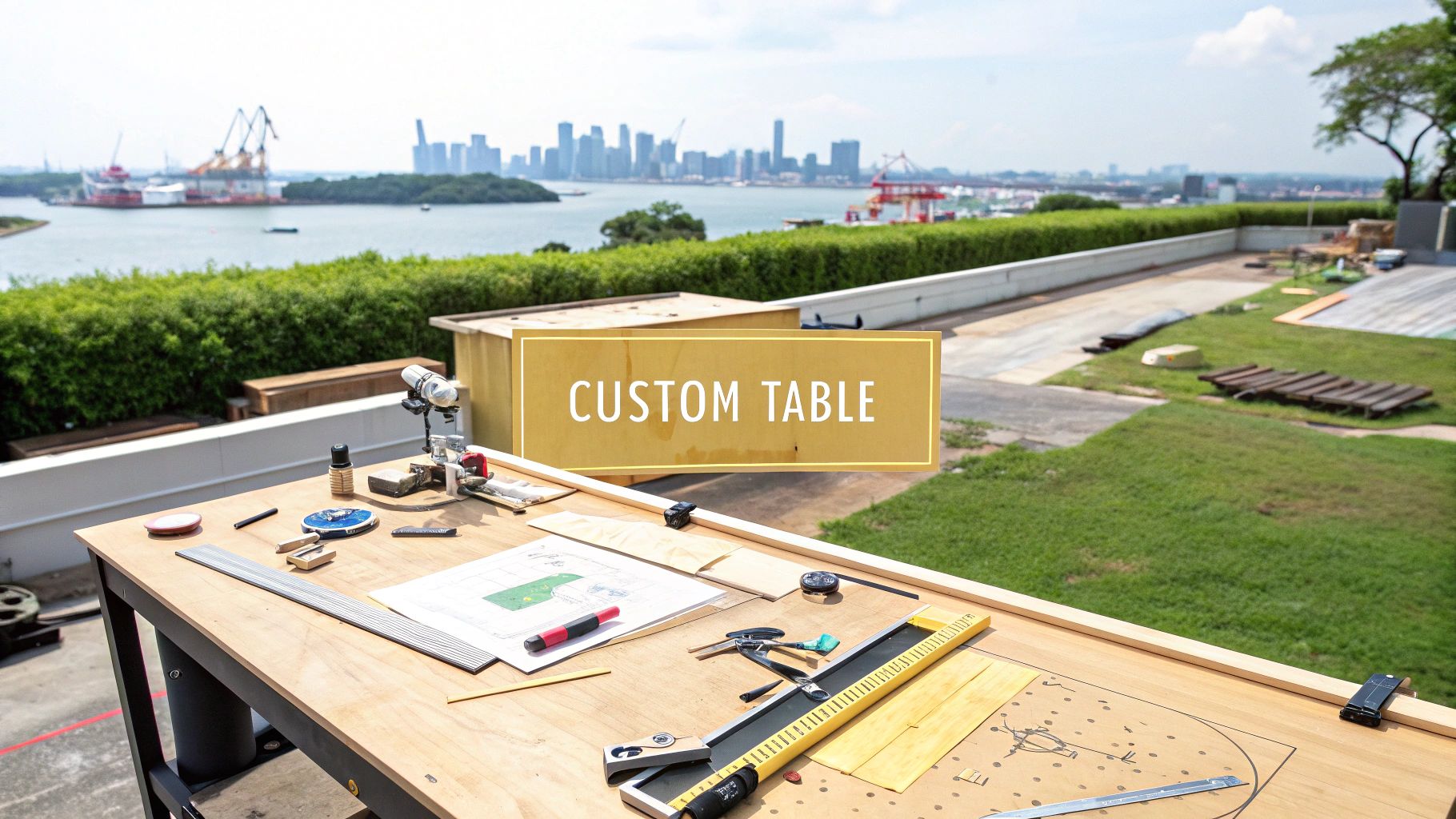
Choosing a custom table in Singapore is a practical decision to get a piece that perfectly fits your home's layout and personal style. It's an investment in function and form, turning a simple piece of furniture into a hard-working centrepiece that elevates daily life. A custom table isn’t just about aesthetics; it's a direct solution for maximising every centimetre in our HDB flats and condos.
Why a Custom Table is the Smart Choice for Singapore Homes
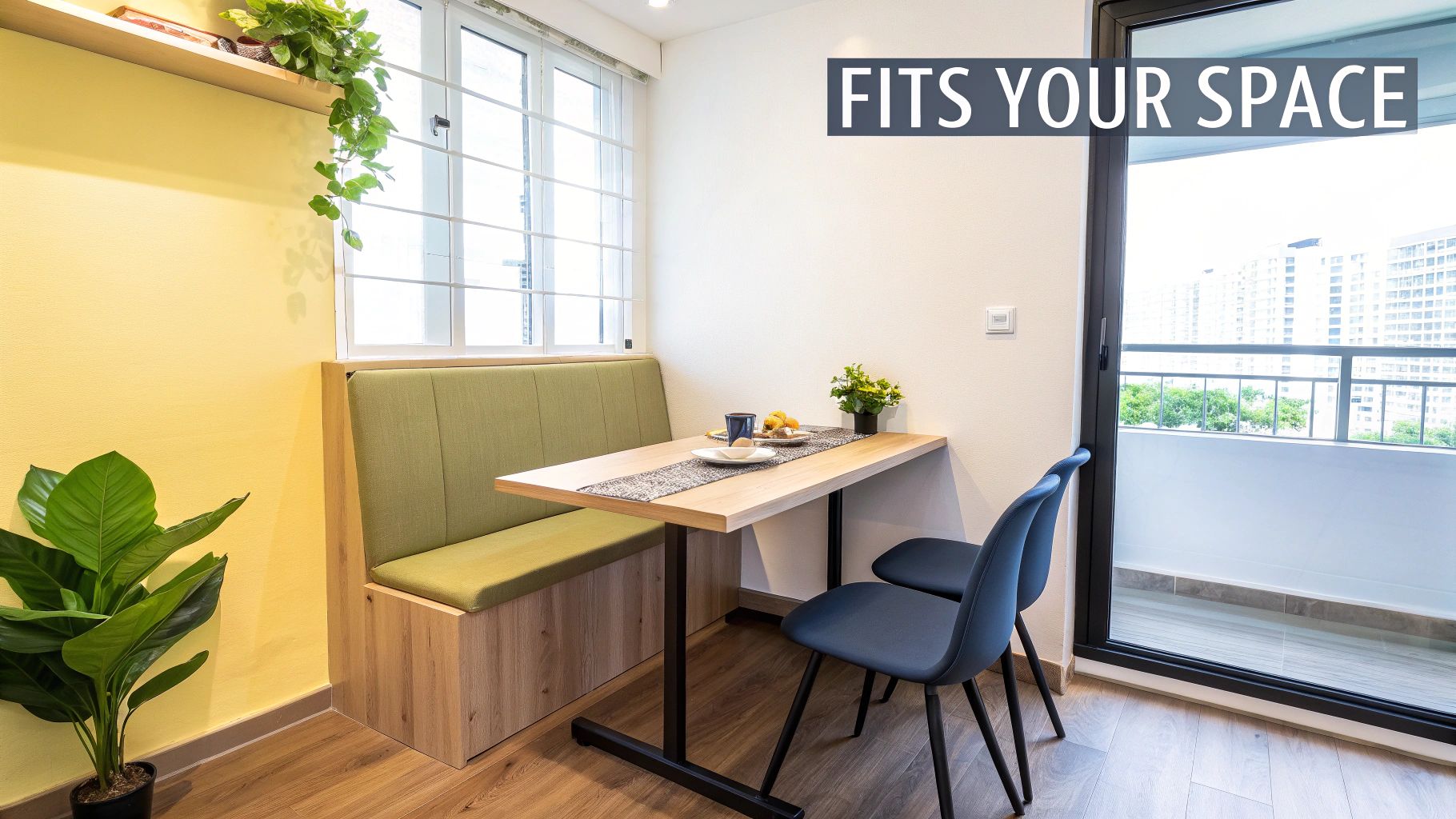
Off-the-shelf furniture almost always involves compromise. You find the right style but it's the wrong size, or you get the perfect dimensions but the material clashes with your decor. A custom table eliminates this problem, providing a solution built precisely for your space and your life.
In Singapore, where every square metre is precious, a custom table is a game-changer. It allows for efficient space planning with exact dimensions and smart designs, making it a sound investment. We see this daily with clients who need multi-functional spaces. For example, a client with a 3-room BTO needed their dining table to also function as their primary work-from-home desk. We designed a piece with a durable, scratch-resistant top and integrated cable management, seamlessly blending work and life.
The Value of Personalisation and Perfect Fit
Going custom puts you in control. You select the exact material, finish, leg design, and dimensions—down to the last centimetre. This isn't just about getting a table that fits; it's about creating a piece that genuinely reflects your personality and solves a real problem.
Consider the practical benefits:
- Space Optimisation: That awkward corner or narrow dining area? A purpose-built table can transform it from unusable space into a functional hub. We recently built a trapezoid-shaped table for a client's bay window area, creating a breakfast nook they never thought possible.
- Unique Style Statement: Your table becomes a one-of-a-kind piece that tells your story, not something you’d see in every other home.
- Long-Term Durability: You have direct input on the quality of the materials used, resulting in a more durable, long-lasting piece of furniture than many retail options.
Based on client requests over the past two years, the demand for tailored furniture is growing. The market for dining tables and kitchen islands in Singapore is projected to hit US$65.61 million by 2025. With over 80% of residents living in HDB flats, it's clear why custom tables with features like foldable extensions are becoming essential. This trend confirms that homeowners today are seeking furniture that is both beautiful and highly practical.
Choosing the Right Materials for Singapore's Climate
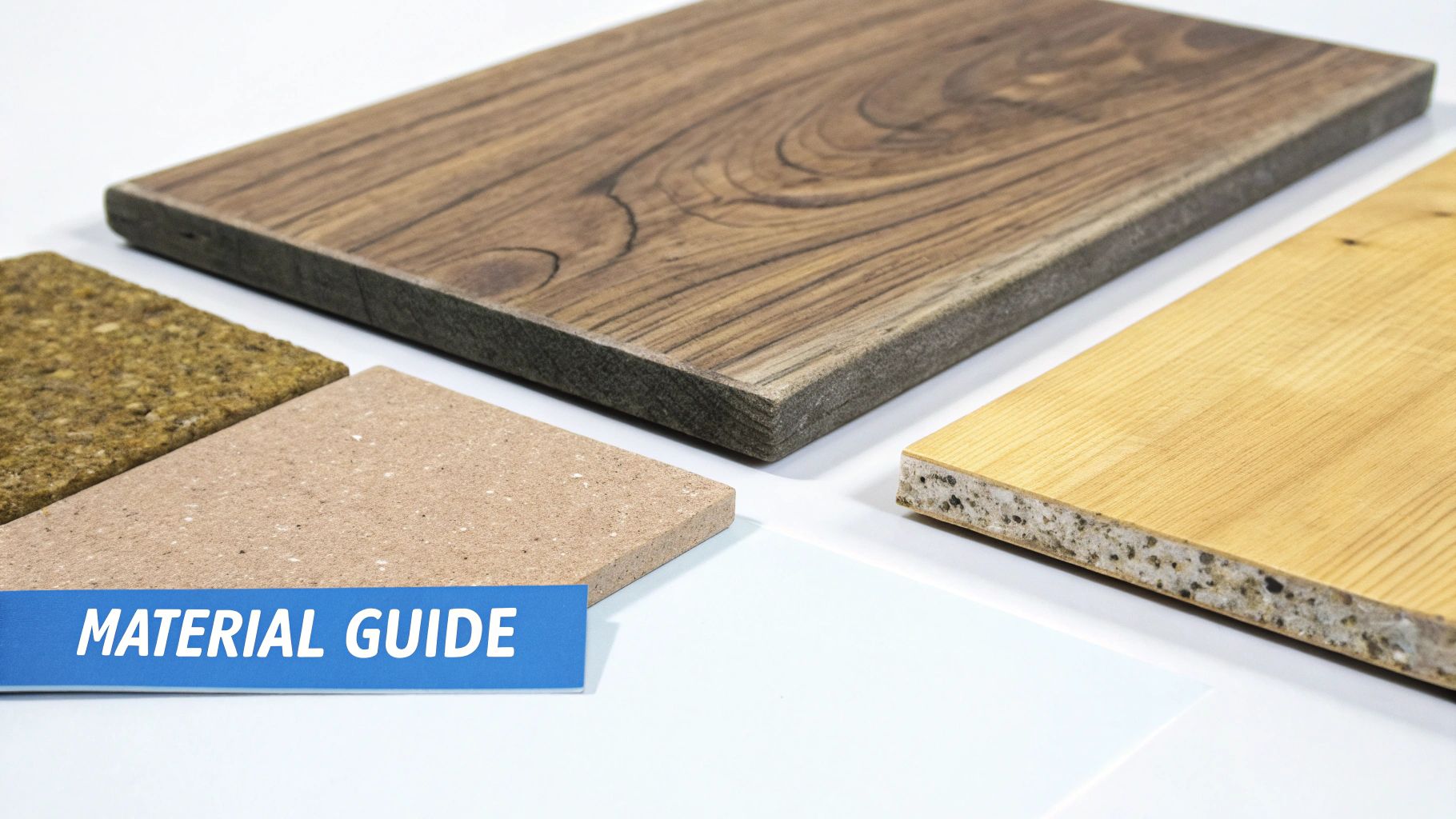
Selecting the right material for your custom table is the most critical decision you'll make. It’s not just about aesthetics; it's about how your table will withstand daily use and Singapore’s relentless humidity. A smart choice means a beautiful, long-lasting centrepiece. The wrong one can lead to warping, staining, and disappointment.
Some woods might look incredible but will struggle against our tropical climate if not properly treated. This is where professional guidance helps you balance your dream aesthetic with the practical needs of your home. The choice boils down to two main paths: classic solid woods that bring warmth, or modern engineered materials known for their toughness and low-maintenance appeal.
Solid Woods: The Timeless Choice
Solid wood never goes out of style. Each slab is unique, with its own grain, knots, and character. It adds an unmatched warmth to a space and often looks better with age, developing a richer patina over the years. However, not all woods are suitable for Singapore's climate.
From years of crafting tables, we've learned that hardwoods with a dense grain and high natural oil content are the best defence against humidity. They are far less likely to expand, contract, or warp.
- Teak: The gold standard for tropical climates. Teak is dense with natural oils that make it highly resistant to moisture and pests. It’s incredibly durable, making it a practical investment for a busy family dining table.
- Suar Wood: Known for its dramatic, interlocking grain patterns, Suar is a fast-growing tropical hardwood already adapted to our climate, giving it fantastic stability.
- American Walnut: Loved for its deep, rich brown tones, Walnut brings an air of elegance. It requires a high-quality finish to protect it from humidity, but its timeless beauty is a worthy trade-off.
Remember that solid wood is a 'living' material. It responds to its environment, so proper sealing and some maintenance are necessary to preserve its organic charm.
Engineered Materials: The Modern Powerhouses
If you’re looking for contemporary style and a low-maintenance lifestyle, engineered materials are an excellent choice. These surfaces are manufactured for performance, offering superior resistance to spills, heat, and scratches.
Over the last few years, we've seen a significant shift in client preferences. Roughly 60% of our custom table commissions now feature sintered stone or quartz, especially for young families or those who entertain frequently. Their feedback is consistent: they want a beautiful table without the constant worry.
These materials offer a sleek, consistent look that fits perfectly into minimalist, industrial, or modern Scandinavian homes.
- Sintered Stone: An impressive material made by fusing natural minerals under extreme heat and pressure. The result is a non-porous, incredibly hard surface that is highly resistant to stains, heat, and UV rays.
- Quartz: A composite of natural quartz crystals, resins, and pigments, offering a massive range of colours and patterns. You can get anything from a realistic marble look-alike to bold, solid hues. It’s also non-porous, making it hygienic and resistant to stubborn stains.
With these materials, you gain peace of mind. You don't have to be so vigilant with coasters and placemats, making them a top practical choice for a durable custom table in Singapore.
Material Comparison for Your Custom Table
How do you decide what’s best for your home? The perfect material fits your lifestyle, style, and budget. Here’s a straightforward comparison table breaking down the key points we discuss with our clients.
| Material | Average Cost (Per Sq. Metre) | Durability & Resilience | Maintenance Level | Best For (Home Style) |
|---|---|---|---|---|
| Teak | S$650 - S$1,100 | Excellent moisture & pest resistance; very durable. | Medium; requires occasional oiling to maintain lustre. | Scandinavian, Balinese, Mid-Century Modern |
| American Walnut | S$700 - S$1,200 | Very durable but needs a good sealant for humidity. | Medium; protect from direct sun to avoid fading. | Modern Luxury, Classic, Contemporary |
| Sintered Stone | S$550 - S$950 | Exceptional; resists scratches, stains, heat, and UV. | Very Low; easy to clean with soap and water. | Minimalist, Industrial, Ultra-Modern |
| Quartz | S$450 - S$800 | Excellent; non-porous and highly resistant to stains. | Low; avoid placing very hot pans directly on surface. | Contemporary, Scandinavian, Transitional |
Understanding these differences will help you commission a table that you'll love for many years to come.
From Concept to Creation: The Custom Table Journey
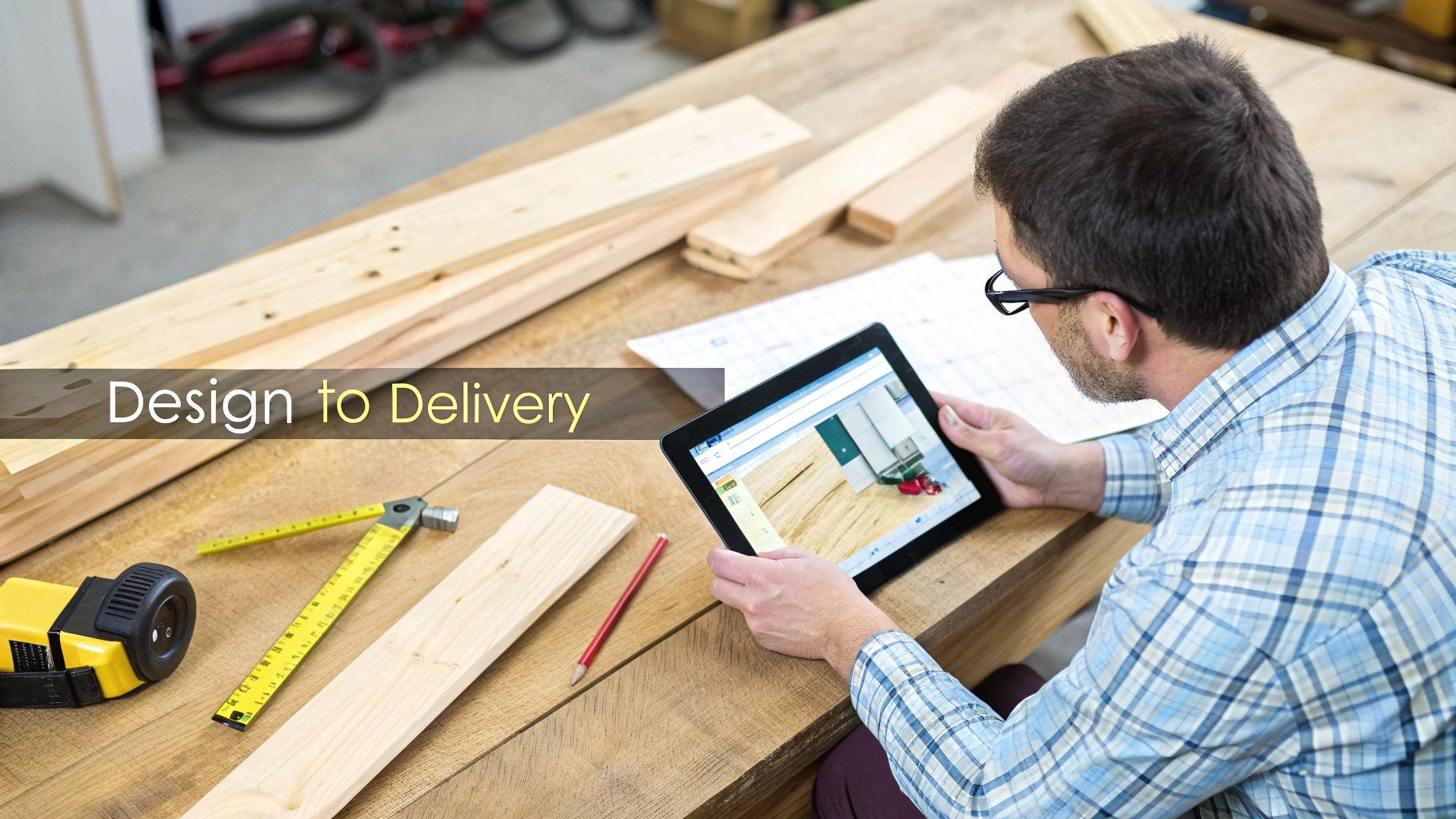
Turning an idea into a functional piece of furniture is a meticulous, collaborative process. When you order a custom table in Singapore, you embark on a journey with us, moving from a need to a tangible centrepiece. We have refined this process to ensure every detail aligns with your vision before any material is cut.
The journey is designed for clarity and confidence, broken down into four key phases: consultation, design visualisation, workshop craftsmanship, and delivery.
Step 1: The Initial Consultation and Design Brief
This first conversation is the most important step. We go beyond "I need a table" and dive into the specifics of your lifestyle. We’ll discuss how you'll use it daily, who will gather around it, and what other furniture it needs to complement.
For example: Is it a dining table for intimate family dinners, or does it need to host gatherings of ten? Will it double as a home office, requiring integrated power solutions? A recent client needed a table for their art hobby, so we incorporated discreet, shallow drawers for brushes and pencils. These details form the foundation of the design brief.
Based on this, we suggest materials and designs that are both beautiful and genuinely practical.
Step 2: Design Visualisation and Material Sampling
Once the brief is clear, our designers get to work creating detailed 3D renderings. These show you exactly how the table will look in your space—including dimensions, colours, and textures. This is a digital prototype that removes guesswork and allows you to give precise feedback.
A critical part of this stage is interacting with physical material samples. A 3D model is useful, but nothing compares to feeling the grain of a solid walnut slab or seeing how a quartz sample looks under your home's actual lighting. This tactile experience is vital for making a final decision you feel great about.
We refine the design based on your feedback until it’s perfect.
Step 3: Workshop Craftsmanship and Fabrication
With the design finalised, our artisans take over. This is where digital plans are brought to life by skilled hands.
The process includes:
- Material Preparation: Selecting and preparing raw materials, ensuring the wood grain is perfectly aligned or the stone slab is flawless.
- Cutting and Shaping: Using a blend of advanced machinery and traditional techniques, each component is cut to exact specifications.
- Assembly and Joinery: The table is carefully assembled, focusing on robust joints that ensure longevity.
- Finishing: We apply protective coatings—like natural oils for wood or tough sealants for stone—that enhance the material's beauty and shield it from daily wear.
We provide progress updates throughout fabrication so you can feel connected to the creation of your piece.
Step 4: Final Delivery and Installation
The final step is bringing your custom table home. Our professional team handles delivery and installation with care, ensuring the table is placed perfectly and assembled securely. We conduct a final quality check with you and provide specific care instructions for your chosen material, empowering you to keep your new centrepiece looking pristine.
So, How Much Does a Custom Table Actually Cost?
The final cost of a custom table in Singapore is a sum of its parts—the materials chosen, design complexity, and the hands-on skill required. Understanding these factors helps you see the value and make choices that fit your budget.
Your choice of material is the biggest factor, followed by the design's intricacy and specific finishes.
What Really Drives the Price?
The price reflects the craftsmanship involved in transforming a raw material into a polished centrepiece. A simple four-legged dining table will be more budget-friendly than one with complex joinery or a detailed base.
Here’s a breakdown of what influences the final quote:
- Your Choice of Material: A slab of rare American Walnut will cost more than a high-quality quartz composite due to its rarity, sourcing difficulty, and the labour needed to shape it.
- Design Complexity: A pedestal base, live-edge details with resin, or built-in extension leaves all require more design hours, specialised skills, and workshop time.
- Size and Thickness: A larger or thicker tabletop requires more raw material and is harder to handle, which adds to the cost. A 10-seater table will naturally cost more than a 4-seater.
- Finishes and Edges: The type of finish, whether it’s a multi-layer Rubio Monocoat for wood or a honed finish for stone, adds to the cost. The same applies to edge styles like a chamfered or bullnose profile.
Ballpark Figures for Popular Tables
To give you a clearer picture, here are some real-world examples based on recent projects. These estimates are a solid starting point for planning your investment.
The demand for quality, personalised furniture in Singapore is strong. The broader goods market is on a steady upward trend. With the average person spending around S$25,000 on goods in 2024, custom tables are carving out a significant 12% of the dining furniture spend. This is partly driven by a buoyant property market, with many new homeowners renovating after buying resale HDB flats. You can dig deeper into this trend by reading the full research on the Singapore Goods Market.
Here are some typical price ranges:
| Table Type & Size | Common Material | Estimated Cost Range (SGD) |
|---|---|---|
| 6-Seater Dining Table (1.8m x 0.9m) | Solid Suar Wood | S$2,800 - S$4,500 |
| 8-Seater Dining Table (2.2m x 1.0m) | Sintered Stone | S$3,500 - S$5,800 |
| Compact Kitchen Island (1.5m x 0.8m) | Quartz Composite | S$2,500 - S$4,200 |
| Round Coffee Table (0.9m diameter) | American Walnut | S$1,800 - S$3,200 |
These prices cover the entire bespoke experience—personal design consultations, 3D mock-ups, sourcing top-notch materials, artisan fabrication, and professional delivery and installation. You're investing in a seamless service and a durable, one-of-a-kind piece.
How Premium Materials Find Their Way to Your Home
Ever wonder where the beautiful solid wood or pristine sintered stone for your table comes from? The journey begins long before our workshop. We source materials from specialist suppliers worldwide, building relationships with partners who are masters of their craft.
Whether it's a family-run timber mill that sustainably harvests American Walnut or an Italian quarry known for exquisite marble, we work with the best to ensure every material meets our strict standards for quality, beauty, and durability.
From Global Source to Our Singapore Workshop
Getting these heavy, delicate materials to our Singapore workshop is a logistical challenge. Each step is carefully managed to protect the material and keep your project on schedule.
This international journey involves:
- Expert Sourcing: Identifying and hand-picking the best materials from reputable global suppliers.
- Secure Packing: Each slab is meticulously crated to prevent damage during its long trip.
- International Shipping: Managing the complexities of freight to transport everything efficiently.
- Local Handling: Once in Singapore, every shipment is carefully unloaded and inspected.
Understanding the logistics, like the intricacies of shipping materials from China to Singapore, highlights the journey these materials take.
This process is the lifeblood of the bespoke furniture industry here. Singapore's customs brokerage market is growing, driven by demand for high-end components. With around 70% of custom table makers in Singapore relying on overseas sourcing, an efficient trade system is vital. You can learn more about Singapore's growing trade ecosystem from Mordor Intelligence.
Our Commitment to Sustainability
Sourcing globally comes with a responsibility to our planet. We are committed to ethical practices, prioritising materials that are not only stunning but also responsibly harvested.
For all our timber projects, we actively seek suppliers who provide Forest Stewardship Council (FSC) certification. This guarantees that the wood comes from a forest managed to the highest environmental and social standards, protecting biodiversity and supporting local communities.
When you choose a table made with ethically sourced materials, you get a piece that does good for the world. Your table’s story becomes one of both beauty and responsibility.
Keeping Your Custom Table Looking Brand New

Your new custom table is a major investment and the heart of your space. With straightforward care, you can ensure it remains a stunning centrepiece for years. Different materials need different care; getting the maintenance right is key to preserving its beauty and strength.
Care Tips for Solid Wood Tables
Solid wood has a natural warmth but is sensitive to its environment. Proper care protects it from Singapore's humidity and daily use. A simple routine is best: dust with a soft, dry microfibre cloth. For cleaning, use a slightly damp cloth with a mild, pH-neutral soap. Always wipe along the grain and immediately dry it to prevent moisture from seeping in.
Crucial Tip: Avoid harsh chemical cleaners, silicone-based polishes, or excessive water. These can strip the protective finish, leaving the wood exposed to damage. For example, using a common multi-purpose spray containing ammonia can dull the finish over time.
To protect against the humid climate, we recommend re-oiling the wood every 12 to 18 months. This simple step nourishes the wood and reinforces its protective barrier.
Maintaining Sintered Stone and Quartz
Engineered surfaces like sintered stone and quartz are known for their durability, making care simple. As they are non-porous, you don’t need to worry about spills causing permanent stains.
For daily cleaning, a soft cloth with warm water and a gentle cleaner is all you need. They are extremely scratch-resistant, but it's still good practice to avoid dragging sharp items across the surface.
Here are a few pointers for long-term care:
- Avoid Abrasive Cleaners: Do not use scouring pads or gritty cleaners, as they can dull the polished finish over time.
- Protect from Extreme Heat: While highly heat-resistant, it’s wise to use trivets for hot pots to prevent any risk of thermal shock.
- Clean Spills Promptly: Even on a non-porous surface, it's good practice to wipe up spills like red wine, coffee, or curry quickly.
Following these material-specific tips will keep your custom table in Singapore looking as good as the day it arrived.
Got Questions? We Have Answers.
Commissioning a custom table is a big decision, and it’s natural to have questions. Here are answers to some of the most common queries we receive.
How Long Does It Take to Make a Custom Table?
From our first consultation to installation, the entire process typically takes about 8 to 12 weeks. This timeline allows for detailed design discussions, sourcing the perfect material, meticulous craftsmanship, and applying finishing touches.
Factors that can affect the timeline:
- Material Sourcing: Specific or rare materials may take longer to procure.
- Design Intricacy: A complex design requires more time in the workshop than a simpler one.
- Workshop Load: Our schedule can get busy, especially during peak seasons.
We provide a clear timeline from the start and keep you updated at every key milestone.
I Found a Picture Online I Love. Can You Make It?
Absolutely. Bring us your inspiration photos. We use them not as a blueprint to copy, but as a starting point to understand the aesthetic you're aiming for. Is it the clean lines? The mix of materials? The overall silhouette?
From there, we collaborate with you to design something unique—a piece that’s perfectly scaled for your space, tailored to your lifestyle, and built to our exacting standards. This way, you get a table that is genuinely yours.
What Kind of Warranty Do You Provide?
We stand behind our craftsmanship. Your custom table comes with a 12-month warranty covering structural defects and workmanship. This is our promise that your table is a lasting investment.
The warranty covers the table's construction, such as the stability of joints and the build integrity. It does not cover damage from normal wear and tear, misuse, or failure to follow the provided care instructions. Proper maintenance is key to keeping your table looking stunning for years to come.
Ready to create a stunning centrepiece for your home? At KIVO, we combine artisan skill with a deep understanding of your needs to build furniture that tells your story. Start your custom table journey with us today.