Opting for a custom wardrobe in Singapore isn’t just about aesthetics; it’s a practical move to reclaim every last inch of space in your home. Unlike grabbing something off a showroom floor, a built-in wardrobe is designed from scratch to solve your specific storage problems, making it a smart long-term investment for HDB and condo residents alike.
Why Custom Wardrobes Are a Necessity in Singapore Homes
In a city where space is a premium, standard furniture often just doesn't cut it. Most Singaporean homes, from cosy HDB flats to modern condos, have their own quirks—think awkward corners, odd structural beams, or varying ceiling heights. This is where a custom wardrobe stops being just furniture and becomes part of your home’s architecture.
Instead of wrestling a bulky, pre-made wardrobe into a spot that’s not quite right, a custom design is made to work with your room’s unique shape. It’s like the difference between a tailored suit and one off the rack. The off-the-rack one might do the job, but the tailored one is crafted to your exact measurements, making it look and feel perfect. In the same way, a custom wardrobe uses every available centimetre, turning what would have been dead space into prime storage.
Making the Most of Awkward and Unused Spaces
One of the biggest wins of going custom is the ability to finally conquer those tricky room layouts.
Sloped Ceilings: A custom wardrobe can be built to perfectly follow the angle of a sloped ceiling, giving you full-height storage where a standard wardrobe would leave a massive, dust-collecting gap.
Odd Corners: That weird little nook in your bedroom? It can be transformed into a functional L-shaped or corner wardrobe, massively boosting your storage capacity without eating into your floor space.
Working Around Obstacles: Wardrobes can be designed to wrap seamlessly around pillars, window ledges, or air-con trunking, creating a clean, built-in look that feels completely intentional.
This perfect fit doesn't just add function; it makes the entire room feel bigger, tidier, and more polished.
Think of a custom wardrobe as a long-term investment in your home's organisation and value. By fitting your space perfectly, it simplifies daily life and elevates your interior, making it a no-brainer for any discerning homeowner.
Custom Wardrobe vs Ready-Made: Pros and Cons
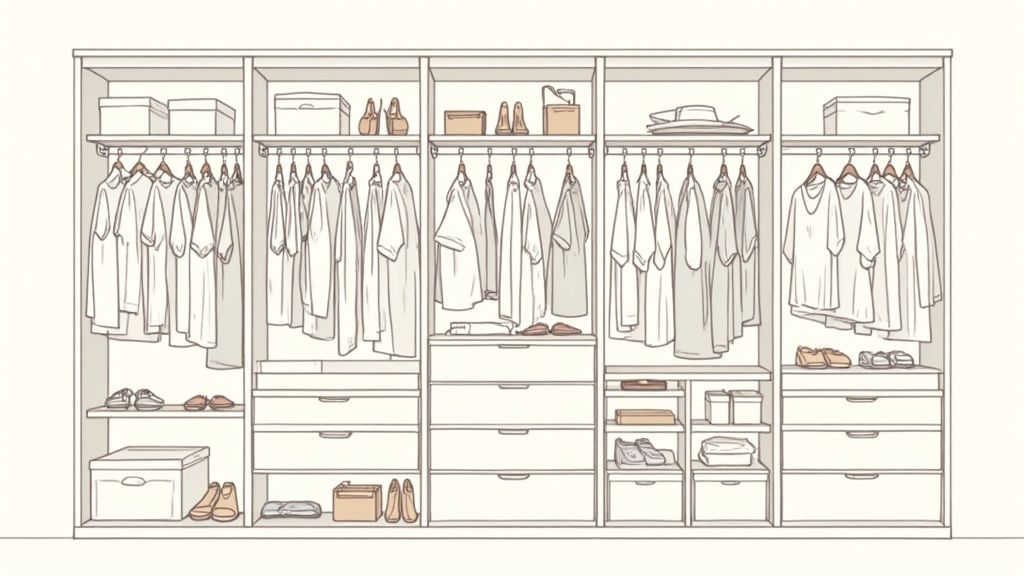
Choosing between a custom-built wardrobe and an off-the-shelf model is a major decision for any homeowner. The instant gratification of a ready-made piece is tempting, but the long-term benefits of a tailored solution often outweigh the convenience. Let's break down the practical pros and cons to help you decide.
Custom Wardrobes: The Pros and Cons
A custom wardrobe in Singapore is the ultimate solution for maximising space and personalising your storage.
Pros:
Perfect Fit & Maximum Space: This is the biggest advantage. It's built to the exact dimensions of your room, eliminating wasted gaps and utilising every inch from floor to ceiling. For example, in a room with a 2.7m ceiling, a custom wardrobe can be built to that full height, giving you high-level storage for luggage or seasonal items that a standard 2m tall wardrobe simply can't offer.
Total Personalisation: You control everything—the internal layout, materials, finishes, and hardware. Need shallow drawers for accessories or extra-deep shelves for folded sweaters? You can design it to match your specific needs.
Superior Quality & Durability: Custom builders typically use higher-grade materials like moisture-resistant plywood, which is essential for Singapore’s humid climate. This means your wardrobe is less likely to warp, sag, or peel over time.
Adds Property Value: A well-designed, built-in wardrobe is a permanent fixture that enhances the room's appeal and can be a significant selling point, adding tangible value to your home.
Cons:
Higher Initial Cost: The craftsmanship, quality materials, and personalised service come at a price. Expect a significantly higher upfront investment compared to a ready-made option.
Longer Wait Time: The process from consultation and design to fabrication and installation takes time, typically several weeks. It’s not an instant solution.
It's Permanent: As a built-in fixture, you can't take it with you when you move. This makes it a less practical choice for renters or those who don't plan to stay in their home long-term.
Off-the-Shelf Wardrobes: The Pros and Cons
Ready-made wardrobes offer a quick and often more affordable way to add storage to your bedroom.
Pros:
Immediate Availability: You can see a wardrobe in a store, buy it, and have it delivered and assembled within a few days. This is perfect if you need storage urgently.
Lower Upfront Cost: Mass production makes off-the-shelf wardrobes much more budget-friendly. This is a key benefit if you're furnishing a home on a tight budget.
Portability: Since it's a freestanding piece of furniture, you can move it around the room or take it with you to your next home, making it a flexible asset.
Cons:
Inefficient Use of Space: Standard sizes rarely fit a space perfectly. This results in awkward gaps beside or above the wardrobe that collect dust and represent wasted storage potential.
Limited Customisation: You are restricted to the manufacturer's pre-set designs, colours, and internal layouts. If the shelf heights or hanging space don't suit your clothes, there's little you can do.
Lower Quality Materials: Most are made from particleboard or MDF, which can be susceptible to damage from moisture and humidity, leading to a shorter lifespan in Singapore's climate.
Doesn't Add to Property Value: As a piece of loose furniture, it's considered a personal belonging and doesn't contribute to the overall value of your property.
Ultimately, if your priority is a perfect fit, maximum storage, and a durable piece that truly reflects your style, a custom wardrobe is an investment that pays off every single day.
Choosing Materials Built for Singapore's Climate
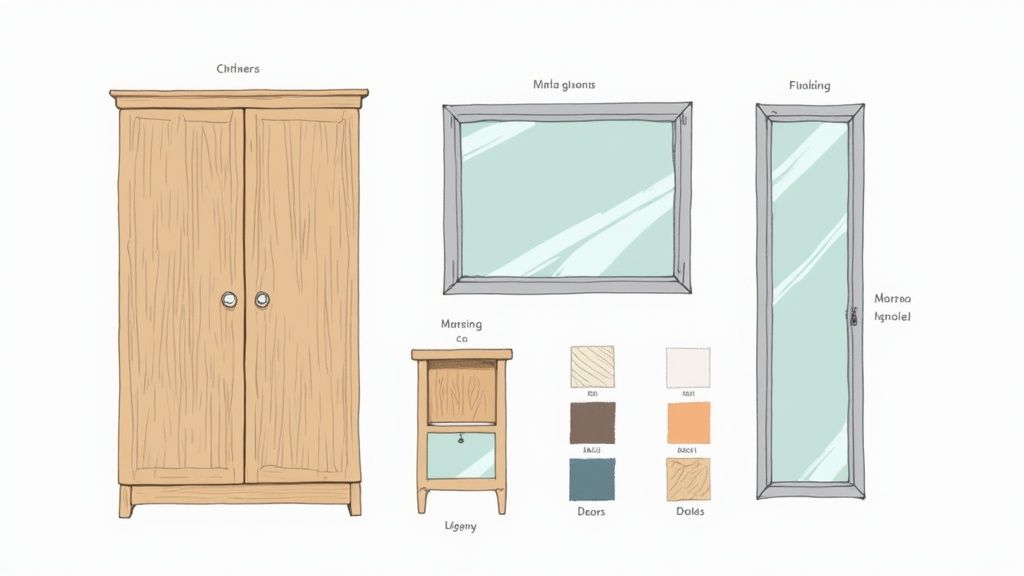
Let’s talk about the single most important decision for your custom wardrobe in Singapore: the materials. Get this right, and your wardrobe will look fantastic for years. Get it wrong, and you're signing up for warped doors, peeling finishes, and even mould. It’s all about winning the battle against our year-round humidity.
Think of your wardrobe’s core material as its skeleton—it has to be strong, stable, and resilient enough to handle the climate. While cheaper options like particleboard might seem tempting, they act like a sponge in humid air, swelling up and losing their shape over time. That’s why any experienced local carpenter will tell you to start with a solid, moisture-resistant foundation.
The Core Material: Plywood vs. MDF
When it comes to the internal structure, the conversation nearly always narrows down to two contenders: plywood and Medium-Density Fibreboard (MDF). They’re both engineered woods, but they behave very differently in a tropical climate.
Plywood is made by gluing together multiple thin layers of wood veneer (called "plies") with their grains running at right angles to each other. This cross-graining trick is what makes it so incredibly strong and, crucially for us, highly resistant to warping and moisture. It's the undisputed champion for durable, long-lasting custom furniture in Singapore.
MDF, on the other hand, is created from compressed wood fibres, wax, and resin. Its main advantage is a perfectly smooth surface that’s a dream for painting. However, it's not a big fan of water. A serious leak or just constant high humidity can cause MDF to swell up and weaken for good.
For a wardrobe built to last in Singapore, high-grade plywood is simply the superior choice for the structure. Its layered construction gives it the strength and moisture resistance needed to keep doors hanging straight and shelves from sagging for years.
The Finishing Touch: Laminates and Veneers
Once you’ve settled on a sturdy plywood core, it’s time for the fun part: choosing the finish. This is the "skin" of your wardrobe, defining its look while adding a vital layer of protection. The two most popular choices here are laminates and veneers.
Laminates: Think of these as tough, multi-layered synthetic sheets that are bonded to the plywood under intense pressure. They are incredibly durable, scratch-resistant, and a breeze to clean. Best of all, they come in a massive range of colours, patterns, and textures—from solid matte colours to surprisingly realistic wood grains. This versatility makes them a practical and stylish go-to for modern homes.
Veneers: A veneer is a paper-thin slice of real hardwood (like oak, walnut, or teak) that's applied over the plywood core. This gives you the authentic, rich beauty of solid wood without the eye-watering price tag or the risk of warping. Veneers need a bit more care than laminates and can cost more, but for that premium, classic look, nothing beats the natural warmth and unique grain of real wood.
So, what's the ultimate combination for a custom wardrobe in Singapore? A high-quality plywood core sealed with a protective laminate finish. This power duo delivers the perfect blend of structural strength, moisture resistance, and design flexibility, giving you a wardrobe that’s not just beautiful but truly built for our climate.
How to Budget for Your Custom Wardrobe
Alright, let's talk numbers. Figuring out the cost of a custom wardrobe in Singapore is the first real step to making that dream closet a reality. Unlike grabbing a flat-pack wardrobe off a shelf, a custom build doesn’t have a single price tag. Its cost is shaped by every single choice you make.
That’s why setting a clear budget from the get-go is so important. It helps you navigate your options without getting any nasty surprises when the final quote arrives. Think of it less like a one-off purchase and more like a mini-construction project, where every part has its own cost.
Breaking Down the Main Cost Factors
So, where does the money go? Four key things will shape your final bill: the wardrobe's size, the materials you pick, all the cool internal gadgets, and the hardware that holds it all together. Each one is a lever you can pull to either splurge on premium features or save a bit without sacrificing quality.
Size and Dimensions: This one's pretty straightforward. A bigger wardrobe needs more materials and more labour, which means a higher cost. In Singapore, contractors often price by the per-foot-run (PFR), which makes it easier to get a ballpark figure early on.
Material and Finish Choices: As we’ve touched on, your choice of core material (like plywood) and the finish on the outside (laminates, veneers, etc.) is a major price driver. A luxe real wood veneer will cost a fair bit more than a standard laminate, so this is where you can really balance your aesthetic goals with your budget.
Internal Accessories: A simple layout with hanging rods and shelves will always be the most wallet-friendly option. The price starts to climb as you add in extras like pull-out drawers, trouser racks, fancy accessory trays, or integrated LED lighting.
Hardware Quality: The hinges, drawer runners, and handles might seem like small details, but they make a huge difference to how your wardrobe feels every day and how long it lasts. Going for premium soft-closing mechanisms from well-known brands adds to the cost, but trust me, it’s a luxury you’ll appreciate every single morning.
Understanding Per-Foot-Run (PFR) Pricing
To simplify things, most contractors in Singapore will quote you a PFR price. This is basically the cost for every one-foot stretch of your wardrobe, measured from floor to ceiling. Here’s a rough idea of what to expect:
Basic Range: $250 to $350 PFR. This will get you a simple, functional wardrobe using standard laminates and a basic interior setup.
Mid-Range: $350 to $500 PFR. In this bracket, you can look at higher-quality laminates, more drawers, and a few handy accessories.
Premium Range: $500+ PFR. For this price, you’re in the territory of premium finishes like veneers, top-tier hardware, and a fully kitted-out interior with all the bells and whistles.
Here's a pro tip: Spend your money on a solid foundation—that means high-quality plywood and durable hardware. You can always add more organisers and trays later, but the core structure isn't something you can easily change.
This demand for tailored storage isn't just a local thing. The Asia-Pacific custom wardrobe market was already valued at around USD 2.5 billion back in 2021, and that number is growing as more people move into cities and need smarter ways to use their space. You can learn more about the regional market growth for custom wardrobes and see how Singapore's trends fit in.
By getting a handle on these cost drivers, you're in a much better position to plan a custom wardrobe in Singapore that perfectly fits your space, your lifestyle, and your budget.
From Design Sketch to Final Touches: What to Expect
Getting a custom wardrobe in Singapore might feel like a huge project, but it’s actually a pretty straightforward journey from hazy idea to beautifully installed reality. Once you understand the steps, the whole thing feels much less intimidating. It all starts with a simple chat.
The process kicks off with an initial design consultation. Think of this less as a sales pitch and more as a brainstorming session. This is where you get to share your vision, vent about your current storage headaches, and walk the designer through your daily routine. Need tons of hanging space for dresses? Are you a sneakerhead with a growing collection? A good designer listens carefully to translate your lifestyle into a smart, functional plan.
Bringing Your Vision to Life
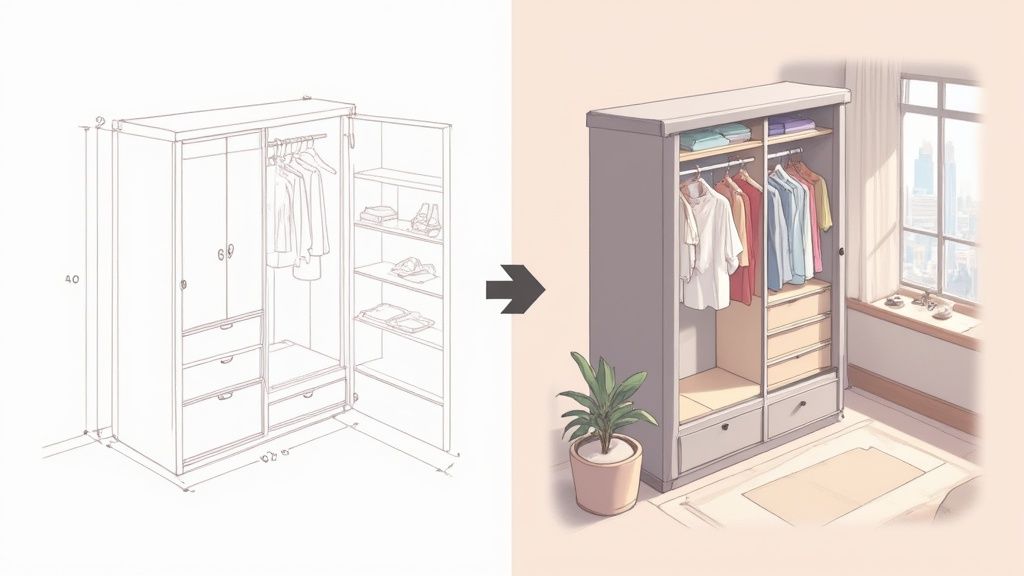
After that first chat, the next step is a precise on-site measurement. A team will pop over to your home to measure the wardrobe space down to the last millimetre. They'll account for any architectural quirks, like sloped ceilings or awkward beams, to make sure the final piece fits like a glove for that seamless, built-in look.
With the exact dimensions locked in, the fun begins. You’ll collaborate with the designer to choose materials and finishes that not only match your home’s vibe but are also tough enough for Singapore's climate. This is also when you'll see your ideas spring to life through 3D design visualisations. These digital mock-ups are a game-changer, letting you see exactly how the wardrobe will look in your room. You can tweak the layout or change a finish before a single piece of wood is even cut.
The 3D visualisation is your final sanity check. It’s the bridge between what’s in your head and what gets built, giving you a crystal-clear preview and heading off any expensive misunderstandings down the road.
From the Workshop to Your Home
Once you give the final thumbs-up on the design, the plans head to the workshop for off-site fabrication. Here, skilled carpenters use your exact specs to cut, assemble, and finish every component. Building everything off-site is a huge plus—it keeps the dust, noise, and general chaos out of your home, making the whole experience much smoother.
The final stage is the on-site installation. The finished pieces are delivered right to your door, where a professional team meticulously puts it all together. This is where all that careful planning pays off, as you watch the components come together to create the beautiful, functional wardrobe you imagined from the start.
To give you a better idea of where your money goes, this infographic shows a typical cost breakdown for a custom wardrobe project.
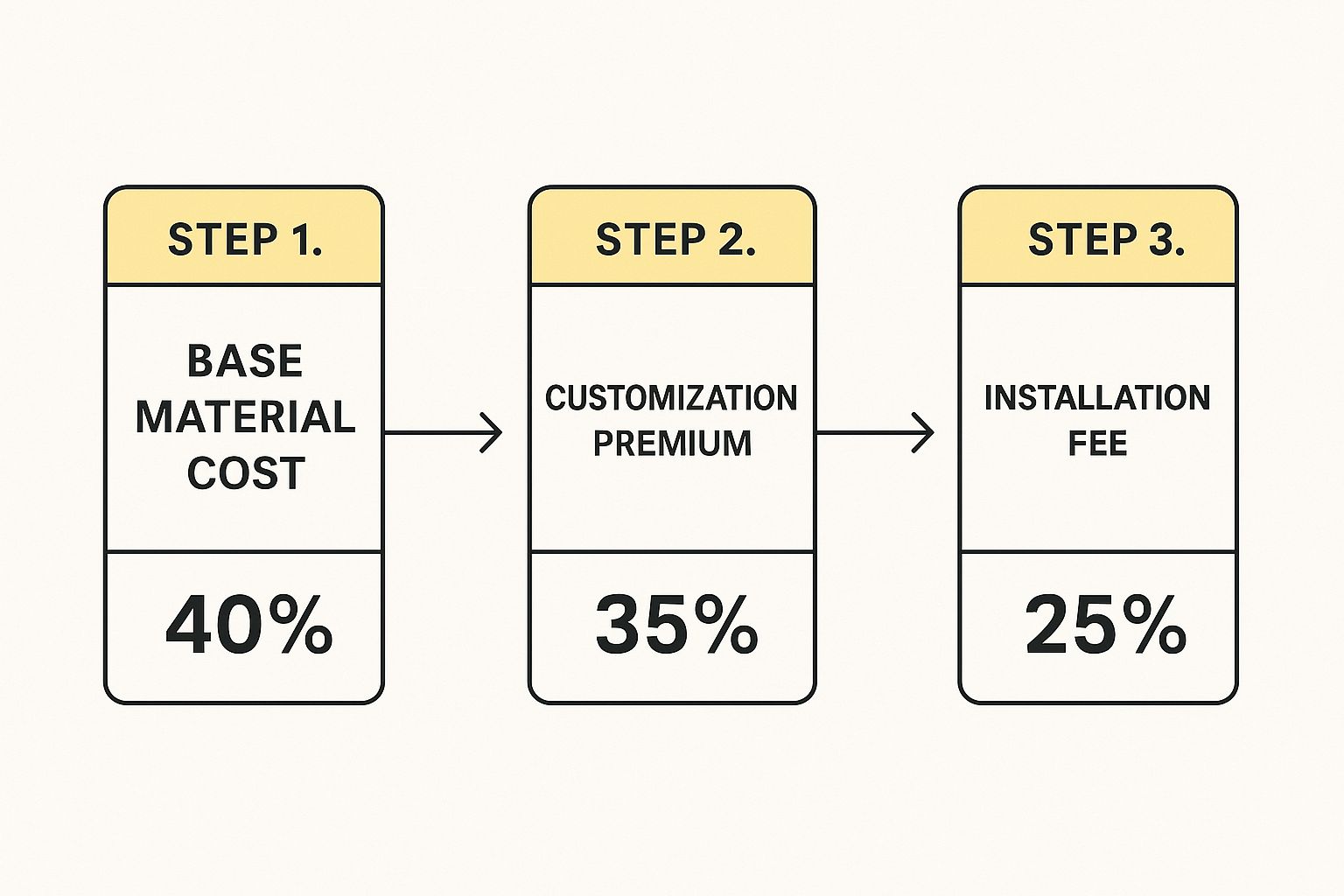
As you can see, the final price is a blend of the materials you choose, the complexity of the design, and the skilled craftsmanship required for a perfect fit and finish.
Designing a Smarter Wardrobe Interior
A beautiful wardrobe is more than just its doors. The real magic happens inside, where a thoughtfully designed interior can completely transform your daily routine. A great custom wardrobe in Singapore isn't just a box with a hanging rail; it's a personalised system built around your life, making everything feel organised and effortless.
width="100%" style="aspect-ratio: 16 / 9;" src="/images/other/6df74597-R1dKybdYyY8.jpg" frameborder="0" allow="autoplay; encrypted-media" allowfullscreen>
Before you even think about layouts, take a quick inventory of what you actually own. It's easy to design for a fantasy life, but the best wardrobes are built for reality. If you have a collection of long dresses, then full-length hanging space is a must. If your handbag collection is your pride and joy, you'll want dedicated compartments that keep them upright and in perfect shape.
Tailoring Storage to Your Lifestyle
This is where customisation really shines. You can incorporate clever components that solve those little everyday annoyances and turn your wardrobe into a seriously efficient hub.
Adjustable Shelving: Life changes, and so do your storage needs. Adjustable shelves offer the freedom to reconfigure your space whenever you want, making room for bulky winter sweaters or creating neat stacks of folded jeans.
Pull-Out Trouser Racks: This is an absolute game-changer. No more digging through a messy pile to find the right pair of trousers. A simple pull reveals all your options, neatly hung and crease-free.
Dedicated Accessory Drawers: Say goodbye to tangled necklaces and lost watches. Custom drawers with soft, velvet-lined dividers or clear tops keep all your small treasures organised, protected, and easy to find.
The Rise of Smart and Efficient Design
This move towards hyper-personalised storage isn't just something we're seeing locally. The demand for clever wardrobes is a global trend. In fact, the fitted wardrobe market is projected to grow from $50 billion in 2025 at a 6% CAGR. This boom is fuelled by growing cities and smaller living spaces, where smart design is essential. Homeowners want minimalist looks packed with clever features, like integrated lighting that makes finding things a breeze. You can read more about this global shift in this market report from Data Insights.
A well-designed wardrobe interior isn’t just about cramming more things in. It’s about creating a sense of calm and order that saves you time and reduces daily stress. When every item has its own place, finding what you need becomes second nature.
Got Questions About Custom Wardrobes? We’ve Got Answers.
Jumping into a big home project like a custom wardrobe always brings up a few questions. It’s a significant investment, so you want to get it right. To help you plan with confidence, here are some straight answers to the questions we hear most often from Singapore homeowners.
How Long Does a Custom Wardrobe Take to Build?
From the moment you sign off on the design to the final screw being tightened, you can generally expect your custom wardrobe to be ready in 4 to 8 weeks.
Now, this isn't set in stone. A few things can nudge that timeline. If you’re dreaming up a complex design with lots of clever compartments, it’ll naturally take a bit longer than a simple, clean layout. Sourcing unique materials or special finishes can also add some time. Your contractor should always give you a clear, detailed schedule upfront, so there are no surprises.
What Is the Best Wardrobe Material for a Humid Climate?
In a climate like Singapore's, your choice of material is non-negotiable. For a wardrobe that’s built to last, high-quality plywood is hands-down the best choice for the main structure. Its layered build gives it fantastic resistance to warping and moisture, ensuring your doors hang perfectly straight for years to come.
For an extra layer of protection, we always recommend pairing a plywood core with a durable laminate finish. Think of it as armour for your wardrobe. It creates a seal that keeps humidity out while giving you a sleek, easy-to-clean surface.
The combination of a high-grade plywood carcase and a protective laminate finish is the industry standard for a reason. It delivers the perfect balance of structural integrity, climate resilience, and aesthetic flexibility, making it a wise investment for any Singaporean home.
Can I Install a Built-In Wardrobe in a Rented Home?
This is a big one for tenants. A built-in wardrobe is considered a permanent fixture—it's physically attached to the walls. Because of this, you must get written permission from your landlord before you even think about starting.
Check your tenancy agreement carefully, as most will have clauses about major alterations. It’s always best to have an open conversation with your landlord first to avoid any headaches or disputes down the road.
Ready to create a wardrobe that fits your space and life perfectly? The expert team at KIVO brings together decades of skilled craftsmanship and thoughtful design to make it happen. Contact us today for a consultation and see what true customisation really means.