Diving into a home renovation can feel like a massive undertaking, but that's where an HDB renovation package comes in. It’s designed to take the guesswork out of the process by bundling essential services—think tiling, basic electrical work, and painting—into one fixed-price deal. This makes it a popular, predictable choice for new Singaporean homeowners.
What Exactly Are HDB Renovation Packages?
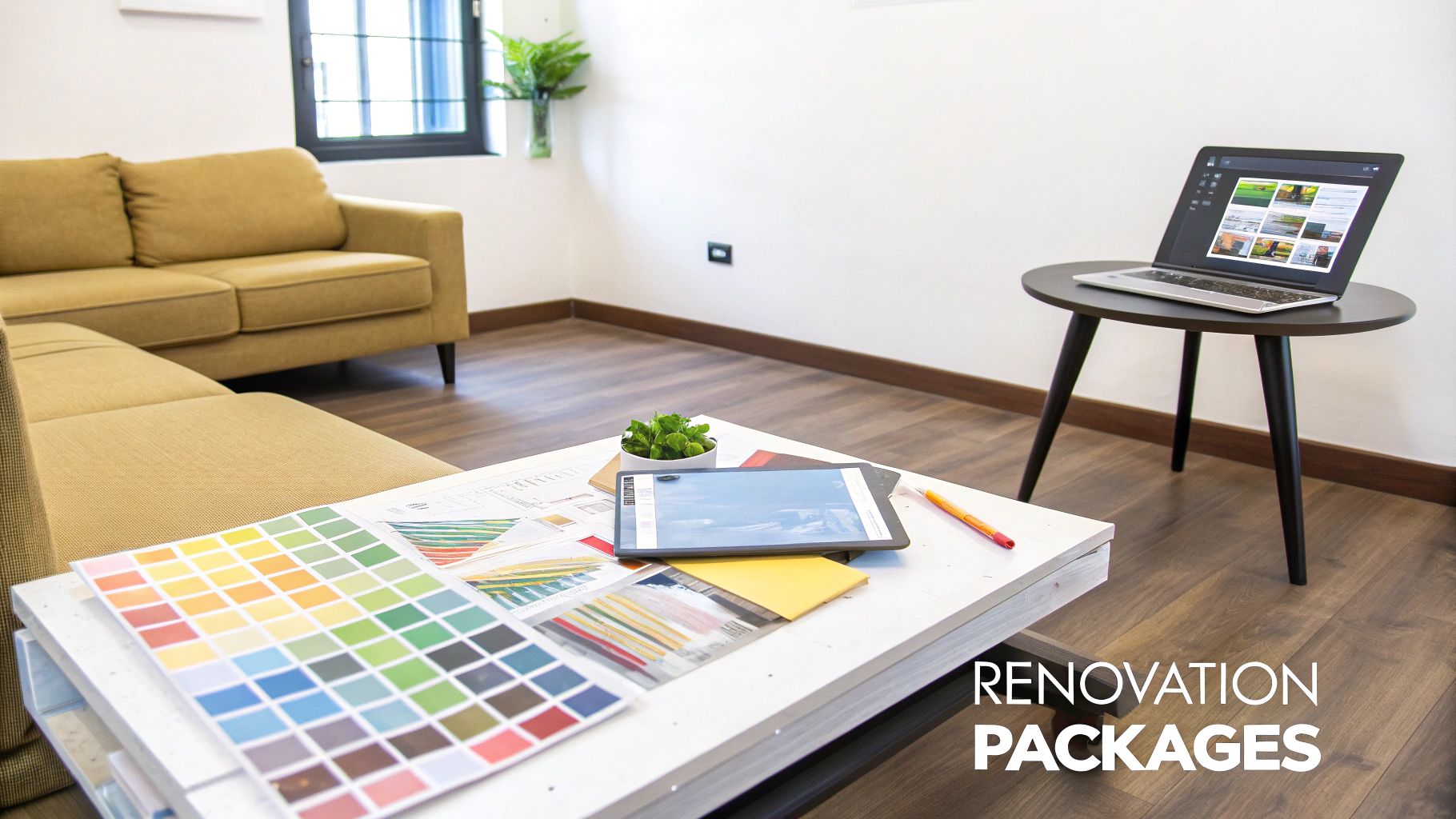
Think of it like ordering a set meal. Instead of picking every single dish à la carte and wondering about the final cost, you get a curated selection of essentials that work well together, all for one clear price. It’s a straightforward approach that cuts through the complexity of a renovation.
For first-time homeowners, especially those with a standard BTO or resale flat, these packages offer a structured and manageable path forward. They bundle the most common works needed to turn an empty flat into a liveable home.
The Logic Behind Packaged Solutions
The concept of renovation packages is a perfect fit for Singapore’s housing landscape. With over 77% of resident households living in HDB flats, it's the most common type of home here. Since 1960, HDB has built over 1.2 million units, creating a huge and relatively standardised housing stock. You can dive deeper into these numbers in the official HDB key statistics report.
This standardisation allows firms to create data-driven, tiered packages calibrated for the typical 3-, 4-, and 5-room layouts. This systematic approach brings major wins for homeowners:
- Budget Clarity: You know the cost for a defined scope of work right from the start. No nasty surprises.
- Time Efficiency: Bundling services streamlines the project, leading to a shorter renovation timeline.
- Simplified Decision-Making: It narrows down the endless choices to a manageable selection of materials and finishes, saving you from decision fatigue.
Different Tiers for Different Needs
Of course, not all packages are the same. They usually come in different tiers to suit various needs and budgets.
Practical Example:
A common entry-level package for a new 4-room BTO flat might cost around $12,000 - $18,000. This typically covers essentials to get it move-in ready:
- Laying floor tiles in the living room and bedrooms.
- Basic plumbing connection for the kitchen sink and bathroom fixtures.
- A set number of new lighting and power points.
- A fresh coat of paint for all internal walls and ceilings.
On the other hand, a more comprehensive package for a 30-year-old resale flat could start from $35,000 and up. This would include all the above, plus necessary hacking of old tiles, dismantling built-in furniture, and mandatory re-waterproofing for bathrooms.
A well-structured package serves as a solid foundation. It covers the non-negotiables, giving you a clear financial and creative baseline from which you can add custom touches or upgrade specific elements to truly personalise your space.
Understanding this core idea is the first step. It helps you see a package not as a rigid box, but as a smart starting point for creating your dream home efficiently.
What’s Actually Inside a Renovation Package?
The scope of work for a new BTO flat versus an older resale unit is like night and day. Think of a standard package as the foundation of your renovation. It’s the skeleton that covers all the major trades needed to turn a bare unit into a home. Once that solid base is there, you can layer on the custom touches that make it yours.
Generally, any good package will cover a few key areas, from the heavy-lifting of masonry and tiling to the final lick of paint. These are the building blocks for nearly every HDB project.
Core Services You Should Expect in Most Packages
The services bundled into a package are designed to tackle the fundamental needs of a new home. These are the non-negotiables that make a space liveable and safe.
Here’s a practical rundown of what you'll almost always find:
- Masonry and Tiling: This covers laying floor tiles in your living room and bedrooms, along with floor and wall tiles for the kitchen and bathrooms. For BTOs, it also includes applying a cement screed to get the floors perfectly level before any tiles go down.
- Plumbing Works: All the essential hook-ups are usually part of the deal. Connecting inlet and outlet pipes for your kitchen sink, washing machine, and bathroom fixtures is standard.
- Electrical Works: Basic electrical points are a given. A package might include a set number of new lighting points (e.g., 10), power sockets (e.g., 15), and switches for crucial spots.
- Painting Services: Packages almost always include painting for all internal walls and ceilings, typically using standard emulsion paint from trusted brands like Nippon or Dulux.
- General Services: This covers the crucial work of project management—coordinating different workers, supervising the site, and a basic clean-up to get rid of construction dust.
A quick heads-up: the word 'basic' is key here. A package provides a baseline—think standard tiles (e.g., priced up to $3.00 per square foot) or a fixed number of electrical points. If you want to upgrade to premium materials or add more outlets, that will be an add-on cost. That's a normal part of tailoring the package to fit your needs.
The Big Difference: BTO vs. Resale Packages
The single biggest factor that changes a package's inclusions and price is the type of flat. A brand-new BTO is a clean slate. A resale flat comes with history that often needs to be stripped away.
This is why resale HDB renovation packages are almost always more extensive—they must include demolition and hacking works. This is the main reason they cost more. You’re not just building; you’re also taking things apart, which involves significant labour and proper disposal.
For instance, a BTO package starts with an empty shell. A resale package must first account for hacking up old floor tiles, dismantling built-in cabinets, and maybe tearing down a non-structural wall. On top of that, older flats (especially those over 20 years old) often need mandatory re-waterproofing in the bathrooms to prevent leaks—another big job you won't find in a BTO project.
BTO vs Resale HDB Renovation Package Inclusions
The table below highlights the key differences you’ll find in renovation packages for new BTOs compared to older resale flats. The extra work required for resale units is what primarily drives up the cost.
| Service Category | Typical BTO Package Inclusion | Typical Resale Package Inclusion |
|---|---|---|
| Demolition | Usually not required, minimal prep work. | Extensive hacking of old floor and wall tiles. Dismantling of old cabinets, fixtures, and sometimes non-structural walls. |
| Masonry | Application of HDB-provided cement screed; laying of new floor and wall tiles. | Laying of new floor and wall tiles; making good of surfaces after hacking. |
| Waterproofing | Not typically needed as HDB provides it. | Mandatory re-waterproofing for bathrooms to meet HDB guidelines and prevent future leaks. |
| Plumbing | Installation of new pipes and fixtures in designated locations. | Often requires rerouting or replacing old pipes in addition to new installations. |
| Waste Disposal | Disposal of packaging and minimal construction debris. | Haulage and disposal of significant hacking debris, which is a major logistical task. |
As you can see, a resale renovation isn’t just about adding new things—it’s about removing the old first. This "subtractive" work requires significant time, manpower, and budget.
Uncovering Exclusions and Potential Hidden Costs

That attractive price tag on a renovation package? Think of it as the starting point. The true test of a good package isn’t just what’s included, but how transparent it is about what’s left out. Understanding these common exclusions is the most important step toward building a realistic budget.
These aren't necessarily sneaky omissions. More often, they're items with highly variable costs or things that fall outside the scope of standard building work. Knowing about them upfront helps you avoid budget shock.
Administrative and Preliminary Works
Before any physical work starts, a lot of background work needs to happen. These are the non-negotiable tasks that make sure your reno is legal, safe, and clean. Almost without exception, they are billed separately.
Be sure to ask your contractor if these items are accounted for in your quote:
- HDB Permit Fees: Any work like hacking walls or altering plumbing requires a permit from HDB. These fees are typically a separate line item.
- Debris Hauling and Disposal: Hacking up old floors creates a mountain of waste. The cost to haul it away is a significant expense rarely bundled into a base price.
- General Cleaning and Chemical Washing: A standard package might include a basic sweep-up, but the intensive chemical wash needed to get grime off your new tiles? That’s usually an add-on.
- Protective Coverings: You’ll want to lay down corrugated sheets to protect your new flooring. The materials and labour for this are often an extra charge.
Upgrades and Premium Selections
The materials included in a basic package are chosen to keep the price competitive—think of them as good, entry-level options. If your vision includes higher-end finishes, these will be itemised as upgrades.
Practical Example: A quote might just say "kitchen countertop," which could mean a basic laminate. If you want to upgrade to a more durable quartz, that will be an additional cost, usually calculated per foot run (pfr).
- Laminate Countertop: ~$40-60 pfr
- Quartz Countertop: ~$90-150 pfr
The purpose of a package is to provide a cost-effective baseline. Think of it as the canvas. The custom details and premium materials are the paint you use to create your masterpiece—and they are accounted for separately.
It’s vital to clarify the exact specifications in your package.
Design and Customisation Costs
While a package covers the execution of the work, the creative process and custom-built elements are specialised services that fall outside a standard bundle.
- 3D Design Renderings: Want a photorealistic preview of your new kitchen? Those detailed 3D visuals are a professional service and almost always an optional add-on.
- Custom Carpentry: That full-height built-in wardrobe or bespoke study desk isn’t part of a standard package. These pieces are quoted separately based on design, materials, and size.
- Premium Fittings: The package will include standard-issue taps and showerheads. If you’ve got your heart set on designer fixtures or smart home integrations, you’ll need to purchase them separately, and there might be extra installation fees.
How to Compare Renovation Packages Like a Pro
Choosing the right HDB renovation package is about more than just picking the lowest price. A smart comparison means digging into the details that define quality and long-term value. This is where you separate a bargain from a future headache.
A lower price might look tempting, but it often comes with compromises, like lower-grade materials or crucial services left out of the fine print. To make a choice you'll be happy with, you need a solid game plan for comparing quotes line-by-line.
Look Beyond the Lump Sum
First things first: break down each quotation into its individual parts. Never accept a single lump-sum figure without a detailed breakdown. A transparent firm will always give you an itemised list of all the work involved. This is non-negotiable.
Once you have these detailed quotes, you can start comparing them apple-to-apple. Don't just glance at "kitchen countertop"; find out exactly what kind. One quote might be for a basic laminate top, while another slightly higher quote could be for a premium quartz surface. This analysis is the only way to see where the real cost differences are.
Scrutinise Material Specifications
The devil is truly in the details when it comes to materials. Two packages can look almost identical on paper until you examine the brand, origin, and technical specs. Here are critical details to check:
- Laminate Flooring: Don't just accept "laminate." Ask for the brand and its AC rating (Abrasion Class). An AC4 or AC5 rating is what you want for high-traffic areas, far superior to a basic AC3.
- Quartz Countertops: Clarify the brand, origin (e.g., European vs. Chinese quartz), and slab thickness. A thicker, more reputable quartz slab offers better heat and scratch resistance.
- Tiles and Tiling Work: The cost of tiles can vary wildly. A great way to get a handle on this is to use a tile cost calculator and budget guide to understand potential costs. Also, confirm if the quoted price includes essentials like waterproofing membranes.
- Workmanship Warranty: A firm confident in its work will offer a clear warranty period. This is a huge indicator of quality.
A detailed quote isn’t just a list of items; it's a promise of quality. If a firm is hesitant to specify the brands or technical details of their materials, it should be a major red flag. True professionals are proud to stand behind the quality of their supplies.
Critical Questions to Ask Every Designer
Your consultation meetings are the perfect chance to gauge a firm’s professionalism and transparency. Arm yourself with these essential questions.
- Who will be my dedicated project manager? You need a single point of contact for clear communication and accountability.
- What is the process for handling variations or changes? Ask how they manage change orders, how extra costs are calculated, and what the approval process looks like.
- Are HDB permit applications and submissions included in your project management fee? Get clarity on who handles the paperwork. A full-service firm should manage all HDB submissions.
- Can you provide references from recent projects similar to mine? Talking to past clients is one of the best ways to verify a firm’s track record.
- What does your payment schedule look like? A standard schedule involves a down payment, followed by progressive payments tied to project milestones. Be wary of any firm that demands a huge upfront payment.
To help you stay organised, use this simple checklist to compare quotes side-by-side.
Renovation Package Comparison Checklist
| Evaluation Criteria | Firm A | Firm B | Firm C |
|---|---|---|---|
| Overall Cost | |||
| Detailed Itemised Breakdown Provided? (Yes/No) | |||
| Carpentry: Material Specifications | |||
| Countertop: Brand & Thickness | |||
| Flooring: Brand & AC Rating | |||
| Tiling: Waterproofing Included? (Yes/No) | |||
| Workmanship Warranty (Months/Years) | |||
| Dedicated Project Manager? (Yes/No) | |||
| HDB Permit Handling Included? (Yes/No) | |||
| Payment Schedule (Milestone-based?) | |||
| Client References Provided? (Yes/No) | |||
| Overall Impression/Gut Feeling |
By taking this methodical approach, you shift the focus from just price to genuine value.
Understanding Timelines and the HDB Permit Process

One of the first questions clients ask is, "How long will this take?" The answer depends on two things: the scope of work and the HDB permit process. Getting a clear picture of how these two work together is key to setting realistic expectations.
Mapping Out a Realistic Project Timeline
A common myth is that hacking can start the moment you sign the contract. The reality is that a big chunk of the initial timeline is about prep work: finalising the design, ordering materials, and getting the green light from HDB.
For a typical 3-room resale HDB flat, we advise clients to set aside 8 to 10 weeks for the full renovation. For a larger 4- or 5-room resale flat, a timeline of 10 to 12 weeks is more realistic. These benchmarks help us structure a sensible schedule. For more background on local housing projects, Singapore's open data portal is a great resource.
Here’s how a typical project breaks down:
- Phase 1: Design & Approvals (1-3 weeks): We finalise your design, pick materials, and send permit applications to HDB. No physical work can begin until approvals are in hand.
- Phase 2: Hacking & Wet Works (2-4 weeks): This stage covers demolition (for resale flats), masonry, tiling, and plumbing.
- Phase 3: Carpentry & Finishing (3-5 weeks): Once the wet works are dry, custom carpentry goes in. This is followed by painting, electrical work, and installing fixtures.
- Phase 4: Final Touches & Handover (1 week): We do a thorough clean-up, conduct final inspections, and fix minor defects before handing the keys over.
A quick tip: BTO renovations are often faster. Resale flats almost always involve demolition and more extensive approvals, which adds time to Phase 2.
Navigating the HDB Permit Maze
The HDB permit process is a non-negotiable part of any renovation. It's in place to protect the building's structural integrity and ensure everyone is safe. We handle all the paperwork, but it’s good for you to know what's happening.
Certain types of work are considered major and absolutely require an HDB permit. Trying to skip this step can lead to hefty fines and being ordered to undo all the work.
Works that typically require an HDB permit include:
- Hacking or demolishing any walls
- Relocating doors or creating new openings
- Altering windows or grilles
- Shifting the position of sinks, toilets, or other plumbing fixtures
- Any work that involves changing the floor finish in the bathrooms
On the flip side, many cosmetic changes don't need a permit.
Works that usually do not require a permit:
- Painting walls and ceilings
- Installing built-in cabinets or wardrobes
- Laying laminate or vinyl flooring over existing tiles
- Replacing internal doors without changing the doorway size
Understanding this difference explains that initial "quiet" period after you've signed the contract. Your designer is busy navigating official channels to make sure your renovation is 100% legal and compliant.
When to Choose a Package vs a Custom Renovation
So, you're at a crossroads: an all-in-one HDB renovation package or a fully custom project? One path offers predictability and speed; the other gives you complete creative control. The right choice boils down to your specific needs, budget, and flat type.
A renovation package is like buying a fantastic ready-to-wear suit. It's well-made, looks great with a few small adjustments, and has you looking sharp quickly. A custom renovation is like visiting a master tailor for a bespoke suit—every detail is crafted just for you.
Neither is inherently better. The key is to figure out which approach fits your home and lifestyle.
Who Benefits Most from an HDB Renovation Package
A package is likely your best fit if you are:
- A New BTO Owner: BTO flats are blank slates with standard layouts. A package is perfect for efficiently sorting out all the essentials—flooring, painting, basic lighting—without getting bogged down in complex decisions.
- Working with a Strict Budget: The beauty of a package is its transparent, fixed pricing for a defined scope. This gives you peace of mind and helps you manage your money confidently.
- Seeking a Quick Turnaround: Need to move in fast? A package is your quickest route. Since the scope and materials are mostly decided upfront, the planning and building phases are much shorter.
When a Custom Renovation Makes More Sense
A custom renovation is the clear winner when your vision is bigger than a standard package can offer, or if your flat has unique quirks.
Consider going custom if:
- You Have a Unique Design Vision: If your dream home involves knocking down walls, creating unconventional layouts, or achieving a specific aesthetic, you'll need a custom approach. When you explore specific living room ideas and realise a standard layout just won't cut it, that's your sign.
- You Want Specialised Materials: Got your heart set on premium Italian tiles, rare wood veneers, or integrated smart home systems? A custom project gives you the freedom to source and incorporate these high-end items.
- Your Flat Has an Unconventional Layout: Older resale flats, jumbo units, or maisonettes often have odd layouts that demand a bespoke solution. A custom plan is essential for major work like relocating a kitchen or creating an open-concept living area.
By weighing these points, you can confidently decide whether the streamlined efficiency of a package or the creative freedom of a custom build is right for you.
Your HDB Renovation Questions Answered
Even after mapping everything out, it’s normal to have a few questions. To help clear things up, we’ve put together answers to the most common queries we hear from homeowners.
Can I Customise an HDB Renovation Package?
Absolutely. In fact, most people do. Think of a package as a solid starting point or a flexible template—not a rigid, take-it-or-leave-it deal. We expect clients to want to tweak things to fit their style.
Some of the most common customisations are:
- Upgrading materials: Swapping the package’s standard ceramic tiles for a more durable porcelain, or upgrading a laminate countertop to quartz.
- Adding custom carpentry: Many homeowners add bespoke pieces like a feature wall with a concealed door, a full-height shoe cabinet, or a built-in study nook.
- Removing unnecessary items: If you don't need something included, like painting for one room, we can usually take it out and adjust the cost.
The most important thing is to finalise every change with your designer before you sign the contract. This ensures you get a revised, itemised quotation that reflects the real scope and cost.
Is the Cheapest Renovation Package Always the Best Deal?
Rarely, if ever. An unusually low price is often a massive red flag. It usually signals compromises you can’t see at first glance, like using lower-grade materials that won’t stand up to daily wear and tear.
What's more, the cheapest quotes often come with the longest list of exclusions. Essential work like debris hauling or chemical washing might be left out, only to pop up later as costly add-ons.
Instead of chasing the lowest number, focus on overall value. This means looking at the quality of materials specified, the completeness of the work scope, the firm’s past projects, and their transparency. A slightly bigger investment upfront for quality and reliability almost always saves you money and stress in the long run.
How Much Extra Should I Budget for Furniture and Appliances?
This is a crucial question. Furniture and appliances are never included in a renovation package, and forgetting to budget for them is a common pitfall.
As a safe rule of thumb, we advise clients to set aside an additional 20-30% of their total renovation cost for these big-ticket items.
Practical Example: If your HDB renovation package and add-ons come to $50,000, you should plan for an extra $10,000 to $15,000. This will cover your sofa, dining set, bed frames, fridge, washing machine, lighting, and curtains. Create a separate shopping list for these items early on so you don’t accidentally blow your entire budget on the renovation itself.
Ready to transform your HDB flat with a partner you can trust? At KIVO, we combine artisan excellence with transparent project management to bring your vision to life.