Figuring out the renovation cost for a kitchen in Singapore is the essential first step before you start pinning dream designs. Generally, you can expect to invest between S$8,000 and S$25,000 for an HDB flat. For condominium and landed properties, the range is wider, typically from S$20,000 to over S$60,000.
Of course, these numbers are just a starting point. Your final costs will hinge on the scale of your project, the type of property you have, and the quality of materials you can’t live without.
Decoding Your Kitchen Renovation Budget

Planning a kitchen renovation goes far beyond just choosing beautiful cabinets and countertops. The final bill is a mix of several key factors, and getting a handle on these is crucial for setting a budget that won’t give you any nasty surprises.
The biggest variables are often your property type and its age. A brand-new BTO flat, for example, is a relatively clean slate. But a 30-year-old resale unit? That’s a different story. It might need extensive hacking, rewiring, and new plumbing before you can even think about the fun stuff.
Key Cost Drivers At A Glance
Your project's scope is another major factor. Are you just giving the space a cosmetic facelift with new paint and cabinet fronts? Or are you planning a full-blown overhaul that involves tearing down walls and completely changing the layout? The more complex the job, the higher the labour costs and the longer the timeline.
Here are the main things that will influence your final quote:
- Property Type: Renovating a BTO, a resale HDB, a condo, or a landed home each comes with a different starting point and cost structure.
- Scope of Work: This covers the extent of demolition (hacking), masonry, and any structural changes needed to bring your vision to life.
- Material and Finish Quality: The choice between laminate, quartz, or high-end sintered stone for your countertops alone can create a huge price difference.
- Carpentry and Cabinetry: Custom-built solutions offer a perfect fit and unmatched function, but they naturally come at a premium compared to off-the-shelf options.
Recent market data from local projects shows that core works like hacking and cabinetry in HDB flats typically range from S$5,000 to S$19,300. When you add in appliances and fixtures, the total can easily climb towards S$29,300. You can explore a more detailed breakdown of these local renovation costs to see how the numbers add up in the real world.
A common mistake we see is underestimating the cost of foundational work in older properties. Addressing underlying plumbing or electrical issues is non-negotiable and must be factored into your initial budget to avoid surprises.
Estimated Kitchen Renovation Cost By Property Type
To give you a clearer picture, here’s a look at what you can generally expect to budget for a kitchen renovation in Singapore, broken down by property type and the level of work involved.
| Property Type | Basic Renovation (S$) | Mid-Range Renovation (S$) | Premium/Extensive Renovation (S$) |
|---|---|---|---|
| 3-Room HDB BTO | S$8,000 - S$12,000 | S$13,000 - S$18,000 | S$20,000+ |
| 4/5-Room HDB BTO | S$10,000 - S$15,000 | S$16,000 - S$25,000 | S$28,000+ |
| Resale HDB | S$15,000 - S$20,000 | S$22,000 - S$35,000 | S$40,000+ |
| Condominium | S$18,000 - S$25,000 | S$28,000 - S$45,000 | S$50,000+ |
| Landed Property | S$25,000 - S$40,000 | S$45,000 - S$70,000 | S$80,000+ |
Keep in mind that these are estimates. A "basic" renovation usually involves essential carpentry and standard finishes, while a "premium" overhaul could include structural changes, high-end European appliances, and bespoke custom joinery. Your final cost will always depend on your specific choices.
Understanding Your Itemised Renovation Quote

Seeing a single, large figure for a kitchen renovation can be overwhelming. The secret to smart budgeting isn’t just looking at the total—it’s understanding exactly where every dollar is going. A detailed, itemised quote is your best friend here, as it demystifies the renovation cost for your kitchen and puts you in control.
Think of it this way: a breakdown transforms one scary number into a series of manageable choices. It lets you see exactly how adjusting one element, like swapping laminate countertops for quartz, directly impacts the final bill. Let's peel back the layers and look at the essential line items you should expect to see.
Foundational and Demolition Work
Before any of the beautiful new stuff can go in, the old kitchen has to come out. This stage is absolutely crucial, especially in older resale HDB flats where foundational work is often non-negotiable and sets the stage for everything that follows.
- Hacking and Demolition: This is the messy part—removing old floor and wall tiles, cabinets, and sometimes non-structural walls. The cost here is driven by the sheer area and thickness of whatever needs to be removed.
- Masonry and Plastering: Once the hacking is done, walls and floors often need to be made good. This involves building up cabinet bases or plastering walls to create a perfectly smooth surface for the new tiles or paint.
- Plumbing and Electrical Works: This is one area you never want to cut corners. Costs cover laying new water pipes, running new electrical points for modern appliances, and ensuring everything is up to Singapore’s strict safety standards. Be aware that moving your sink or oven will bump up this cost significantly.
Finishes and Fixtures
This is where your kitchen's personality really starts to shine through. The materials and finishes you choose are some of the biggest variables in your budget, and where you can really make your mark.
We often see clients surprised by how much material choices can swing the budget. For instance, upgrading from a standard porcelain tile (S$3-S$5 psf) to a premium European tile (S$10-S$15 psf) can add thousands to the cost for an average-sized kitchen floor and backsplash.
- Tiling: This line item covers both the labour and materials for installing your new floor and wall tiles. The final cost depends on the tile size, material, and how complex the layout is (e.g., a herringbone pattern will cost more to lay than a simple grid).
- Painting: A professional paint job gives the kitchen a clean, crisp finish. The quote should include the sealer, paint, and labour for both walls and ceilings.
- Doors and Windows: If your renovation plans include replacing or adding windows or doors, this will appear as a separate line item. The cost is influenced by the material (like uPVC or aluminium) and the overall design.
Custom Carpentry and Countertops
Custom carpentry is the heart and soul of a functional, beautiful kitchen. This is where we create bespoke solutions that perfectly fit your space and your life. It's also, understandably, a significant portion of the budget.
In Singapore, carpentry costs are typically calculated per-foot-run (pfr). This measurement simply refers to the length of the cabinetry. For example, a 10-foot stretch of both top and bottom cabinets is calculated as 20 pfr.
Thinking about a kitchen island? It's a fantastic way to add workspace and a social hub, but remember it also increases the pfr count and requires more countertop material, directly affecting your budget. From our experience, clients increasingly want multi-functional islands with built-in storage and seating, which can turn a kitchen into a true social hub.
Detailed Breakdown Of Kitchen Renovation Line-Item Costs
To give you a clearer picture, we've put together a table breaking down the typical costs for each component. This should help you see how the final renovation cost for your kitchen is actually constructed.
| Work Component | Typical Cost Range (S$) | Key Cost Factors |
|---|---|---|
| Demolition & Hacking | S$800 – S$2,500 | Scope of removal, wall/floor material thickness, haulage access. |
| Masonry & Plastering | S$1,000 – S$3,000 | Area to be covered, condition of existing surfaces, building of bases. |
| Plumbing Works | S$700 – S$2,000+ | Number of new points, relocation of sink/appliances, material quality. |
| Electrical Works | S$800 – S$2,500+ | Number of lighting points and power sockets, rewiring needs. |
| Tiling (Labour & Materials) | S$2,000 – S$5,000 | Area (psf), tile material (ceramic vs. stone), laying pattern complexity. |
| Custom Carpentry (pfr) | S$120 – S$250 per foot run | Material (laminate vs. veneer), internal mechanisms, design complexity. |
| Countertops (pfr) | S$85 – S$220 per foot run | Material (laminate, quartz, sintered stone), edge profiling, cutouts. |
| Painting | S$500 – S$1,200 | Kitchen size, type of paint used, condition of walls. |
As you can see, the final cost is a sum of many smaller parts. Understanding these line items gives you the power to prioritise your spending and make savvy decisions that align with both your vision and your budget.
How Your Property Type Shapes Your Kitchen Budget
The four walls you start with are the biggest factor in your kitchen renovation budget. There's a world of difference between a brand-new BTO flat and a 30-year-old resale HDB. Each presents a completely different canvas with its own rules, challenges, and—most importantly—costs. Getting your head around these differences is the first real step to setting a budget that won’t give you any nasty surprises.
Think of a new BTO kitchen as a clean slate. All the important stuff—the plumbing, wiring, and structure—is fresh out of the box and up to current standards. This is great news because it means your renovation cost for the kitchen is driven almost entirely by your taste, not by expensive repair work.
On the other hand, tackling a resale HDB is often more like a restoration project. You’re not just adding new things; you’re usually undoing decades of wear and tear before you can even think about the fun stuff.
The BTO Advantage: A Blank Canvas
From our experience with BTO homeowners, the conversation is almost always about adding personality and making the space work smarter. Because the fundamentals are sound, the budget goes directly into the things you see and touch every day.
- Carpentry is King: Most of the budget is spent on custom cabinetry. This is where you get your storage sorted, create display nooks, and design a workflow that makes sense for you. For example, a popular request is to integrate a coffee machine station with hidden sockets.
- Minimal Hacking: Demolition is usually light. Often, it’s just about knocking down the wall between the kitchen and the service yard to open things up, which keeps hacking costs low.
- Focus on the Finishes: You have more freedom to invest in quality countertops, a beautiful backsplash, or clever lighting because you aren’t sinking thousands into fixing what’s behind the walls.
What this all means is that a BTO renovation is more about enhancement than a complete overhaul. This makes the budget far more predictable and, generally, a bit kinder on the wallet.
Resale Properties: The Cost of Character
Older properties, especially resale HDBs, have a charm of their own, but they also come with a unique set of financial hurdles. The quote you get for the pretty things is often just the tip of the iceberg. The real costs can be hiding behind old plaster and under cracked tiles.
We always tell our clients with resale flats to budget for the unseen. It's incredibly common to start hacking and discover outdated wiring or corroded pipes. These aren't optional upgrades; they are non-negotiable fixes for the safety and longevity of your new kitchen.
This essential preliminary work can easily add S$5,000 to S$10,000 (or more) to your bill before a single new cabinet goes in. This covers things like extensive hacking, a complete rewiring job to handle modern appliances, and replumbing to make sure you don't have to deal with leaks down the road.
Condos and Landed Homes: Scaling Up the Investment
When you step into the world of condominiums and landed properties, both the scale and expectations shift dramatically, pushing the budget up. The larger footprint alone means you’re simply buying more of everything—more flooring, more cabinetry, and more countertop material.
But it's not just about size. There's an expectation for premium finishes and high-performance, integrated appliances. Based on client expectations, we see a strong trend towards creating separate wet and dry kitchen areas in larger homes. The dry kitchen often becomes an entertaining space with a wine chiller and coffee station, while the wet kitchen handles heavy-duty cooking. This dual-zone approach significantly impacts the overall cost.
For landed properties in Singapore, the investment is substantial. Current industry data for 2025 shows a kitchen renovation can run anywhere from $20,000 to $60,000. This higher price tag reflects the demand for larger spaces, premium materials like natural stone, and sophisticated features that turn the kitchen into the true centrepiece of the home. You can find more insights on costs for landed property renovations at 9creation.com.sg.
Ultimately, the type of home you have sets the baseline for your renovation. Acknowledging this from day one keeps your budget grounded in reality and paves the way for a smoother project without any unwelcome financial shocks.
Choosing Materials That Fit Your Style And Budget
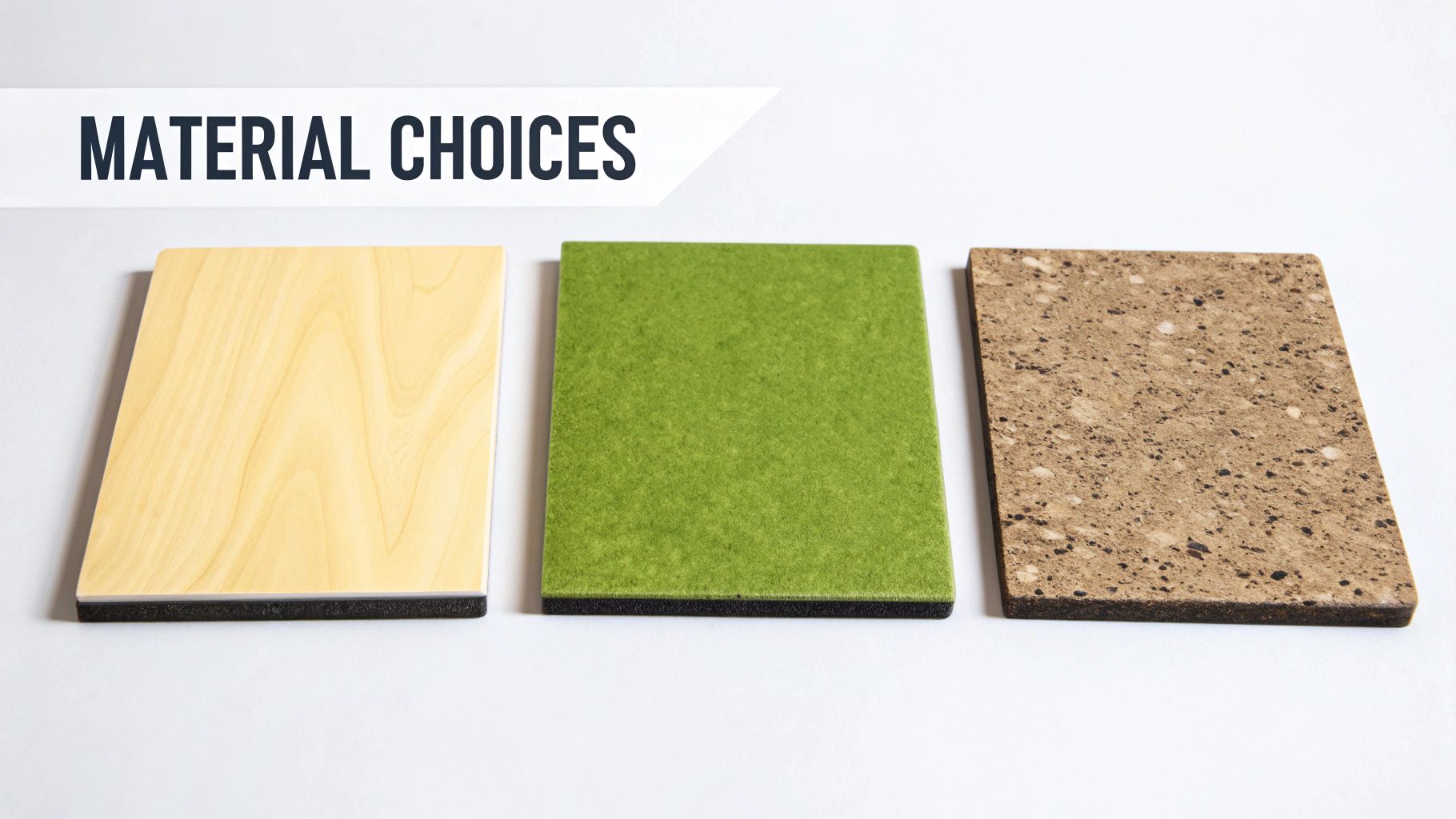
This is where your vision really starts to take shape. The materials you pick for your kitchen set the tone for the final look, define your day-to-day experience, and make up a huge chunk of the renovation cost for your kitchen. Getting these choices right is all about striking that perfect balance between durability, upkeep, and price.
Think of your main material choices—cabinetry, countertops, and flooring—as the three pillars of your kitchen's design. They all have to work together. Understanding what makes each one tick is the secret to creating a cohesive, practical space you'll be happy with for years to come.
Cabinetry: The Foundation Of Your Kitchen
Let's face it, your cabinets are the first thing anyone sees. They dominate the visual space. But it’s not just about looks; the material inside is what ensures they last, especially with Singapore’s humidity.
- Laminate on Plywood: This is our go-to for most projects, and for very good reason. High-pressure laminates come in a massive range of colours and textures, from convincing wood grains to slick matte finishes. Paired with a moisture-resistant plywood core, you get a solution that's tough, a breeze to clean, and budget-friendly.
- Solid Plywood with Veneer: If you're after the authentic look and feel of real wood, veneers are a brilliant option. A super-thin layer of actual wood is bonded to a stable plywood core, giving you that natural beauty without the hefty price tag or the risk of solid wood warping. It just needs a little more TLC.
When you're trying to nail down a look, tools that help you visualize kitchen cabinet colors can be a lifesaver. It’s a great way to experiment with different combinations before you lock anything in.
Countertops: The Workhorse Surface
Your countertop is where the magic (and the mess) happens, so it has to be tough. The price and performance can vary wildly, making this a pivotal decision that really impacts your overall renovation cost.
We often tell our clients to set aside a healthy part of their material budget for the countertop. It’s a high-impact, high-use surface. Investing in a quality material like quartz or sintered stone pays you back every single day in satisfaction and long-term durability.
Here’s a quick rundown of the top contenders:
| Material | Price Point | Durability & Maintenance | Best For |
|---|---|---|---|
| Quartz | Mid to High | Excellent. Non-porous, stain and scratch-resistant. Very low maintenance. | Busy families and keen cooks who want a stylish and completely worry-free surface. |
| Sintered Stone | High | Superior. It’s heat, scratch, UV, and stain-proof. Practically indestructible. | Homeowners wanting the absolute best in performance and a sleek, high-end look. |
| Granite | Mid to High | Very durable but it is porous. Needs sealing every so often to stop stains. | Anyone who loves the unique, natural patterns of real stone and doesn't mind the upkeep. |
Flooring: The Unsung Hero
Kitchen flooring has a tough job. It has to handle spills, constant foot traffic, and the occasional dropped pot, all while tying the room's look together. The sweet spot is finding something that is both practical and stylish.
- Porcelain Tiles: A classic for a reason. Porcelain is incredibly dense, which makes it highly resistant to water, stains, and scratches. Thanks to modern printing, these tiles can mimic anything from natural stone to concrete or wood, giving you massive design flexibility without breaking the bank.
- Luxury Vinyl Tiles (LVT): This isn't your grandma's vinyl. Modern LVT is water-resistant, feels comfortable underfoot, and is seriously durable. It's often more affordable than porcelain and can be installed quickly—sometimes right over your old flooring, which helps keep the overall renovation cost for your kitchen in check.
At the end of the day, picking your materials is a personal journey. By understanding the trade-offs between cost, durability, and aesthetics, you can make smart decisions that lead to a kitchen that’s not only beautiful but perfectly built for your life.
Practical Ways to Manage Your Renovation Costs
A high-end kitchen doesn't have to come with a jaw-dropping price tag. In fact, some of the most stunning transformations we've seen were the result of smart, strategic planning, not just a blank cheque. It’s all about making informed choices that deliver the biggest impact without needlessly inflating the final bill.
The single most effective way to keep costs in check? Work with the layout you’ve already got. Drastic changes are the number one budget killer because they set off a domino effect of expensive work. The moment you decide to shift your sink, dishwasher, or oven, you’re not just moving an appliance—you’re talking about rerouting plumbing and electrical lines. That's a labour-intensive headache that can add thousands to your quote before you've even picked out a single cabinet.
Stick to Your Existing Layout
By keeping your kitchen’s main work triangle (the path between your sink, stove, and fridge) right where it is, you completely sidestep the need for extensive hacking and rework. This one decision can free up a significant chunk of your budget. Suddenly, you have more to spend on higher-quality materials or better appliances, giving you a far more luxurious result for the same money.
To get a real grip on your project, it’s crucial to learn how to accurately estimate renovation costs, which includes everything from labour and materials to permits, long before you commit.
Make Smart Material and Labour Choices
Beyond the layout, there are plenty of other practical ways to rein in spending. While each one might seem small on its own, they add up to substantial savings.
- Overlay, Don't Hack: If your existing floor tiles are still in good shape, why tear them up? Consider overlaying them with a modern material like high-quality vinyl. You avoid the cost, mess, and dust of hacking, saving a bundle on both labour and disposal fees.
- Choose High-Value Alternatives: Everyone loves premium materials, but today’s alternatives offer stunning aesthetics and durability for a fraction of the cost. For example, high-end laminates can beautifully mimic the look of real wood veneers or natural stone without the hefty price tag.
- Prioritise Function Where It Counts: You don't need premium European-branded mechanisms for every single hinge and drawer. Opt for standard, high-quality internal hardware. They’ll function just as reliably without the designer markup.
It also helps to know where the money typically goes. In 2025, data from over 200,000 Singapore projects reveals that kitchen works often make up 25-35% of a total home renovation budget. For a new BTO flat, that means a standalone kitchen renovation can easily cost $9,000-$20,000. That figure often climbs higher for resale properties, which need more retrofitting work. You can dive deeper into the data and explore the renovation calculator's insights on qanvast.com.
Modular vs. Custom Carpentry
Another major decision point is choosing between modular (off-the-shelf) systems and fully custom carpentry. Modular cabinets can seem cheaper upfront, but they often lead to wasted space, leaving you with awkward gaps and clunky filler panels.
Custom carpentry, like the solutions we craft at Kivo, is designed to fit your space like a glove. While the initial investment might be higher, it maximises every centimetre for storage and function. This delivers far better long-term value and saves you from making costly compromises down the road.
Finally, partnering with an experienced interior design firm often unlocks access to trade discounts on materials and appliances, which can help offset the design fees. More importantly, professional project management is your best defence against costly mistakes and delays, ensuring every dollar in your budget is used as efficiently as possible from day one.
Planning for Hidden Costs and Contingencies

Think of your initial quote as the roadmap for your renovation journey—it shows you the intended route, but it doesn't account for unexpected detours. A smart renovation plan always anticipates surprises, because even the most meticulous budget can hit a snag once the work actually begins.
This is especially true when renovating older resale flats. The moment your contractor starts hacking away old tiles, they might uncover issues lurking behind the walls. We’re talking about things like rusted pipes on the verge of leaking or old electrical wiring that’s a fire hazard by today's standards. These aren't just minor hiccups; they're critical fixes that need to be dealt with on the spot.
Common Unbudgeted Expenses
It’s not just structural surprises that can throw your budget off course. A few other common costs often catch homeowners by surprise, so it pays to factor them in from the get-go.
- Wall Rectification: Once old tiles are removed, the wall underneath is rarely a smooth, perfect surface. It often needs extensive plastering to get it flat enough for new cabinetry or tiling, which adds to both material and labour costs.
- Haulage and Debris Disposal: If your flat doesn't have direct lift access, every bag of cement and every piece of debris has to be carried up and down the stairs by hand. This extra manual labour, known as haulage, comes with an additional charge.
- Permit Applications: In Singapore, you can't just start hacking walls or rerouting pipes in an HDB flat or condo. Certain works require official permits, and the application fees are a small but necessary administrative cost.
- Professional Cleaning: Renovation dust is relentless—it gets everywhere. Budgeting for a professional deep-cleaning service will make your new kitchen truly move-in ready and save you a massive headache.
Based on our experience managing countless kitchen projects, we strongly advise clients to set aside a contingency fund of 10% to 15% of their total renovation budget.
This buffer isn't for splurging on a fancier faucet at the last minute. It’s your financial safety net for absorbing necessary but unexpected work. Having this fund ready provides incredible peace of mind, ensuring that a surprise issue doesn't derail your timeline or force you to compromise on your vision. It turns a potential crisis into just another manageable step in the process, keeping your project running smoothly.
Your Top Kitchen Renovation Questions, Answered
Embarking on a kitchen renovation journey naturally brings up a lot of questions, especially when it comes to cost, timelines, and the final value it adds to your home. We've guided countless Singaporean homeowners through this exact process, so we've heard it all.
To help you plan with confidence, we've put together answers to the most common queries we get. Getting these key aspects clear from the start is the best way to set realistic expectations and ensure your budget, timeline, and dream kitchen all align perfectly.
How Long Will My Kitchen Renovation Actually Take?
The timeline for your kitchen renovation really boils down to how complex the job is. A simple cosmetic refresh—think painting cabinets and swapping out a countertop—could be wrapped up in just two to three weeks.
But if you're looking at a full-scale overhaul of a typical HDB kitchen, which involves hacking, tiling, new plumbing, and custom carpentry, you need to be more patient. A realistic timeframe for this kind of project is about four to six weeks.
For larger condominium or landed property kitchens, especially those with structural changes or high-end bespoke finishes, the project can easily stretch to eight weeks or more. This schedule doesn't just cover the hands-on labour; it also factors in crucial curing times for materials like cement screed and the lead times for custom-ordered items.
Is It Cheaper to Hire a Contractor or an ID Firm?
At first glance, a direct contractor's quote might seem lower. It’s tempting, for sure. However, that price usually just covers the execution of specific tasks, leaving you to juggle the overall design, coordinate all the different workers, and solve any problems that pop up along the way.
An interior design (ID) firm, on the other hand, provides a complete, end-to-end service. We handle everything from the initial design concept and sourcing materials to coordinating every single trade—the tilers, plumbers, electricians, and carpenters. This integrated management is your best defence against the kind of costly mistakes and miscommunications that can completely derail a project.
Our job is to make sure a single, cohesive vision is brought to life flawlessly. The project management we provide, combined with our access to trade pricing for materials, often balances out the design fee. The result? A superior, stress-free process and a much more polished final kitchen.
Will a New Kitchen Actually Increase My Property's Value?
Without a doubt. In Singapore’s competitive property market, a modern, well-designed, and truly functional kitchen is a huge selling point. It’s one of the very first spaces potential buyers scrutinise, and a beautifully renovated kitchen can make your home stand out dramatically.
This often helps a property sell faster and fetch a higher price compared to similar units with dated or poorly maintained kitchens. While you might not recoup every single dollar spent, the return on investment (ROI) for a kitchen renovation is consistently one of the highest for any home improvement project. For an older resale flat, a stunning new kitchen can be the single most powerful transformation you can make.
I'm Ready to Start. What's the Very First Step?
Before you even think about looking at tile samples or cabinet colours, the most critical first step is to define your needs and set a realistic budget. Get really honest about how you and your family use the kitchen every day.
- List Your Pain Points: Where are the daily frustrations? Is it the constant lack of storage? Is the workflow a chaotic mess? Do you never have enough counter space to prepare a proper meal?
- Define Your Style: Start gathering inspiration. Create a board on Pinterest or tear pages from magazines to get a clear picture of the aesthetic you're aiming for.
- Set Your Budget: Figure out a budget range you're comfortable with. And don't forget to include a 10-15% contingency fund. Trust us, you’ll be glad you have it when unexpected issues inevitably arise.
Once you have a solid idea of your goals and your financial comfort zone, it's time to talk to a professional. An experienced designer can take your rough ideas, refine them into a layout that is both beautiful and functional, and give you an accurate cost estimate to get your project started on the right foot.
Ready to transform your kitchen with expert guidance and impeccable craftsmanship? At KIVO, we specialise in creating bespoke kitchens that perfectly balance beauty and function. Contact us today for a consultation and let's start planning the heart of your home.