So, you're about to tackle a resale HDB renovation. It’s an exciting process, transforming an older flat into a space that’s truly yours. But unlike a brand-new BTO, a resale flat often means you have to do a bit of demolition before you can start building. Think of it as undoing the past before creating your future—a critical first step that sets the foundation for everything to come.
Your Essential Resale HDB Renovation Roadmap
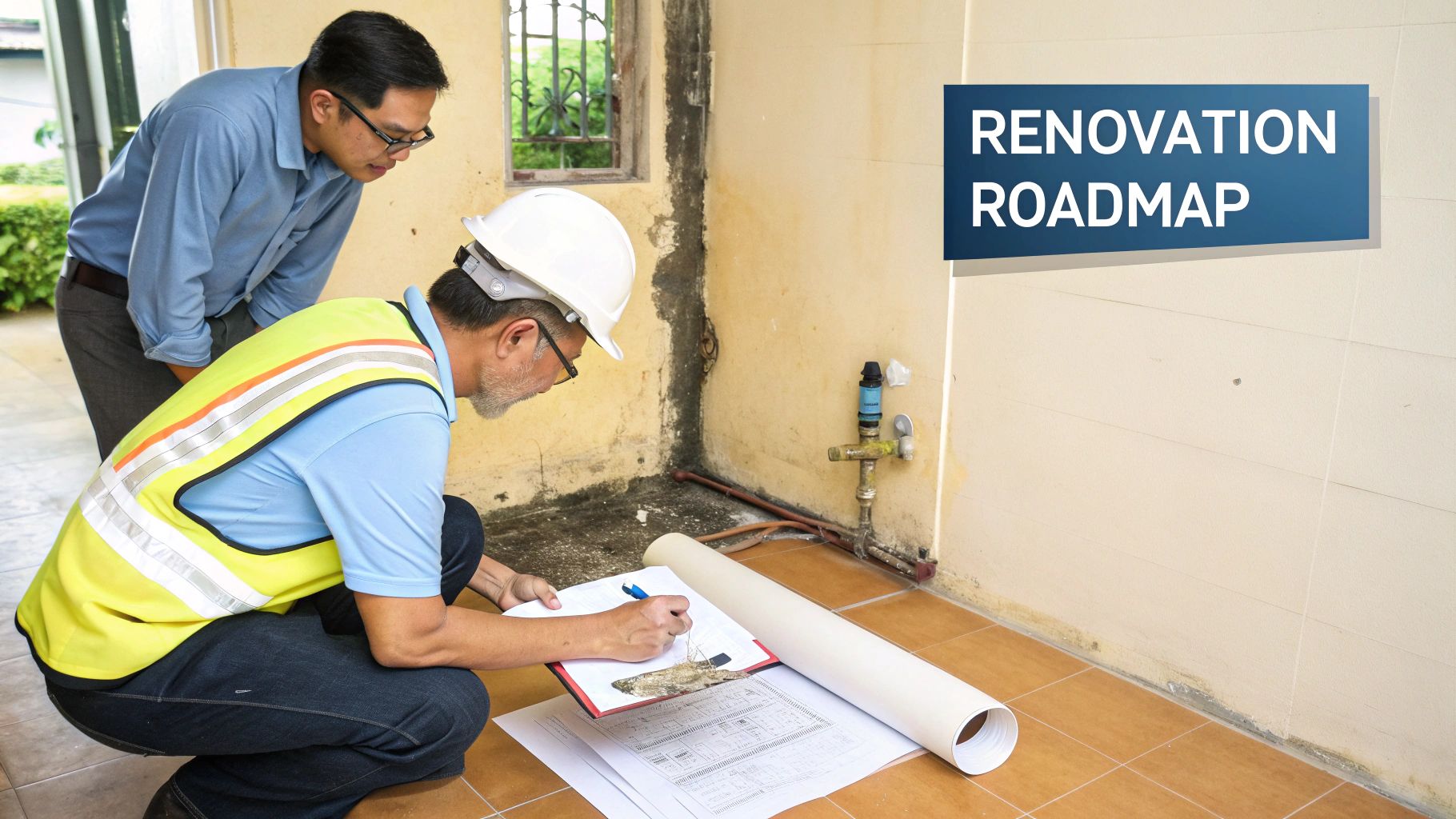
The journey to a stunning resale flat doesn't start with a sledgehammer. It begins with careful planning, a sharp eye for detail, and a solid grip on the costs and rules involved. This roadmap will walk you through those crucial first steps, so you know exactly what to expect.
Older flats are full of character, but they can also hide problems you wouldn't spot during a quick viewing. Uncovering these issues early on is the secret to keeping your budget and timeline on track.
The Critical Pre-Renovation Inspection
Before you even dream about colour palettes or custom carpentry, a thorough inspection is a must. This isn't just about admiring the layout; it’s about getting to know the flat's real condition. From our experience on countless resale projects, here’s what you absolutely need to check:
- Outdated Electrical Wiring: Many flats built over 20 years ago have wiring that just can’t handle today’s load of air-conditioners, smart TVs, and kitchen gadgets. Limited power outlets or old, yellowed sockets are often tell-tale signs. A client of ours in a 30-year-old Ang Mo Kio flat had only one power point in the master bedroom, which is completely unworkable for modern needs.
- Hidden Plumbing Issues: Look for subtle clues of water damage. Think bloated paint on the ceiling, faint dark stains in corners, or a musty smell under the sinks. These could point to slow leaks hiding inside the walls. In a recent Bishan project, a faint watermark on the ceiling led us to discover brittle, corroded pipes that were close to bursting.
- Structural Integrity: Keep an eye out for hairline cracks on walls and beams. Most are just surface-level plaster cracks, but larger, diagonal ones might signal deeper issues that need a professional opinion.
- Uneven Surfaces: Run your hand across the walls and floors. You might find that previous owners simply tiled over old flooring, creating uneven levels that will need to be hacked away and re-levelled.
Budgeting for the Unseen
One of the biggest mistakes homeowners make is underestimating the cost of prepping an old flat. With a resale unit, a good chunk of your budget will go towards demolition and making things right before the real fun begins.
As a rule of thumb for any resale HDB renovation, always set aside a contingency fund of 10% to 15% of your total budget. This buffer gives you the peace of mind to tackle unexpected surprises, like hollow tiles or old pipes that need replacing, without derailing your entire project.
To keep the worksite organised and your furniture safe from all the dust and debris, it's also smart to think about planning for storage during your HDB renovation. Getting your things out of the way early prevents damage and gives your contractors the space they need to work efficiently. By sorting out these basics first, you’re setting yourself up for a much smoother and more predictable renovation journey.
Decoding the Costs of a Resale Renovation

It’s one of the first questions we always get: "Why does renovating a resale flat cost so much more than a BTO?" It's a great question, and the answer is all about the groundwork. A new BTO is a blank canvas, ready for you to paint your masterpiece. A resale flat, on the other hand, is an existing painting that first needs to be stripped bare before you can even think about picking up a brush.
This process of "undoing" the previous owner's work is where the initial costs start to pile up. For example, hacking just the floor and wall tiles in two bathrooms can easily cost S$2,000 to S$3,000 for labour and haulage alone, before you even buy a single new tile.
The Major Cost Components in a Resale Project
The budget for a resale HDB is a completely different beast compared to a new flat. In our experience, the lion's share of the initial investment goes into fixing and fortifying the flat's core systems. These aren't glamorous, but they're non-negotiable for safety and making sure your home lasts.
Here’s a practical look at the main cost drivers you’ll encounter:
- Hacking and Demolition: This is the messy but essential first step. It involves tearing down non-structural walls, smashing up old floor and wall tiles, and dismantling dated, built-in carpentry. The cost is directly tied to how much material needs to be removed and legally disposed of.
- Masonry and Wet Works: Once everything is hacked away, the surfaces need to be made good again. This means applying fresh waterproofing in the bathrooms and kitchen, screeding the floors to create a perfectly level base for new tiles, and plastering the walls for a smooth finish.
- Electrical Rerouting: Older flats were not built for our modern, gadget-heavy lifestyles. A full rewiring is often necessary to handle the load from modern appliances and meet today’s safety standards. This is a critical investment to prevent electrical fires or frustrating tripped circuits down the line.
- Plumbing Works: Just like the wiring, old pipes can be a ticking time bomb. Replacing aged water and sanitary pipes is crucial to avoid the nightmare of future leaks, burst pipes, and poor water pressure.
These early stages are incredibly labour-intensive and form the bedrock of your entire renovation. Trying to cut corners here is a surefire recipe for eye-watering repair bills in a few years.
Realistic Budgeting for Different Flat Sizes
Knowing the potential costs upfront is the key to smart planning. A huge factor in the final bill is the flat's age and its current condition—a 40-year-old unit will naturally demand far more extensive work than one that’s only 10 years old.
Based on industry figures and our own projects, a resale renovation can easily cost up to 40% more than a BTO project of the same size. For example, current estimates put a 4-room resale HDB renovation in the range of S$60,000 to S$75,000, while a 5-room flat can climb to between S$80,000 and S$95,000. This jump in cost is almost entirely due to the essential replacement of old wiring, plumbing, and worn-out built-ins. You can dive deeper by exploring more detailed renovation cost breakdowns.
The goal isn't just to make the space look pretty; it's to ensure it functions safely and reliably for years to come. Prioritising these "unseen" upgrades—like new pipes and wiring—is the smartest investment you can make in an older home.
To paint an even clearer picture, let's look at a side-by-side comparison of the work involved in a resale flat versus a BTO.
Estimated Renovation Cost Comparison Resale HDB vs BTO
This table shows where your money goes in a resale renovation compared to a BTO, highlighting why the costs differ so significantly.
| HDB Flat Type | Average Resale Renovation Cost | Average BTO Renovation Cost | Key Cost Drivers for Resale |
|---|---|---|---|
| 3-Room Flat | S$45,000 - S$60,000 | S$30,000 - S$45,000 | Full hacking, rewiring, and new plumbing are almost always required. |
| 4-Room Flat | S$60,000 - S$75,000 | S$40,000 - S$55,000 | More extensive masonry and wet works after removing old finishes. |
| 5-Room Flat | S$80,000 - S$95,000 | S$50,000 - S$65,000 | Higher disposal costs for debris and dismantling of larger built-ins. |
Ultimately, budgeting for a resale HDB renovation is about striking a balance between foundational necessities and your aesthetic wish list. By understanding exactly where the costs are concentrated, you can make informed decisions that ensure your new home is not only beautiful but built on a solid, reliable foundation that will stand the test of time.
Navigating HDB Renovation Rules and Permits
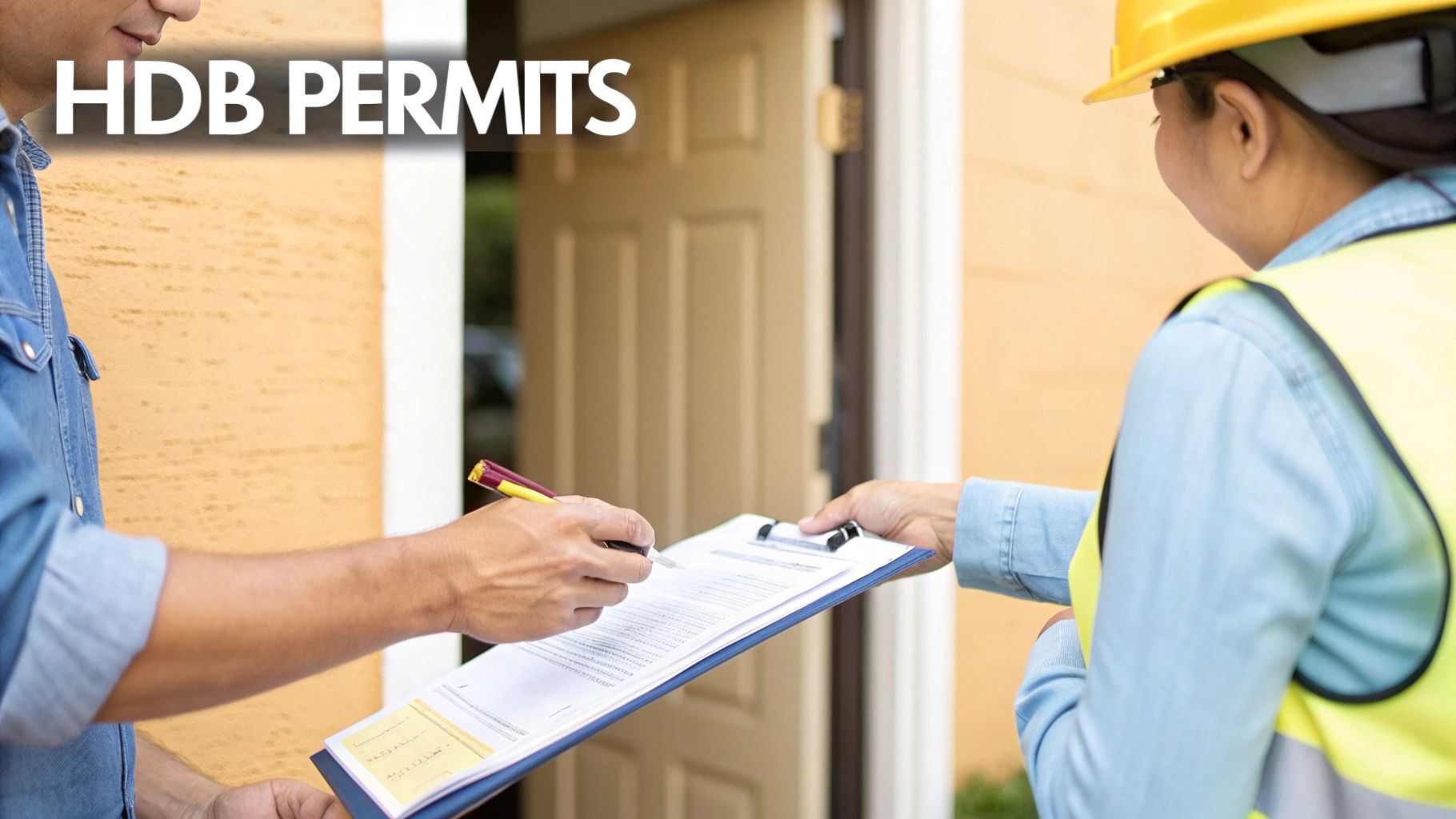
Starting a resale HDB renovation isn't just about picking out tiles and paint colours; it's also about playing by the rules. The Housing & Development Board (HDB) has a clear set of guidelines in place for a few very good reasons: to keep everyone safe, protect the building's structural integrity, and maintain a reasonably uniform look for the entire block.
Think of these guidelines as the non-negotiable foundation of your project. Trying to bypass them can lead to some serious headaches, including an order from HDB to undo all the unauthorised work at your own expense. Understanding the process from the get-go is the secret to a smooth, stress-free reno.
Works Requiring an HDB Permit
Not every little thing you do requires a permit, but the big jobs certainly do—especially anything that could affect the building or your neighbours. Your HDB-registered contractor is the one who will handle the paperwork and submit the applications, but as the homeowner, it's vital you know what needs official approval.
As a rule of thumb, any work that involves demolition or altering the flat's core structure will need a permit. Here are some of the most common permit-required jobs we manage for our clients:
- Hacking Walls: Whether you're removing a wall entirely or just a part of it, you'll need a permit. This is to make absolutely sure it isn't a load-bearing wall supporting the floors above.
- Replacing Flooring: Planning to hack away the old floor tiles to lay down a new finish? That requires a permit.
- Bathroom Alterations: Any work that messes with the waterproofing membrane in your bathrooms or toilets needs a green light from HDB. This is critical to prevent water leakage nightmares for your downstairs neighbour.
- Changing Windows: You can't just install any window you like. Replacing window frames or grilles must follow HDB's approved designs, and yes, that needs a permit.
Understanding Key Restrictions
Beyond just getting permits, HDB has some hard-and-fast rules on what you simply cannot do. These are in place to uphold building standards and safety, and they are not up for negotiation. This is often where homeowners, without realising it, can make some very expensive mistakes.
A client once dreamed of knocking down a wall to create a massive, open-concept living area. It sounded great on paper, but a quick look at the floor plan showed it was a structural wall. Hacking it would have been a disaster for the building's safety and is strictly forbidden.
A common myth is that all internal walls are fair game. Always, always check your flat’s floor plan with an experienced contractor. Structural walls are marked with thick, bold lines and must never be touched.
Here are a few other critical restrictions to keep in mind:
- Main Doors: If your flat came with a fire-rated main door, you cannot remove it or swap it for a non-rated one. It's a crucial fire safety feature.
- Pipes: You are not allowed to conceal gas pipes within walls or cabinets for safety inspection reasons. Any adjustments must be done by a licensed gas worker.
- External Facade: You can't make any changes that alter how the HDB block looks from the outside. This means no painting the exterior of your walls or installing window grilles that haven't been approved.
Knowing these rules before you even finalise your design saves you from the massive headache of having to undo completed work. It ensures your grand plans are both beautiful and compliant, letting your renovation move forward without any nasty surprises.
Charting Out Your Resale Renovation Timeline
Think of your renovation timeline as the master recipe for your new home. Getting the steps right ensures everything—from your contractor to your custom tiles—shows up exactly when needed, saving you from a half-baked disaster. A clear, well-planned schedule is genuinely the secret to a stress-free renovation.
Unlike a brand-new BTO flat, a resale unit isn’t a blank canvas. It’s more like a painting you need to strip back before you can create your own masterpiece. There’s a crucial "subtraction before addition" phase, which involves carefully dismantling the old to make way for the new. That’s a big reason why resale projects almost always take longer than a BTO reno of a similar scope.
The Step-by-Step Flow of a Resale Renovation
Every home is different, but the renovation process follows a pretty logical order. You can't, for instance, lay down your beautiful new vinyl flooring while electricians are still pulling wires through the ceiling—that’s just asking for dust and damage. Understanding this flow helps you see the bigger picture.
Here's a breakdown of the typical stages we follow to keep projects running smoothly:
- Phase 1: Design & Planning (2-4 weeks) This is where the magic begins. We’ll finalise your layout, you’ll pick out materials, and we’ll create detailed 3D mockups so you can see your vision come to life. Behind the scenes, we’re also busy submitting all the necessary HDB permit applications.
- Phase 2: Hacking & Site Prep (1-2 weeks) Time to get our hands dirty. The physical work kicks off with hacking down old walls and floors, tearing out dated built-in wardrobes, and clearing everything out. The goal is to get back to a clean slate.
- Phase 3: Masonry & MEP Works (2-3 weeks) This is the most intensive part of the project. It covers all the "wet works"—building new walls, plastering surfaces, and screeding floors to make them perfectly level. At the same time, our electricians and plumbers are laying down the new wiring and pipes, which are the essential arteries and veins of your home.
- Phase 4: Finishing Works (2-3 weeks) With the heavy lifting done, we start making things look good. This is when the false ceiling goes up, the painters come in, and your floor tiles or vinyl are expertly laid. We’ll also install new doors and windows.
- Phase 5: Carpentry & Fittings (1-2 weeks) The moment many homeowners wait for! Your custom-built kitchen cabinets, wardrobes, and countertops are carefully installed. We also fit in the sanitary ware for the bathrooms, along with all the light fixtures and power outlets.
- Phase 6: Final Touches & Handover (1 week) The home stretch. This last week is all about a deep clean of the entire site, conducting final inspections with you, and touching up any minor defects before we officially hand the keys to your new home back to you.
Realistic Timelines and What Might Cause Delays
It’s crucial to go into this with realistic expectations. Based on our on-the-ground experience, a resale HDB renovation now takes about 8–10 weeks for a 3-room flat. For larger 4-room and 5-room flats, you should probably budget for 10–12 weeks, mainly because the hacking and prep work is much more involved. You can get a deeper dive into how project timelines have changed from these helpful insights on renovation durations.
We always tell our clients to build in a buffer. It's smart to plan for an extra 1-2 weeks to deal with the little surprises that older flats love to throw at you, like discovering hollow floor tiles that need fixing or waiting on a shipment of custom-ordered material.
Even with meticulous planning, some things are just out of our control. Knowing what these potential roadblocks are can help you stay cool and collected.
- Permit Approvals: Standard permits usually sail through in about a week. But if you're requesting something more complex, like removing a non-structural wall, HDB might take a bit longer to give the green light.
- Material Lead Times: If you’ve fallen in love with specific tiles from Italy or a particular slab of natural stone, it can add weeks to the timeline. These items need to be ordered well in advance to avoid holding up the project.
- Surprise Discoveries: You never really know what’s hiding behind old walls. Hacking might uncover old, brittle pipes that are close to bursting or reveal uneven subfloors that need to be rectified before any new flooring can go down.
By understanding how the process unfolds and padding your schedule realistically, you can navigate your resale HDB renovation journey with confidence, knowing you're on track to a beautiful home delivered on time.
Smart Design Ideas for Older HDB Flats
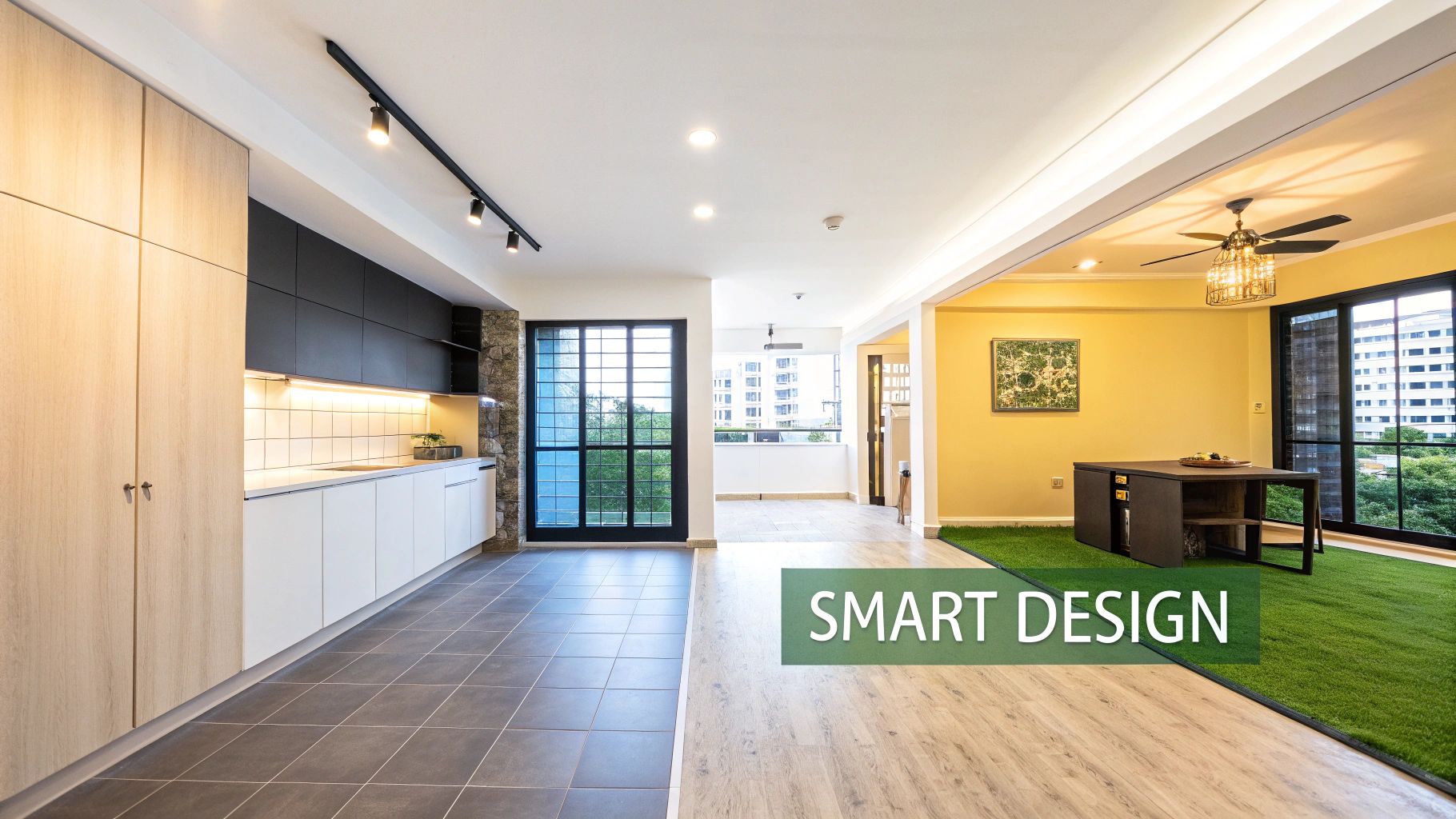
Older HDB flats have a certain charm, don't they? They often come with more generous floor space, but their layouts can feel a bit out of sync with how we live today. The great news is that with some smart spatial planning, you can completely transform these dated configurations. It’s not just about making things look pretty; it's about reshaping the space to fit your life.
Based on our recent projects, clients are increasingly looking for homes that support flexible lifestyles. High-quality finishes and intelligent, multi-functional design are no longer luxuries but expectations. This shift shows why a resale HDB renovation is now seen as a smart investment, blending essential upgrades with thoughtful personalisation.
Reimagining the Layout for Modern Living
One of the most powerful changes you can make in an older flat is to rethink the entire layout. The goal is nearly always the same: move away from small, boxed-in rooms and create brighter, more connected living spaces.
A hugely popular request is to create an open-concept kitchen and living area. By hacking a non-structural wall between the two, we instantly make the common area feel larger, brighter, and way more sociable. It turns the kitchen from a purely functional zone into the heart of the home, perfect for chatting with guests while you're prepping a meal.
Another common strategy is to combine rooms. For instance, we often merge a smaller bedroom with the master bedroom. This carves out enough space for a proper master suite, complete with a dedicated walk-in wardrobe and a more spacious ensuite—a touch of luxury you rarely find in older HDBs.
The Power of Custom Carpentry
Storage is always a battle in a resale HDB renovation. Let’s face it, older flats just weren't designed to hold all the stuff we accumulate. This is where custom carpentry becomes your secret weapon, letting you squeeze function out of every square inch without sacrificing style.
Think of custom carpentry as architectural problem-solving. It's not just about building cabinets; it's about creating intelligent, integrated solutions that make your daily life smoother and more organised.
Here are a few ways we use bespoke carpentry to tackle common storage headaches:
- Full-Height Integrated Cabinets: We love designing floor-to-ceiling wardrobes and display units that blend right into the walls. Not only does this give you a massive amount of storage, but it also creates a clean, uncluttered look by getting rid of those awkward dust-collecting gaps.
- Multi-functional Furniture: A bay window can become a cosy reading nook with hidden drawers underneath. A TV console can flow seamlessly into a work-from-home desk, and a platform bed can hide deep compartments for stashing away luggage or seasonal clothes.
- Solving Awkward Corners: Older flats are notorious for odd nooks and structural beams. Custom carpentry lets us build around these quirks, turning a useless corner into a functional pantry or a stylish bookshelf.
Practical "Before and After" Transformations
Seeing the change for yourself is the best way to understand the impact of good design. In a recent project, we worked on a 30-year-old 4-room flat where the original kitchen was a narrow, dark space completely cut off from the living room.
- Before: The layout felt cramped and isolating. The homeowners felt disconnected from family and guests whenever they were cooking.
- After: We took down the wall between the kitchen and living room and designed a sleek peninsula counter. This one move flooded the space with natural light and created a casual spot for breakfast. The flat instantly felt 20% larger, transforming how the family used their home.
For other innovative touches, you can explore how different Mirrors and Specialty Glass Styles can make a space feel bigger and brighter. By focusing on smart layout changes and clever storage, your resale HDB renovation can unlock the hidden potential of an older flat, creating a modern, functional home that’s perfectly tailored to you.
Choosing the Right Renovation Partner
Let’s be honest. The single most important decision you’ll make for your resale HDB renovation isn’t about the tiles or the paint colour. It’s about who you trust to bring your home to life. This choice will make or break your entire experience, influencing everything from the budget to the final craftsmanship. Get this right, and you're building your project on solid ground.
First, you need to know the players. In Singapore's renovation scene, you're generally looking at two main options: an interior designer (ID) or a contractor.
- Interior Designer: Think of an ID firm as your project's creative director and manager all in one. They handle everything from the initial design concept and 3D mock-ups to selecting materials and managing all the different workers. It’s the perfect route if you want a cohesive design vision and a single, trusted expert to navigate all the complexities for you.
- Contractor: A contractor is the executor. They are the skilled hands that build what you’ve designed. This path is ideal if you already have a crystal-clear, detailed plan and feel confident managing the various tradespeople—like electricians, plumbers, and carpenters—yourself. You provide the instructions; they get it done.
So, Who’s Right for You?
The choice between an ID and a contractor really boils down to your own needs and how much you want to be involved in the nitty-gritty of the renovation.
If you’re after creative ideas, advice on making the most of your space, and someone to take the daily stress of project management off your shoulders, then an ID is your best bet. Especially with resale HDBs, where you can uncover unexpected quirks, having an experienced ID who can troubleshoot on the spot is an absolute lifesaver.
On the flip side, if you have a strong eye for design, enjoy the challenge of project management, and just need a reliable team to build your vision, hiring a contractor directly can be more budget-friendly. Just be prepared—this route demands a serious commitment of your own time and energy.
The Must-Ask Questions for Any Potential Partner
Before you sign any dotted lines, you need to do your homework. When it comes to resale flats, experience is everything. Here are the crucial questions to ask:
- Can you show me your resale HDB portfolio? "I'd love to see some recent resale projects similar in age and size to my flat. What were the biggest surprises you ran into, and how did you handle them?"
- How do you manage your projects? "What's your communication style like during the reno? Will I have one main person to talk to, and how often will you provide updates or arrange for me to see the site?"
- Can we talk about the contract and payment? "Could I review a sample contract? I need to understand your payment milestones and exactly what’s included in the quote to avoid any hidden costs down the road."
- What happens after you hand over the keys? "What kind of warranty do you offer on the workmanship and materials? And what's the process if I find any defects that need fixing?"
Your contract is your safety net—don't start without a detailed one. It should spell out the full scope of work, list specific materials and brands, include a project timeline with key dates, and have a clear payment schedule. Never, ever move forward with someone who works on a verbal agreement alone.
Ultimately, a successful renovation is built on a strong partnership. When you have clear communication and trust, you know you’ve got a reliable expert on your side, ready to tackle any challenge that a resale HDB renovation throws your way.
Your Resale HDB Renovation Questions Answered
To wrap things up, let's tackle some of the most common questions we hear from homeowners just starting their resale HDB renovation journey. These are the real-world, no-fluff answers you need, straight from our years of experience on the ground.
How Much Cash Do I Need Upfront?
This is probably the biggest question on everyone's mind, and for good reason. While you can get a renovation loan, it won't cover everything from day one. You'll definitely need cash for the initial down payment to your interior designer or contractor, which is typically 10% to 20% of the total contract value.
Also, keep in mind that renovation loans have a ceiling. If your dream reno ends up costing more than the maximum loan amount you're approved for, that difference has to come out of your pocket. It’s always a smart move to have a healthy cash buffer ready to go before you sign on the dotted line.
Can I Use My CPF for Renovations?
We get this one a lot, but unfortunately, it's a common misconception. You cannot use your CPF Ordinary Account (OA) savings to pay for your renovation.
CPF funds are strictly ring-fenced for the property purchase itself, plus any legal fees and stamp duties that come with it. All your renovation costs will need to be covered by cash, a personal loan, or a dedicated renovation loan from a bank.
What Are the Most Common Hidden Costs?
Ah, the infamous hidden costs. Resale flats are notorious for throwing a few curveballs once the hacking starts. Based on what we see project after project, here are the usual suspects that can sneak up on your budget:
- Hollow Floor Tiles: You tap on the old tiles and they sound fine, but once work begins, we often find hollow spots. To prevent cracks down the line, these have to be hacked and the floor re-screeded, which adds to your masonry bill.
- Deteriorated Plumbing: It’s incredibly common to uncover old, corroded pipes that are just waiting to spring a leak. Replacing them isn't optional—it's essential to prevent a major water damage headache later on.
- Uneven Subfloors: After hacking away the old flooring, the original concrete subfloor is often far from level. This means more screeding work is needed to create a perfectly flat base for your new tiles or vinyl.
- Pest Infestations: Old, built-in wardrobes can sometimes hide unwelcome guests like termites. If we find any signs, you'll need professional pest control to sort it out before any new carpentry can be installed.
A contingency fund isn't just a nice-to-have; it's a must-have for any resale HDB project. We always tell our clients to set aside at least 10-15% of their renovation budget to handle these kinds of surprises without the stress.
What Kind of Warranty Should I Expect?
Any reputable interior design firm will stand by their workmanship. The industry standard is a warranty of at least 12 months that covers any defects from the installation process. So, if a cabinet hinge works its way loose or you notice tile grout cracking, the firm should come back and fix it free of charge.
Just be aware that this warranty typically doesn't cover general wear and tear, or defects in the materials themselves (which would be covered by the supplier's warranty). Always ask for the warranty terms upfront and make sure you get it in writing.
Ready to turn your resale flat into the home you've always envisioned, without the guesswork? We specialise in mastering the unique challenges of HDB renovations. Let's build your vision together.