The first step into your home sets the tone. Too often, it’s a chaotic pile of footwear that greets you, creating clutter and immediate stress. For many homes in Singapore, where every square centimetre is precious, a well-designed shoe storage solution isn't a luxury; it's a fundamental necessity. The search for effective shoe unit designs is ultimately a search for order, style, and a seamless transition from the outside world to your personal sanctuary. This is about more than just hiding shoes; it's about creating a functional and welcoming entryway that enhances your daily routine.
Based on our experience designing for Singaporean homes, clients are looking for solutions that are both space-efficient and aesthetically pleasing. This guide moves beyond generic racks to explore seven practical design concepts we frequently implement. We'll cover the specifics of built-in cabinetry, versatile freestanding units, and multi-functional combinations. For each concept, we provide actionable insights on dimensions, material recommendations, and real-world applications to help you plan a storage solution that works for your HDB flat, condominium, or landed property.
1. The Integrated Entryway Hub: Maximising Your "Drop Zone"
Instead of a standalone cabinet, one of the most practical shoe unit designs is the integrated entryway hub. This is a custom carpentry solution that combines multiple functions into a single, seamless feature, transforming your foyer into an organised "drop zone."
For many of our clients, especially those in newer BTOs where space is tight, maximising the entryway is a top priority. A multi-functional hub achieves this by merging shoe storage with other daily needs, creating a cohesive and clutter-free first impression.
Key Components for a Practical Hub
An integrated hub is tailored to your lifestyle, but typically includes:
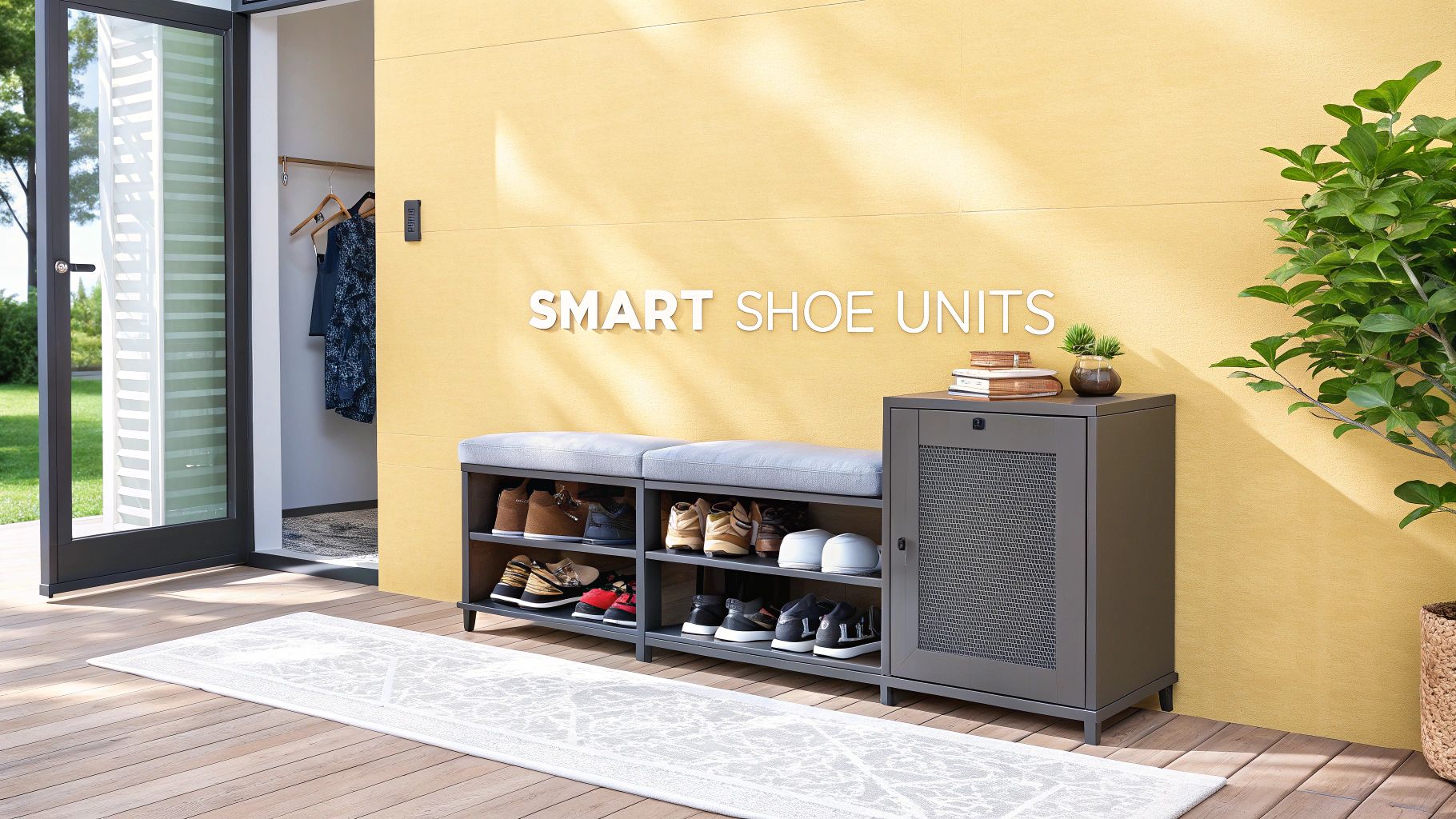
- Concealed Shoe Storage: This is the foundation. We often recommend tilted shelves or slim pull-out drawers. A standard shelf depth of 350mm is usually sufficient for most shoe sizes. For ventilation, we incorporate slatted doors or a subtle 20mm ventilation gap at the top and bottom of the cabinet.
- Seating Bench: A built-in bench provides a practical spot to put on or take off shoes. The space beneath can be used for open storage of daily-use footwear or for housing storage baskets. A comfortable seating height is typically between 450mm and 500mm.
- Key and Mail Niche: A small, recessed alcove or a dedicated "catch-all" drawer prevents countertop clutter.
- Display Shelving: Open shelves offer a place to personalise the space with decor, a small plant, or a scented diffuser.
- Full-Height Cabinetry: For homes needing more storage, the hub can extend upwards to provide space for umbrellas, reusable bags, or other out-the-door essentials.
Why This Approach Works
The primary benefit of an integrated hub is its ability to maximise function within a minimal footprint. By building these features into a single unit, it feels like an intentional part of your home’s design rather than a collection of separate furniture.
For a recent project in a Punggol BTO, we designed a slim, full-height hub with a soft-closing seating bench and concealed vertical shoe racks. This not only provided ample storage but also created a stunning feature wall. By using the same laminate finish as the adjacent living room console, we ensured a harmonious visual flow.
2. The Floating Console: A Sleek, Space-Saving Solution
In modern interior design, creating a sense of spaciousness is crucial. The floating or wall-mounted console is one of the most popular shoe unit designs that achieves this, offering a clean, minimalist aesthetic while providing essential storage. By lifting the cabinet off the floor, it creates an uninterrupted sightline that makes any entryway appear larger.
This approach is highly favoured in our projects for condominiums, where every square centimetre counts. The floating design not only looks chic but also makes cleaning the floor underneath effortless—a practical benefit homeowners appreciate.
Key Components of a Floating Console
A well-executed floating console balances form and function. Here’s what we typically include:
- Secure Wall-Mounting: The core of the design is its secure mounting to a structural wall. This requires professional installation with heavy-duty brackets to ensure it can handle the weight of shoes and daily use.
- Slim Profile: To maintain a light feel, floating units often have a shallower depth, typically around 300-350mm. This is ideal for narrow corridors where a bulky unit would obstruct movement.
- Drop-Front or Tilted Drawers: These are space-saving mechanisms. Instead of conventional swing-out doors that require clearance, drop-fronts allow shoes to be stored vertically or at an angle, maximising capacity within a slim profile.
- Ventilated Doors: We often recommend incorporating slatted fronts, fluted details, or perforated panels. This ensures adequate air circulation, which is crucial for preventing mould and odours in Singapore's humid climate.
- Flat Top Surface: The top of the console serves as a functional "landing strip" for keys, mail, or decorative items, adding to its utility.
Why This Approach Works
The primary advantage of a floating console is its ability to combine practical storage with a strong visual statement. It feels less like furniture and more like an architectural element.
For a recent project in an Orchard Road condominium, we designed a long, low-profile floating console that spanned the entryway. Finished in a dark wood laminate to contrast with the light-coloured walls, it featured minimalist slatted doors and subtle under-cabinet LED lighting. This not only provided ample shoe storage but also acted as an elegant ambient light source, making the narrow foyer feel wider and more luxurious.
3. The Concealed Setback: Hiding Storage in Plain Sight
For homeowners who prefer an ultra-minimalist aesthetic, one of the most effective shoe unit designs is the concealed setback. This approach involves building the shoe storage directly into a wall, flush with the surface, making it virtually disappear. It’s the ultimate solution for creating a seamless, clutter-free entryway.
This design is particularly effective in homes where a partition wall can be constructed or an existing niche can be utilized. By integrating the storage into the architecture itself, it eliminates the visual bulk of a traditional cabinet, preserving the clean lines of the space.
Key Components of a Concealed Setback
A concealed unit is a feat of precision carpentry and planning:
- Flush-Mounted Doors: The doors of the cabinet are designed to sit perfectly flush with the surrounding wall. This is often achieved using handleless, push-to-open mechanisms for a completely seamless look.
- Integrated Paneling: The door fronts are typically finished to match the wall, whether painted the same colour or clad in the same material (like fluted panels or laminate), to enhance the camouflage effect.
- Shallow-Depth Shelving: To fit within a standard wall structure, the internal shelving is often shallow. Angled shelves or slim vertical dividers are used to maximize shoe capacity within the limited depth.
- Full-Height Integration: The most impactful concealed units run from floor to ceiling, appearing as a simple feature wall rather than a functional cabinet.
Why This Approach Works
The main advantage of a concealed setback is its ability to provide substantial storage with zero visual intrusion. It maintains a clean, architectural look that is impossible to achieve with even the most minimalist of standalone furniture.
In a recent project for a landed property at Sentosa Cove, we designed a full-height concealed shoe cabinet disguised as a fluted feature wall next to the main entrance. The push-to-open doors revealed storage for over 50 pairs of shoes, complete with integrated ventilation. When closed, the unit was indistinguishable from the decorative wall paneling, delivering a high-impact "wow" factor while keeping the foyer sleek and uncluttered.
4. The Pull-Out Vertical Tower: High-Density Storage Redefined
For homeowners with extensive shoe collections or those working with narrow, awkward spaces, the pull-out vertical tower is a game-changing solution among modern shoe unit designs. This innovative approach adapts the concept of a pantry pull-out to create an incredibly space-efficient and organised shoe storage unit. It is essentially a tall, slender cabinet that slides out on runners to reveal multiple tiers of shelving.
This design is particularly effective in tight entryways or alongside full-height cabinetry where a conventional hinged door would be impractical. By sliding forward, the entire collection becomes visible and accessible without requiring a large swing space.
Key Components of a Vertical Tower
A pull-out tower relies on quality hardware for a seamless user experience.
- Heavy-Duty Runner System: This is the heart of the unit. The tower must glide smoothly and support the weight of dozens of pairs of shoes. For smooth and quiet operation, we use high-quality hardware like the Hettich Quadro V6 soft-close drawer runners.
- Adjustable Angled Shelves: The shelves are typically angled downwards to secure the shoes and provide a clear view. Making them adjustable allows for customisation to accommodate different footwear, from flat sandals to high-top sneakers.
- Integrated Handle or Push-to-Open Mechanism: The tower needs a clean exterior. This can be achieved with a discreet recessed handle or a handleless push-to-open system for a completely seamless look.
- Ventilation Considerations: As with any enclosed shoe storage, ventilation is key. We often incorporate subtle perforated back panels or gaps between shelves to promote air circulation.
Why This Approach Works
The pull-out tower's greatest advantage is its unmatched storage density. It leverages vertical space, allowing you to store a large number of shoes within an extremely small footprint. It transforms a narrow 300mm-400mm wide gap into a powerhouse of organisation.
In a recent project for a condominium at The Sail @ Marina Bay, we faced the challenge of creating significant shoe storage without a dedicated entryway. We designed a pair of slim, full-height pull-out towers flanking the main door, finished in a dark wood laminate to match the feature wall. Each tower provided eight tiers of storage, accommodating over 30 pairs of shoes while appearing as simple, elegant panels when closed.
5. The Rotating Shoe Carousel: 360-Degree Access
For the true shoe enthusiast with a large collection, the rotating shoe carousel or "lazy Susan" style unit is one of the most dynamic and high-capacity shoe unit designs. Typically housed within a full-height cabinet or a walk-in wardrobe, this system features multiple circular tiers that spin 360 degrees, allowing you to browse your entire collection with a simple turn.
This solution is perfect for maximising corner spaces that are often difficult to utilise effectively with standard shelving. Instead of losing items in a deep, dark corner, the carousel brings every pair of shoes to the forefront, ensuring nothing gets forgotten.
Key Components of a Rotating Carousel
This is a mechanically complex unit that requires precise engineering:
- Robust Rotating Mechanism: The central pillar and bearing system must be heavy-duty to support the weight of the shelves and shoes while providing a smooth, stable rotation.
- Adjustable Tiers: The height of each circular shelf should be adjustable to accommodate everything from ankle boots to flats, maximising the vertical storage space.
- Tiered Shelving: Each level is often divided into individual compartments to keep pairs organised and prevent them from shifting during rotation.
- Full-Height Enclosure: The carousel is housed within a custom cabinet, which can have a standard hinged door or be left open in a walk-in wardrobe for a boutique-like display.
Why This Approach Works
The primary benefit of a rotating carousel is its combination of high-density storage and complete accessibility. It can store a significantly larger number of shoes in the same footprint compared to traditional shelving, and the rotating design means no more digging around in the back of a deep cabinet.
For a client in a landed home with a spacious walk-in wardrobe, we designed a custom floor-to-ceiling rotating shoe carousel that could hold over 100 pairs of shoes. Housed in a cabinet with glass doors, it created a stunning, boutique-like display. The ease of access completely transformed how the client organised and selected their footwear, turning a storage problem into a highlight of their personal space.
6. Ventilated and Climate-Controlled Cabinetry
Advanced shoe unit designs now incorporate technology to preserve valuable footwear. Ventilated and climate-controlled cabinetry actively manages the internal environment to combat humidity, prevent odours, and extend the lifespan of materials like leather and suede.
For our clients in Singapore, where high humidity is a constant concern, this approach is particularly valuable. A standard enclosed cabinet can trap moisture, leading to mould and material degradation. A purpose-built, climate-controlled solution transforms a shoe cabinet into a preservation chamber.
Key Components of a Climate-Controlled Unit
These specialised units are engineered with specific features to maintain an optimal storage environment:
- Integrated Ventilation Fans: Small, quiet fans are built into the cabinet's structure to create consistent air circulation, preventing stagnant air and keeping the interior fresh and dry.
- Dehumidifying Systems: For ultimate protection, compact electronic dehumidifiers can be integrated. These systems actively pull moisture from the air, maintaining a consistent humidity level ideal for preserving leather goods.
- Perforated or Slatted Shelving: Instead of solid shelves, materials like perforated metal or slatted wood are used. This allows air to flow freely around each shoe.
- Cedar Lining: Natural materials like cedar are known for their moisture-absorbing and deodorising properties and can be incorporated into the cabinet's interior.
- Low-Heat LED Lighting: LED strip lighting can showcase the collection and can be connected to door sensors, adding a touch of functional luxury.
Why This Approach Works
The primary advantage is active footwear preservation. You are creating an environment that actively works to maintain the condition of your shoes. This is essential for anyone with an investment in luxury, bespoke, or collectible footwear.
In a recent project for a client with an extensive collection of designer heels, we designed a full-height, glass-fronted shoe wardrobe. The unit featured custom-angled shelves, integrated dehumidifiers for each section, and discreet ventilation channels. The result was a stunning display that also functions as a professional-grade storage solution, ensuring our client’s collection remains in pristine condition.
7. The Modular and Adaptable System: Storage That Grows With You
For homeowners whose needs may change over time—such as a growing family or a budding shoe collection—a modular system is one of the most flexible shoe unit designs. This approach uses a series of interconnected, stackable, or reconfigurable components to create a storage solution that can be easily expanded, reduced, or rearranged.
Instead of a single, fixed piece of custom carpentry, a modular system offers the freedom to adapt. It can start as a simple low bench and later have vertical units added on top, or it can be reconfigured to fit a new home if you move.
Key Components of a Modular System
A successful modular design relies on a cohesive and versatile set of building blocks:
- Standardised Units: The system is built from a core set of components—such as cubes, benches, and vertical cabinets—with standardised dimensions that allow them to fit together seamlessly.
- Interlocking Mechanisms: Secure but non-permanent connectors are used to link the units, ensuring the overall structure is stable while still allowing for future reconfiguration.
- Variety of Modules: A good system includes different types of units: open cubbies for grab-and-go shoes, drawers for accessories, and cabinets with doors for a cleaner look.
- Consistent Aesthetics: All modules are designed with a consistent finish and style, so the system looks cohesive and intentional, no matter how it's configured.
Why This Approach Works
The key benefit of a modular system is its long-term flexibility and cost-effectiveness. You can invest in a core setup now and expand it later as your budget allows or your needs change, without having to replace the entire unit. It’s a sustainable approach to furniture design.
We recently designed a modular entryway system for a young couple in a new BTO. They started with a two-meter-long bench with open cubbies underneath. Two years later, as their family grew, we added two matching vertical cabinets on either end of the bench to store their children's shoes and school bags. Because the system was designed to be modular from the start, the additions integrated perfectly, providing a custom look without the cost of a complete overhaul.
Crafting Your Perfect Entryway with KIVO
The right shoe unit design is far more than just a place to store your shoes. It is a cornerstone of an organised, welcoming, and efficient home. As we've explored, the options available today blend aesthetic desires with the practical demands of daily life in Singapore. From sleek floating cabinets in a compact HDB to multi-functional built-in systems, your shoe unit is a powerful statement piece.
Key Takeaways for Your Ideal Shoe Unit Design
Recapping the core principles, the most successful shoe unit designs are born from a deep understanding of your personal needs.
- Functionality First: Prioritise a layout that accommodates the types of shoes you own, from tall boots to everyday flats, and consider how many pairs you need to store.
- Ventilation is Non-Negotiable: In our humid climate, airflow is critical to prevent mould and unpleasant odours. Opt for slatted doors, ventilated back panels, or other designs that ensure your footwear can breathe.
- Material Matters: Your choice of material dictates both the look and longevity of your unit. High-quality moisture-resistant plywood with laminate finishes offers a robust and customisable solution that stands up to the rigours of a busy household.
- Customisation is Key: A bespoke, custom-built unit allows you to control every detail, from precise dimensions that fit an awkward nook to integrated features like key hooks or charging stations.
Translating Vision into Reality
The planning phase is where your dream entryway takes shape. The detailed measurements, material selections, and hardware choices all come together to form the blueprint for your project. To ensure the concept aligns perfectly with a client's home aesthetic, we leverage advanced techniques. Methods such as 3D product rendering produce photorealistic visuals that allow homeowners to see and approve their custom unit before a single piece of wood is cut. This process removes guesswork and ensures the final installation is a perfect match for the intended space and style.
Ultimately, a well-designed shoe unit reduces clutter, streamlines your daily routines, and sets a tone of order and elegance from the moment you walk through the door. It’s an investment not just in carpentry, but in a more organised daily life.
Ready to transform your cluttered entryway into a functional and stylish focal point? The team at KIVO specialises in creating bespoke shoe unit designs that perfectly match your home's aesthetic and your family's needs. Explore our custom solutions and let us help you build the organised, welcoming entryway you've always wanted.