Choosing the right materials for your Singapore kitchen cabinet is the most critical decision you'll make for your kitchen's longevity. It's not just about aesthetics; it's about building a functional space that withstands our relentless humidity. A cabinet made with the wrong core material will warp, swell, or delaminate, leading to a costly and frustrating replacement. This is why the first question we always address is: what's it made of on the inside?
Why Cabinet Materials Matter in Singapore's Climate
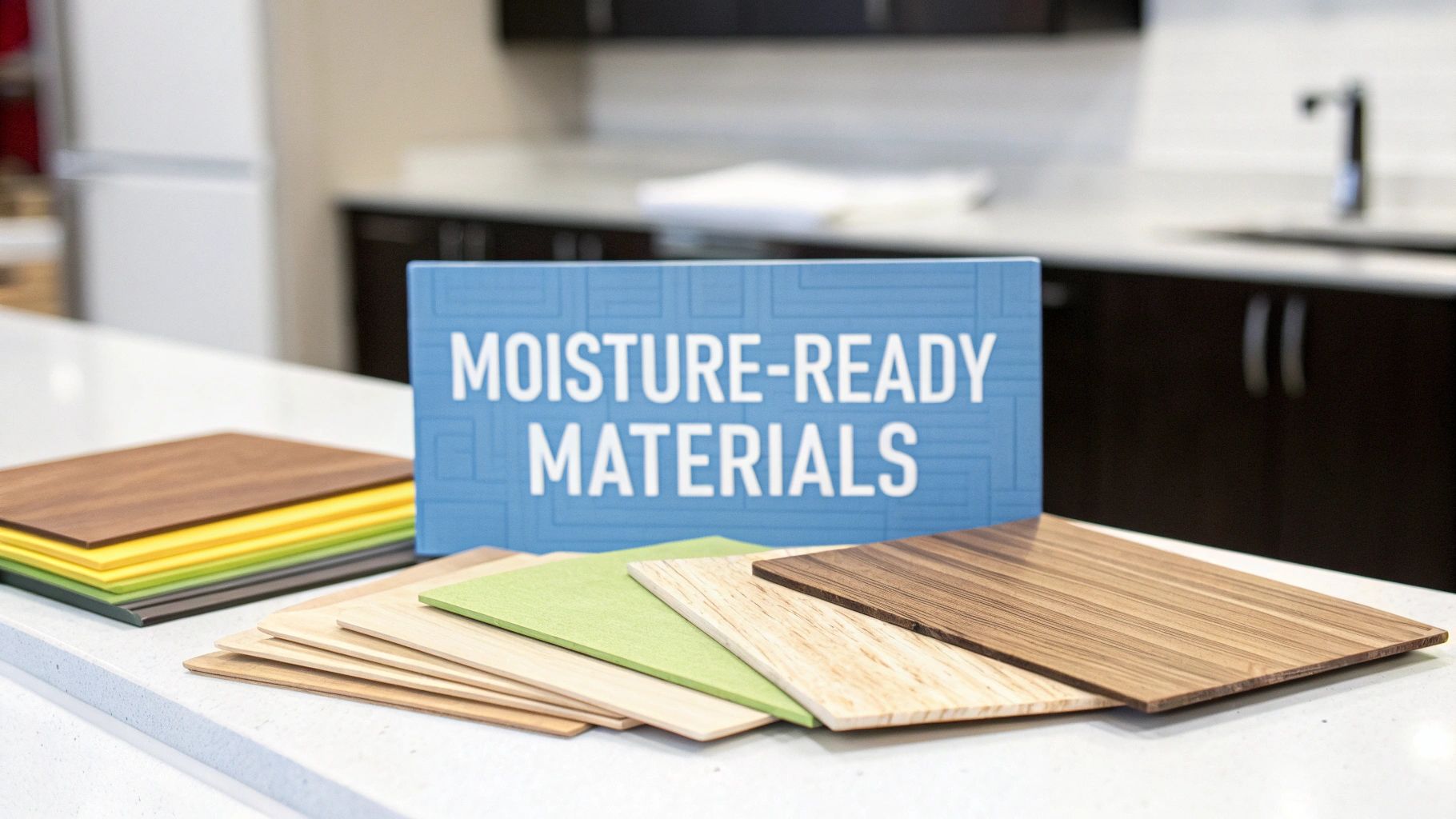
The true strength of a kitchen cabinet lies in its core material, what we call the "carcass." Here in Singapore, where humidity levels consistently hover above 80%, a moisture-resistant core isn’t just a recommendation—it's a necessity. This is especially crucial for cabinets near the sink and stove, where steam and water are part of the daily routine.
After completing countless BTO and condo projects, a common pattern emerges: homeowners select materials based on the lowest price and face problems later. For example, a client once opted for standard particleboard cabinets to save a few hundred dollars. Within two years, the cabinet base under their sink had swelled and disintegrated from a minor, unnoticed leak. Investing in a moisture-resistant core from the start is the single most important financial decision for your kitchen.
The Best Core Materials for Local Conditions
When it comes to the internal structure—the bones—of your kitchen cabinets, a few materials are proven to handle our local climate.
High-Grade Plywood: This is our top recommendation and the industry standard for quality custom carpentry in Singapore. It's constructed by layering thin wood veneers with alternating grain directions, creating a board that is incredibly strong and resistant to warping and moisture. It also provides excellent screw-holding strength, meaning your hinges won't sag over time.
Solid Wood: While materials like teak or nyatoh offer timeless beauty, they can be temperamental in our humidity, prone to expanding and contracting. Solid wood requires more maintenance and is a premium choice, typically reserved for feature cabinet doors rather than the entire carcass.
Medium-Density Fibreboard (MDF): MDF provides a perfectly smooth surface, ideal for spray-painted finishes. However, standard MDF is highly susceptible to water damage. If you choose this material, you must insist on a moisture-resistant (MR) grade and ensure it's sealed on all edges to prevent water absorption.
The smartest investment you can make in your kitchen isn't the fanciest countertop or the trendiest handles. It's the unseen plywood carcass that quietly fights off moisture day after day, providing the solid foundation for everything else.
Finishes That Protect and Personalise
With the core material chosen, the exterior finish provides the final layer of protection and defines your kitchen's style. This is the surface you see and interact with daily, so it needs to be both durable and visually appealing.
The most practical and popular choice is laminate, specifically High-Pressure Laminate (HPL). Modern laminates are a world away from the plastics of the past, now available in thousands of designs, from realistic wood grains and stone textures to sleek matte colours. They are highly durable, scratch-resistant, and easy to clean—a perfect combination for a busy kitchen.
Based on recent client requests, two-tone kitchens (e.g., dark blue base cabinets with light wood-grain uppers) and fluted panel details are gaining popularity. These looks are easily achieved with laminates, offering a trendy aesthetic without compromising on practicality. If you're considering an all-white kitchen, there are great tips for highlighting white cabinets to make the design stand out.
Pairing Cabinets with the Right Countertop
Your cabinets must be structurally sound enough to support the weight of your chosen countertop. This partnership is crucial for a functional and lasting workspace.
- Quartz: A favourite among Singaporean homeowners for its non-porous, stain-resistant, and highly durable properties. It complements any cabinet style with a clean, modern look.
- Sintered Stone: For serious home cooks, this material offers superior heat and scratch resistance. Its slim profile pairs exceptionally well with contemporary and minimalist cabinet designs.
Ultimately, building a kitchen that lasts starts with smart material choices. By prioritising moisture resistance and durability from the core outwards, you create a kitchen that will function perfectly and look great for years to come.
Understanding the True Cost of Kitchen Cabinets
Budgeting for a new kitchen can be confusing. When you receive a quote for a Singapore kitchen cabinet, the numbers can seem abstract. Let's break down the factors that determine the final cost so you can plan effectively.
The standard pricing model in Singapore is the per-foot-run (PFR) method. This isn't an arbitrary figure; it's a calculation based on the length of your cabinetry. For a 10-foot wall of bottom cabinets, the cost is 10 feet multiplied by the PFR rate.
However, the PFR rate is just the baseline. The material you choose for the cabinet carcass and doors is the single biggest factor influencing that rate.
How Materials Dictate Your Budget
The core material of your cabinets is the primary cost driver. A cabinet built from standard particleboard will have a lower PFR rate than one made from high-grade plywood, but the long-term value is vastly different.
From our experience, investing in a plywood core is the most prudent choice for homeowners who want their kitchen to last. For instance, a typical 4-room BTO kitchen might require around 20 feet of cabinetry. Choosing plywood over a cheaper alternative might increase the initial cost by S$800-S$1,200, but it prevents the far greater expense of replacing water-damaged cabinets a few years later.
To help you budget, here is a breakdown of how different materials affect the per-foot-run cost.
Estimated Cost of Kitchen Cabinet Materials in Singapore (Per Foot Run)
This table provides a comparative look at typical PFR costs for common kitchen cabinet materials, helping homeowners understand the trade-offs between cost, aesthetics, and durability.
| Cabinet Material | Estimated Cost (PFR) | Best For | Durability Notes |
| :--- | :--- | :--- |
| Plywood with Laminate Finish | S$110 - S$160 | The go-to for most HDB and condo kitchens, offering the best balance of durability and design options. | Excellent moisture resistance and structural strength. Laminates are a breeze to clean and incredibly tough. |
| Plywood with Veneer Finish | S$150 - S$200+ | Homeowners who love the authentic look and feel of real wood without the solid wood price tag. | Needs proper sealing to protect against moisture. Delivers a premium, natural look. |
| Solid Wood (e.g., Nyatoh) | S$180 - S$300+ | Creating a timeless, classic kitchen. Often used for feature doors rather than the whole kitchen. | Can expand and contract in high humidity, so it requires consistent maintenance to look its best. |
| MDF with Paint Finish | S$130 - S$180 | Achieving that seamless, smooth look with custom colours, perfect for modern and minimalist styles. | Make sure it's moisture-resistant (MR) grade MDF. The painted surface can be prone to chipping over time. |
These figures provide a solid budgeting foundation, but other customisations will also affect the final cost.
Beyond the Base Price: What Else Adds to the Cost?
Once you've chosen a material, several other elements will influence the final price. These are where you can tailor your kitchen's functionality—and where costs can add up.
Internal Mechanisms: A cabinet with simple shelves is the most economical. Adding drawers increases the cost due to runners and additional labour. Specialised pull-out systems, like corner LeMans units or pantry pull-outs, are more expensive but can be transformative for storage efficiency. A practical example: a standard drawer might add S$80-S$120 per unit, while a corner system could add S$400-S$600.
Hardware Selection: Hinges and handles are crucial. Basic hinges are inexpensive, but upgrading to soft-closing hinges from brands like Blum or Hafele adds a touch of quality and prevents doors from slamming. This upgrade typically adds S$15 to S$30 per door but is a worthwhile investment in user experience.
Design Complexity: A simple, straight-run kitchen is the most cost-effective. Adding curves, unique angles, or detailed door profiles like shaker-style or fluted panels requires more intricate carpentry, increasing labour time and the overall price.
A smart budgeting strategy is to spend where it matters most: on a durable plywood carcass and reliable soft-closing hardware. You can achieve a high-end look with a mid-range laminate and opt for fewer, more efficient drawers instead of installing them in every cabinet.
Understanding these components demystifies the quotation process, empowering you to have a clear discussion with your designer and make informed decisions.
The Custom Carpentry Journey from Design to Installation
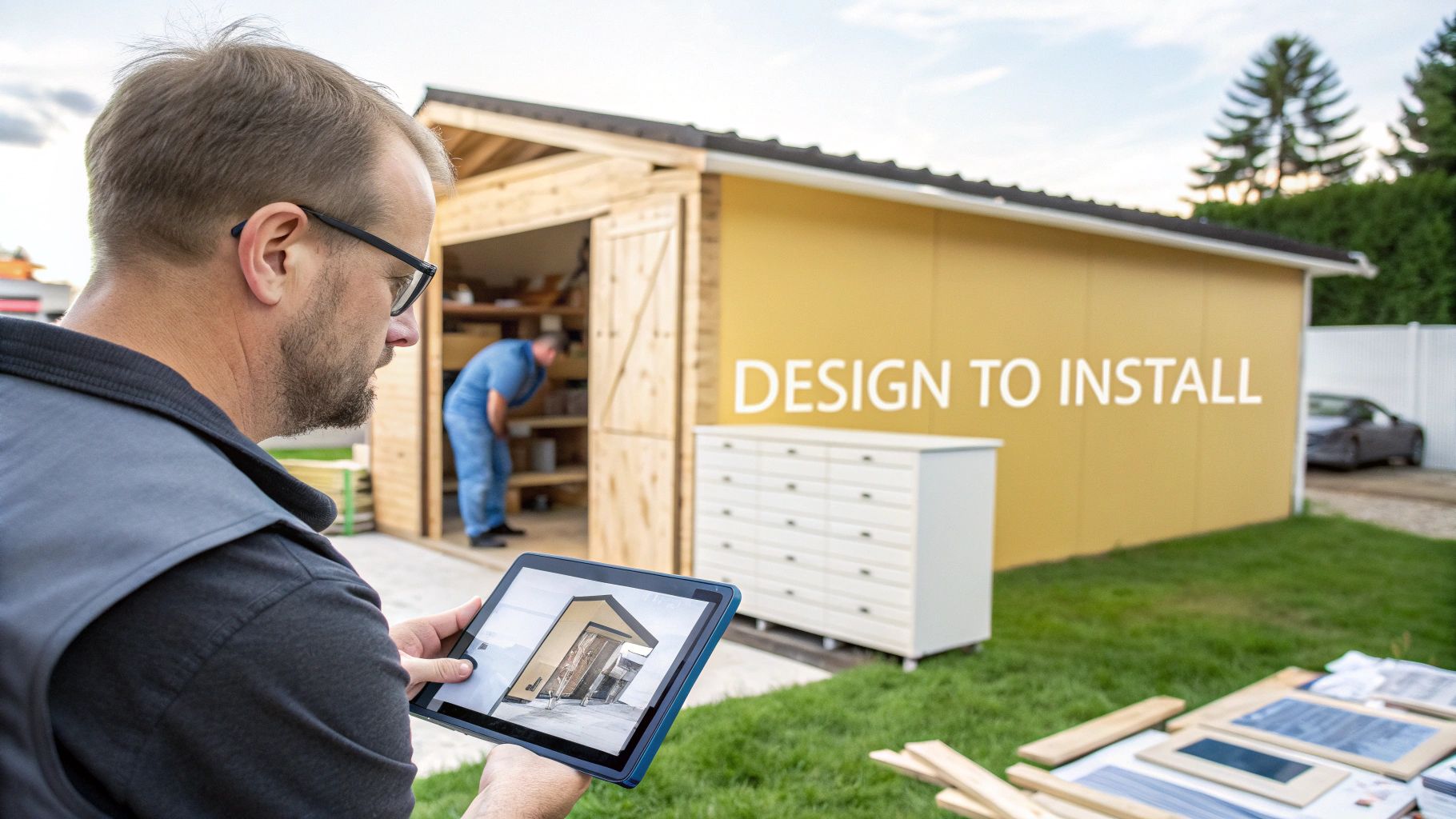
Opting for custom carpentry means creating a kitchen that is a true extension of your lifestyle. The process transforms an idea into a functional space built precisely for you. Knowing the stages helps you plan with confidence.
It's a collaborative process. Our first conversation focuses on how you actually use your kitchen. Do you need a dedicated "baking station"? Is a hidden coffee nook a priority? These details form the foundation of the design.
This approach ensures every element, from countertop height to the placement of a spice drawer, is tailored to your needs. We then bring these concepts to life with detailed 3D mockups, allowing you to visualise your new kitchen before any materials are cut.
Stage 1: The Design and Planning Phase
This is where your vision takes shape. We go beyond simple layouts to design a kitchen that works for you.
- Initial Consultation (1-2 Meetings): We discuss your needs, style preferences, and current kitchen pain points. We analyse your floor plan to brainstorm layouts that optimize workflow and function.
- 3D Visualisation and Material Selection (1 Week): Our designers create realistic 3D renders. This crucial step lets you see how different laminate colours, countertop textures, and hardware will look in your space, eliminating guesswork.
- Site Measurement and Finalisation (1-2 Days): Once the design is approved, we conduct a precise on-site measurement. In custom carpentry, every millimetre is critical to ensure a perfect, seamless fit for your Singapore kitchen cabinet installation.
The most successful kitchen renovations are born from a meticulous planning phase. Taking the time to refine the 3D design and confirm every material choice ensures the final result doesn't just meet your expectations—it exceeds them.
Stage 2: Fabrication at Our Workshop
With the blueprints approved, the project moves to our local workshop. Here, skilled carpenters transform detailed drawings into the high-quality components of your new kitchen.
Using precision machinery, we cut the high-grade plywood for the cabinet carcasses and doors. Each piece is then laminated and edge-banded to seal it from moisture—a non-negotiable step in Singapore's climate. By building everything off-site, we minimise dust and disruption in your home, leading to a cleaner, more efficient installation.
Stage 3: On-Site Installation and Completion
This is the final and most exciting stage, where the crafted pieces come together in your home. Our installation team assembles your new kitchen with precision and care.
The process involves assembling the cabinet carcasses, mounting them securely, and then installing doors, drawers, and hardware. Finally, the countertop is fitted, and any associated plumbing or electrical work is completed. We conduct a final quality check to ensure every hinge is aligned and every drawer glides smoothly, leaving you with a flawless new kitchen.
Typical Project Timeline:
- Design & Planning: 1–2 Weeks
- Fabrication: 3–4 Weeks
- Installation: 3–5 Days
This structured timeline ensures a predictable and smooth process, turning your dream kitchen into a reality with minimal stress.
Meeting HDB Renovation Guidelines for Your Kitchen
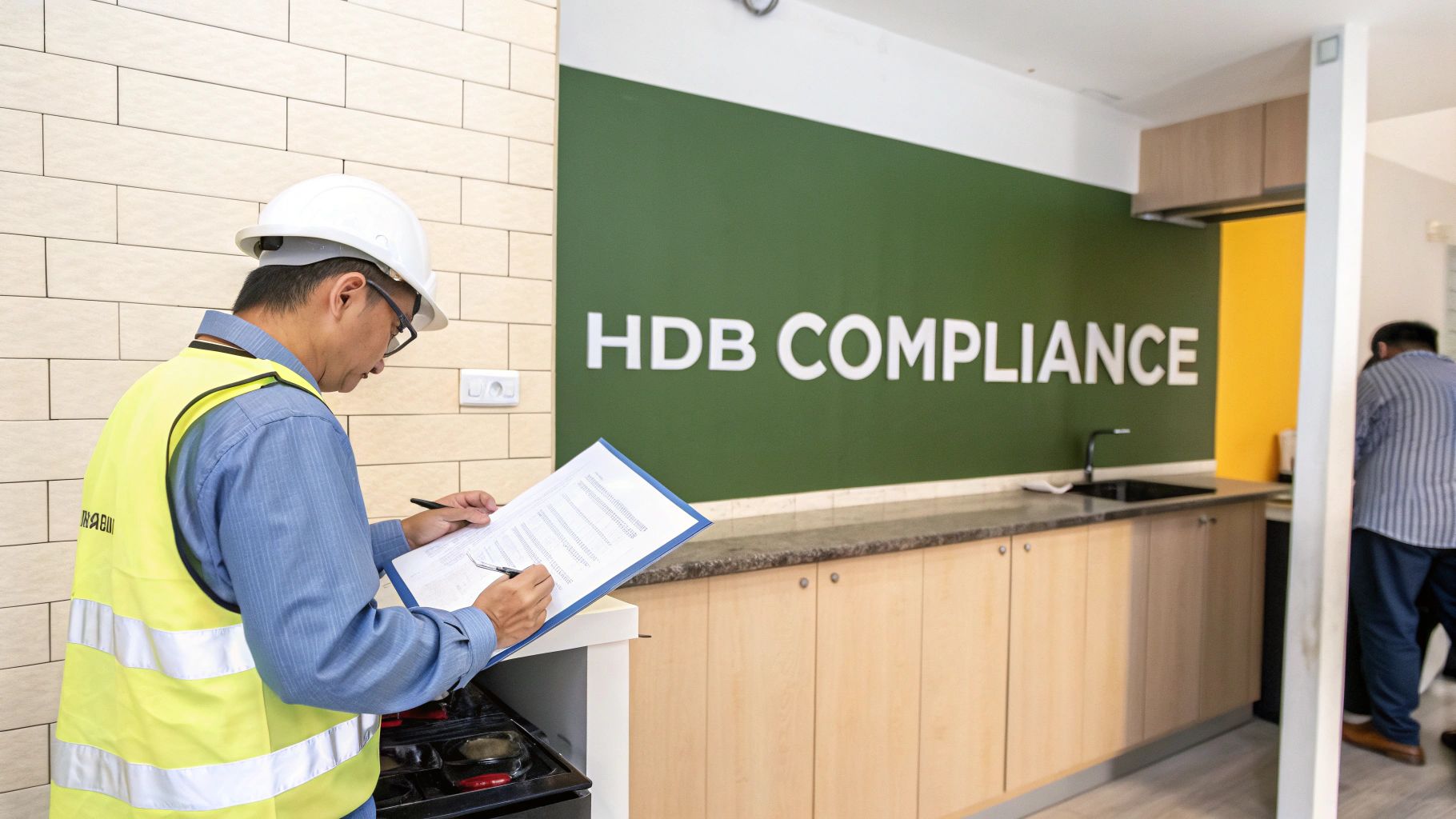
Renovating an HDB kitchen involves more than just selecting finishes. It requires adherence to a clear set of rules designed to ensure building integrity and resident safety.
Ignoring these guidelines can result in a stop-work order, hefty fines, or the costly requirement to demolish and rebuild your new kitchen.
Understanding these regulations from the outset ensures your Singapore kitchen cabinet project is both beautiful and compliant. The Housing & Development Board (HDB) has specific requirements that must be followed, and an experienced contractor will be well-versed in them. Hiring a licensed, HDB-registered contractor is essential; they handle the permits and ensure every detail meets HDB's strict standards.
Core HDB Rules for Kitchen Renovations
While the official guidelines are extensive, several key rules consistently apply to kitchen projects.
- Wall Hacking Restrictions: You cannot alter any reinforced concrete walls, columns, beams, or slabs. These are the structural elements of the building. Hacking non-structural walls may be possible, but it always requires an HDB permit before any work begins.
- Waterproofing in Wet Areas: Any floor works in wet areas, such as near the kitchen sink, require proper waterproofing. HDB mandates the use of a specific waterproofing membrane and a water tightness test to prevent leaks affecting your neighbours below.
- Plumbing and Electrical Standards: All plumbing and gas work must be performed by a Public Utilities Board (PUB) licensed plumber. Similarly, any new electrical wiring or power points must be installed by a licensed electrical worker to comply with Energy Market Authority (EMA) safety standards.
Following HDB guidelines isn’t about limiting creativity; it's about protecting your home, your neighbours, and your investment. A compliant renovation is a safe renovation, ensuring peace of mind long after the work is done.
Why Licensed Contractors Are Essential
Navigating the HDB permit process can be complex. Licensed contractors are registered with HDB and are authorised to submit renovation plans on your behalf. They understand the technical requirements and documentation, which facilitates a smoother approval process.
An experienced contractor will conduct a thorough site assessment before finalising the design, identifying potential compliance issues early. They will confirm which walls can be hacked and ensure your planned layout for cabinets and appliances adheres to all required safety clearances. A compliant renovation is the foundation of a successful project, guaranteeing your new kitchen is built to last and to code.
Keeping Your New Kitchen Cabinets Looking Their Best
Your new kitchen is installed, but the work isn't over. Proper long-term care is essential to ensure your investment stands the test of time, especially in Singapore’s humid environment.
These are the practical tips we provide all our clients to keep their Singapore kitchen cabinet looking as good as new for years.
Regular, gentle cleaning is your most effective tool. For most kitchens featuring high-pressure laminates, a simple routine is sufficient. Avoid harsh chemical cleaners; a soft, damp cloth with mild soap is all that's needed to remove daily grease and grime.
After cleaning, always wipe the surfaces with a dry microfibre cloth. This simple step is critical in our climate, as it prevents water from seeping into seams and causing the core material to swell over time.
Tailoring Care to Your Cabinet Finish
Different cabinet finishes require different care routines. What works for a durable laminate can damage a delicate wood veneer.
For Laminate Surfaces: Use non-abrasive cleaners. For stubborn stains like turmeric, a paste of baking soda and water is effective. Apply it gently, then wipe clean. Avoid scouring pads, which can create micro-scratches that dull the finish.
For Wood Veneers: Treat these like fine furniture. Dust regularly and clean with a wood-specific cleaner, wiping in the direction of the grain. Ensure good kitchen ventilation by using the cooker hood or a dehumidifier to combat humidity.
For Painted Finishes (e.g., MDF): These surfaces are more prone to chipping. Clean gently. If you notice a chip, address it immediately with the touch-up paint provided by your contractor. This seals the area and prevents moisture from penetrating the core material.
Preventative care is always easier than repair. Simple habits, like wiping up spills the moment they happen and using your cooker hood to manage steam, will protect your cabinet surfaces from the daily wear and tear of a busy kitchen.
Proactive Maintenance Checks
Beyond daily cleaning, periodic checks will keep your cabinets functioning perfectly. We recommend performing these simple tasks every six months.
First, check all cabinet hinges and drawer runners. Over time, screws can loosen with use. A quick tightening with a screwdriver can prevent doors from sagging and keep drawers aligned.
Next, inspect all surfaces for minor scratches or stains you may have missed. Catching these issues early prevents them from worsening. These small, proactive steps build long-term durability. While focusing on cabinets, remember that appliances also need care. Following essential maintenance tips for kitchen appliances will keep your entire kitchen in top condition.
Your Kitchen Cabinet Questions, Answered
Planning a kitchen renovation involves many questions. To help you proceed with confidence, here are straightforward answers to common queries from Singaporean homeowners.
How Long Does a Typical Kitchen Cabinet Installation Take?
From design approval to final installation, a custom kitchen cabinet project typically takes 4 to 6 weeks. This timeline allows for meticulous craftsmanship without rushing.
The majority of this time, around 3 to 4 weeks, is dedicated to off-site fabrication in our workshop. The on-site installation is relatively quick, usually completed in 3 to 5 days. Complex designs or special materials may adjust the schedule, but a clear timeline will always be established with you upfront.
What Is the Most Practical Cabinet Material for an HDB Flat?
The most practical and reliable choice for HDB kitchens is high-quality plywood with a laminate finish. Its superior moisture resistance and structural strength make it ideal for Singapore's humid climate, outperforming other engineered woods.
Practicality doesn't mean sacrificing style. Laminate surfaces are durable, easy to clean, and available in a vast range of colours and textures, offering complete design freedom without compromising on performance.
Should I Hire an Interior Designer or a Direct Carpenter?
This decision depends on your project's scope. If you are doing a simple, like-for-like replacement of your existing cabinets in the same layout, a direct carpenter can be a cost-effective solution.
However, if your vision involves more than just new cupboards—like changing the layout, needing help with colours and materials, or a complete kitchen overhaul—an interior designer is invaluable. They don't just design; they manage the entire orchestra.
An interior designer acts as a project manager, coordinating plumbers, electricians, and carpenters to work in sync. They provide a holistic vision, ensuring the final space is not only functional but also cohesive and aesthetically pleasing. This oversight prevents costly mistakes and elevates a good kitchen to a great one.
Ready to create a kitchen that perfectly balances beauty and function? The team at KIVO is here to guide you through every step, from initial design to flawless installation. Discover our custom carpentry and interior design services at https://kivo.com.sg.