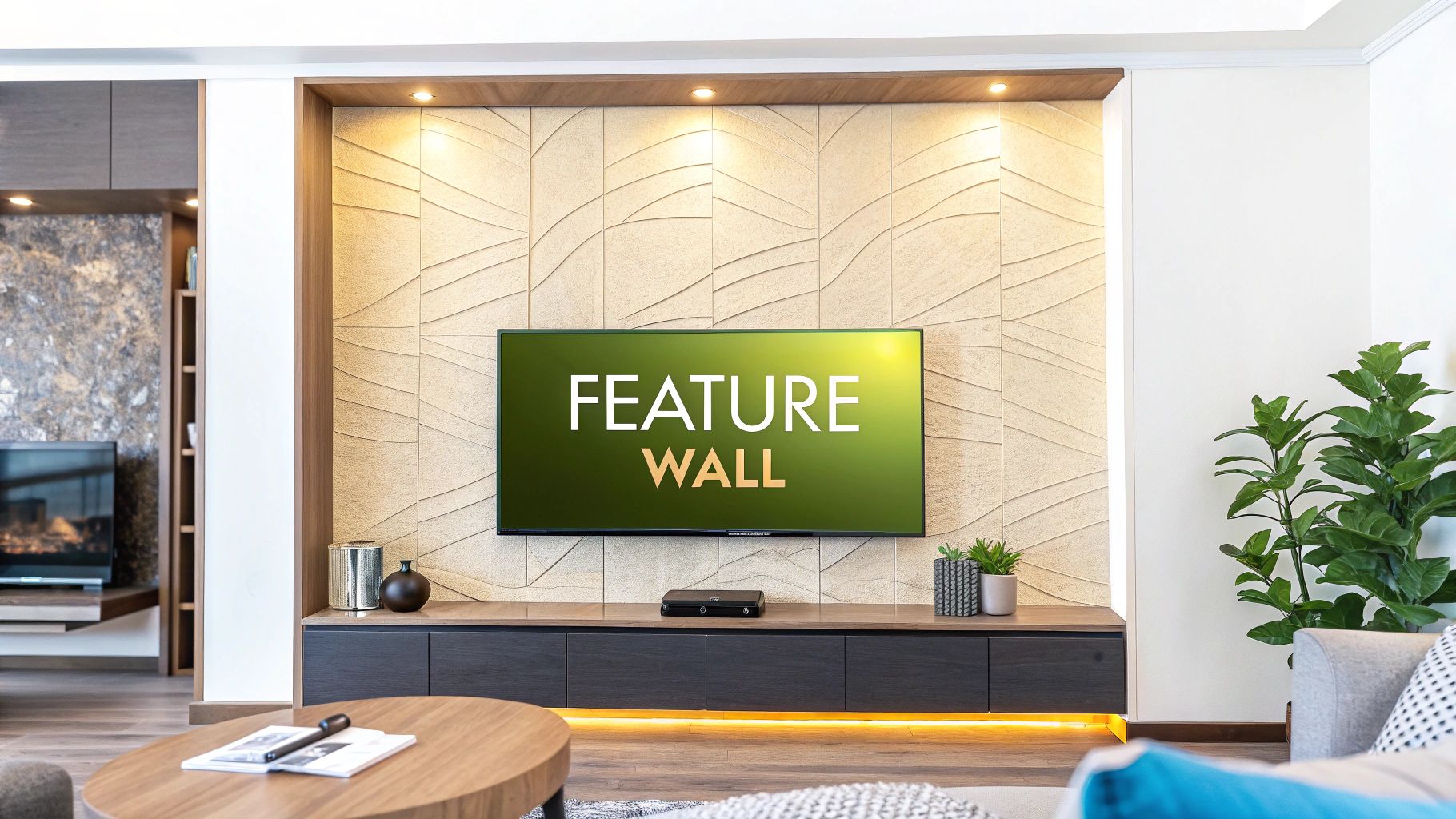
A TV feature wall is more than just a backdrop for your television. It's the functional and aesthetic anchor of your living room. A well-designed feature wall organises clutter, hides unsightly wires, and sets the tone for the entire space, transforming a plain wall into a purposeful centrepiece.
From our experience with homeowners in Singapore, the goal is always the same: create something beautiful that also solves practical problems.
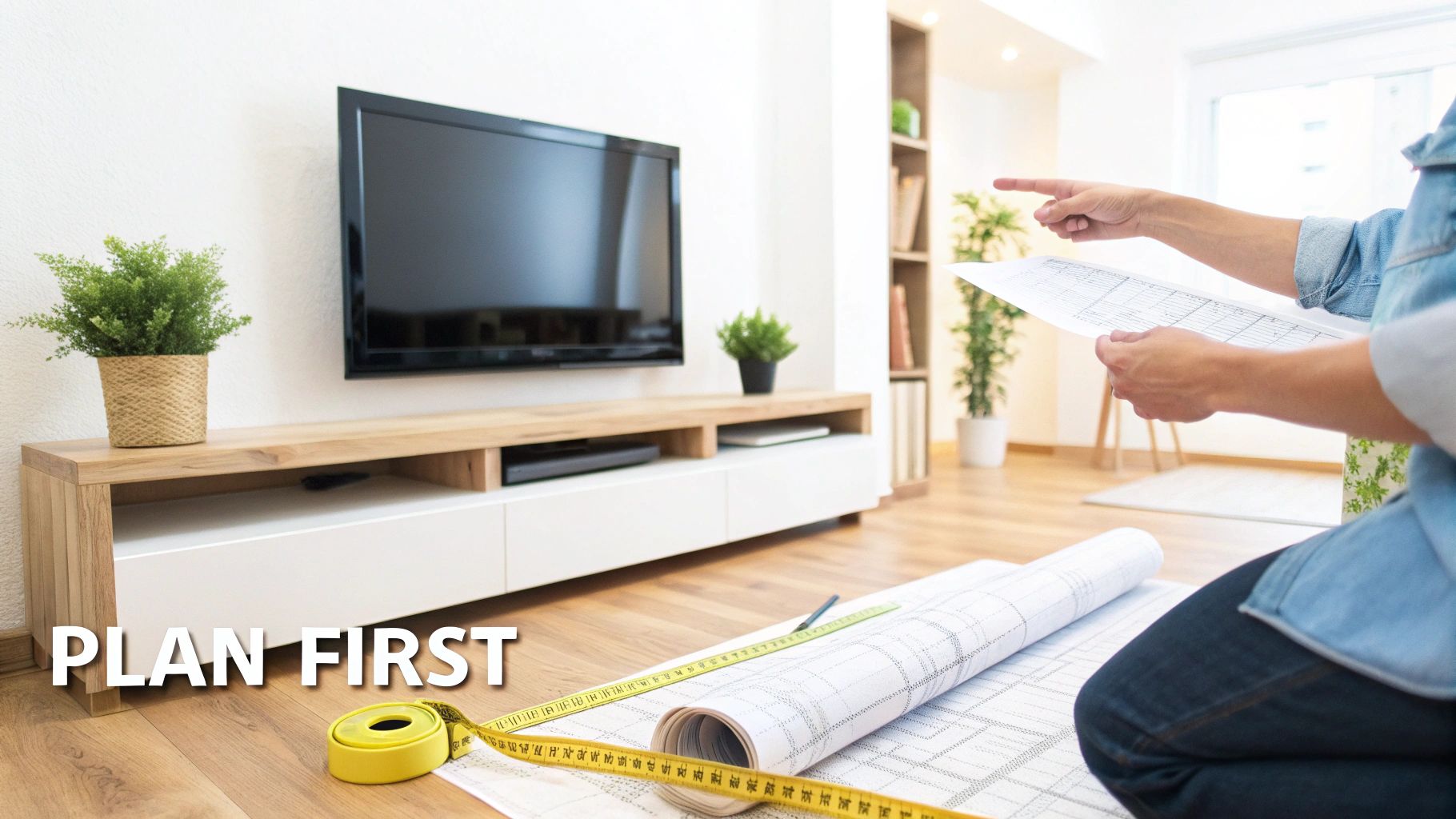
Step 1: Planning Your TV Feature Wall Layout and Function
Before choosing materials or colours, a solid plan is essential. This initial stage is about asking the right questions to ensure your TV feature wall is perfectly suited to your room and lifestyle, avoiding common mistakes we often see.
Assess Your Living Room Space
First, evaluate the room's layout. The placement of your feature wall affects viewing comfort, room flow, and even how you use the space daily.
Here are the key factors to consider:
- Viewing Angles: Position the TV directly opposite your main seating area. This prevents neck strain during viewing. For a recent project in a Punggol BTO, we mapped out the sofa placement first to ensure the TV was perfectly centred for the family.
- Window Glare: Note where natural light enters the room. Placing a TV opposite a large window will cause significant glare, making it difficult to see the screen during the day. Consider walls adjacent to windows instead.
- Traffic Flow: Ensure the feature wall doesn't obstruct main walkways. A common issue in HDBs is placing it where it cramps the path to the bomb shelter (storeroom) or bedrooms. Measure clearances to ensure comfortable movement.
Define the Wall's Primary Purpose
Next, clarify what you need the wall to do. Is it purely decorative, or is it a functional hub for storage and media? This decision will dictate the design, materials, and budget.
A question we always ask clients is: "Besides looking good, what problem must this wall solve for you?" Answering this clarifies whether we're designing a simple backdrop or a multifunctional unit.
For example, a client who is an avid gamer needed specific ventilation for their PS5, deep shelves for their collection, and robust cable management. In contrast, a minimalist homeowner only wanted a clean backdrop for their TV and soundbar. Their needs led to two completely different designs.
A Practical Planning Checklist
Use this checklist to translate your ideas into actionable requirements for your designer or contractor.
Functionality Checklist
- Storage: Do you need open shelves for displaying decor, or closed cabinets to hide game controllers, remotes, and routers?
- Devices: List every device that needs to be connected: TV, soundbar, gaming consoles (PS5, Xbox, Switch), set-top box, Apple TV, etc. This determines the number of power points and cable runs required.
- Cable Management: Do you want all wires completely hidden within the wall (the cleanest option), or is a simple cable trunking acceptable?
Aesthetics Checklist
- Design Theme: What is your home's interior style? Modern luxe, Scandinavian, industrial, or minimalist? The feature wall should complement this theme.
- Material Preference: Are you drawn to the warmth of wood-look laminates, the clean texture of fluted panels, or the luxurious feel of a marble-effect sintered stone?
- Lighting: Do you want integrated lighting? LED backlighting can create a "floating" effect, while accent spotlights can highlight decor.
Careful planning ensures your investment results in a TV feature wall that is both stunning and perfectly practical for your daily life.
Step 2: Choosing Materials That Match Your Style and Budget
The material you select is the soul of your TV feature wall. It sets the aesthetic tone for the entire room. In Singapore, our clients often seek materials that balance style, durability, and practicality for our climate and lifestyle.
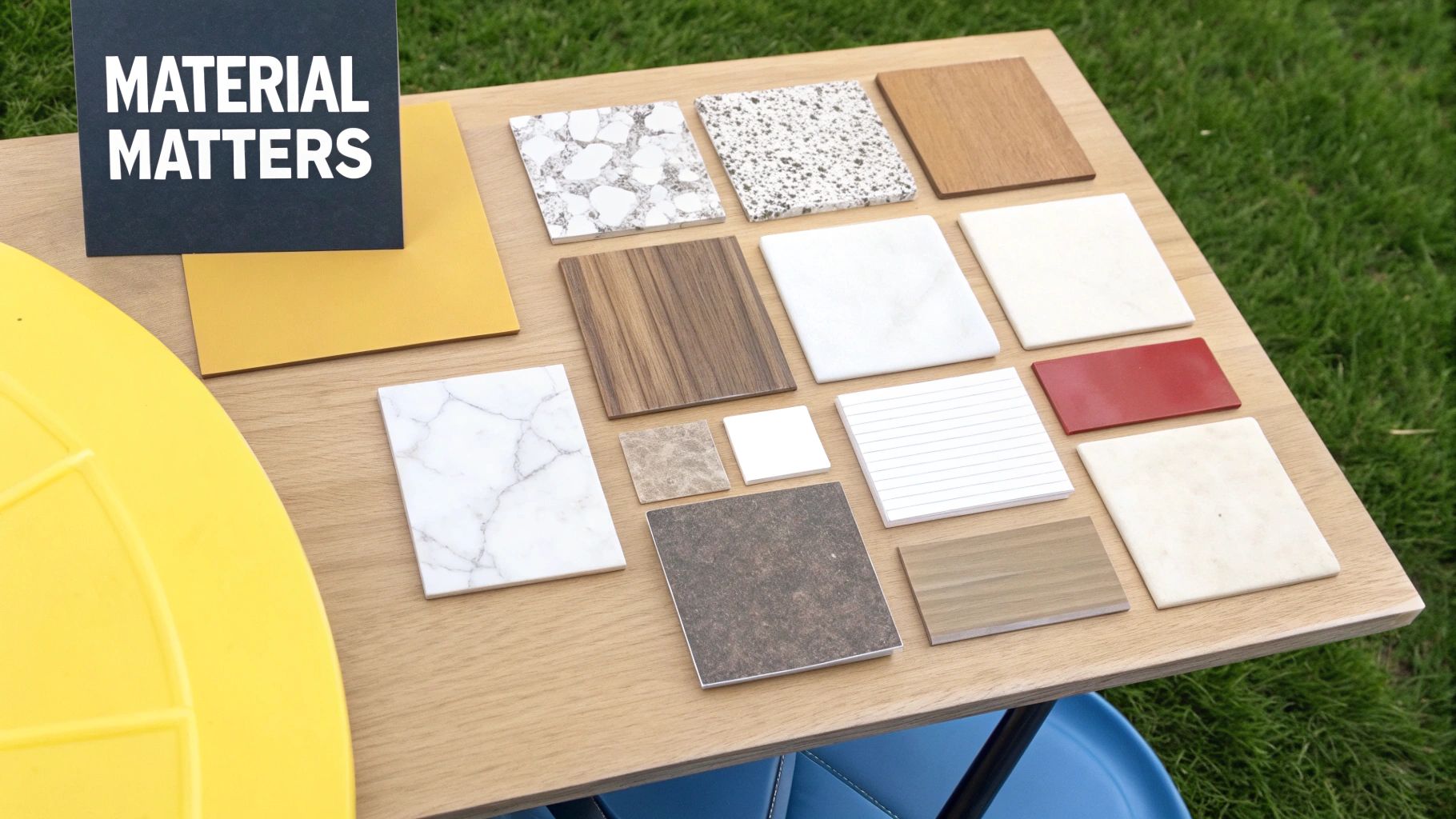
From the clean lines of fluted panels to the timeless luxury of sintered stone, each material brings a unique personality. Your choice will influence the look, maintenance requirements, and final project cost.
The Modern Texture of Fluted Panels
Fluted panels are incredibly popular right now, and for good reason. Their vertical lines add texture and create an illusion of height, which is a great advantage in HDB flats and condos with standard ceiling heights.
We frequently use fluted panels to achieve a minimalist or Japandi-inspired aesthetic. The clean, uniform lines are perfect for a clutter-free look.
- Best For: Creating a sense of height and adding modern, clean-lined texture.
- Maintenance: Low. A quick dusting or wipe-down is typically sufficient.
- Actionable Tip: Combine fluted panels with a smooth laminate finish on different sections of the wall. This contrast in textures adds visual interest without overwhelming the space.
The Timeless Luxury of Marble and Sintered Stone
For a touch of opulence, nothing beats the classic elegance of marble or the modern resilience of sintered stone. A feature wall with a marble-like finish instantly elevates a space into a statement piece.
While genuine marble is beautiful, it is porous and requires careful maintenance. This is why sintered stone is often the preferred choice for our clients. It delivers the same high-end look with superior durability—it's resistant to scratches, stains, and heat, making it a practical option for homes with children.
A single slab of sintered stone with dramatic veining can act as a piece of art. It provides such a powerful backdrop that minimal additional styling is needed.
TV Feature Wall Material Comparison
| Material | Estimated Cost (per sq. ft.) | Best For (Aesthetic) | Maintenance Level |
|---|---|---|---|
| Fluted Panels | S$25 - S$50 | Modern, Japandi, Minimalist | Low |
| Sintered Stone | S$45 - S$80+ | Luxury, Contemporary, Classic | Low |
| Laminates (HPL) | S$20 - S$40 | Highly Versatile (any style) | Low |
| Paint / Plaster | S$10 - S$25 | Eclectic, Budget-Conscious | Medium |
Note: Costs are estimates and can vary based on supplier, grade, and project complexity. Always get a detailed quote.
The Unmatched Versatility of Laminates
High-pressure laminates (HPL) are the chameleons of interior design. Modern laminates offer incredibly realistic finishes, including natural wood grains, raw concrete textures, brushed metals, and solid colours.
This versatility makes them suitable for almost any design theme. For a recent project in a Tampines condo, a client wanted an industrial look. We used a concrete-effect laminate paired with black metal accents to achieve the desired aesthetic at a fraction of the cost and complexity of using real concrete. Laminates offer aesthetic freedom without compromising on durability.
Budget-Friendly Plaster and Paint
Never underestimate the impact of a well-executed paint or plaster finish. For homeowners on a tighter budget, creating a feature wall with a bold paint colour or a textured finish like limewash can be highly effective. This approach offers the most creative freedom for patterns and colour-blocking. While less durable against knocks than harder materials, it is the easiest and most affordable to update in the future.
Ultimately, a TV feature wall in Singapore is about more than just looks; it's a blend of smart placement and function. Costs can start from around S$20 per ft² for simpler designs, giving you a versatile canvas to work with. However, if you opt for premium materials like marble, the price can climb to S$75 per ft² or more. If you'd like to get a clearer picture, you can explore more detailed cost insights about feature walls in Singapore to help plan your budget.
Step 3: Integrating Seamless Storage and Cable Management
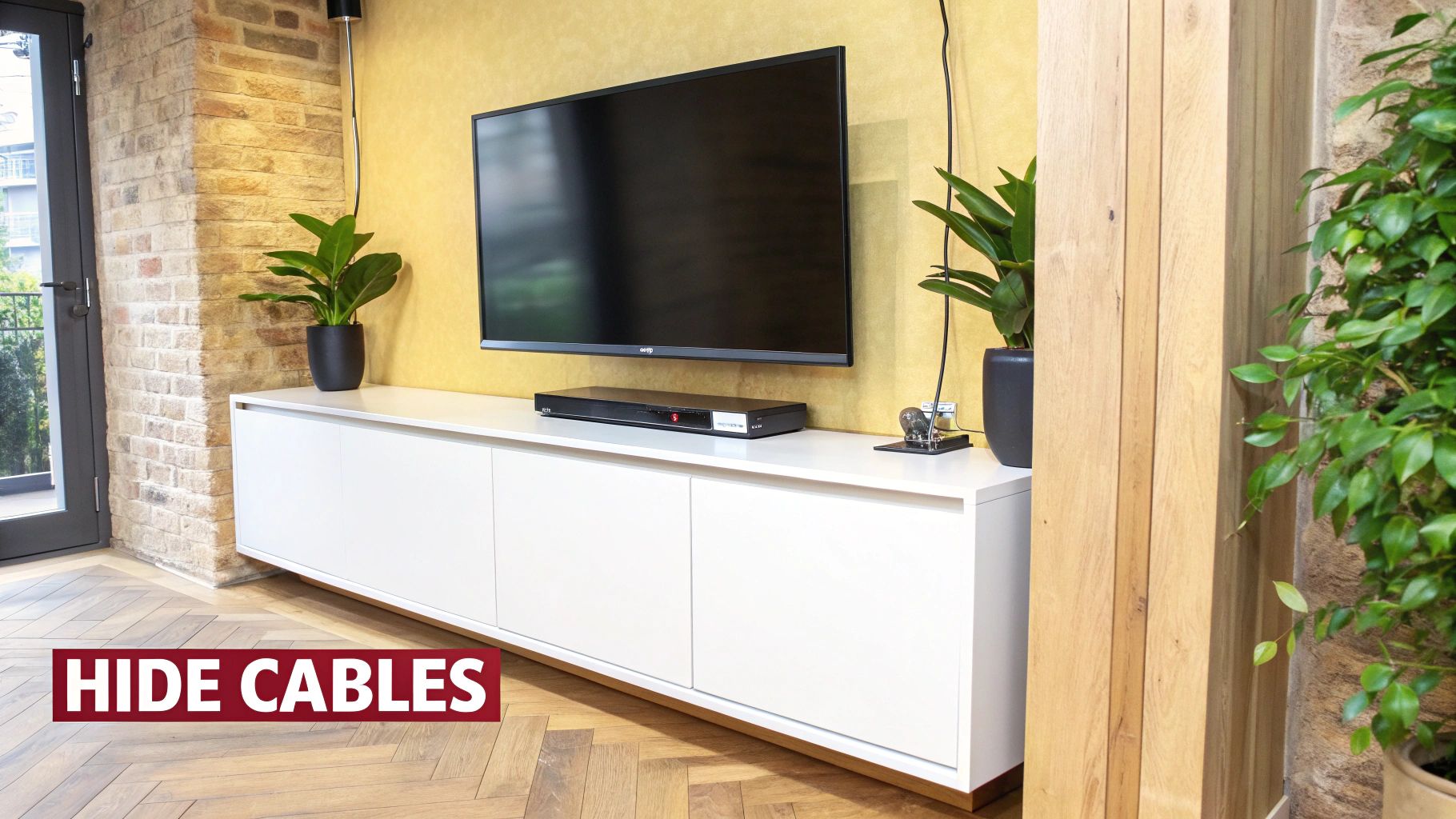
A beautiful TV feature wall loses its appeal with a visible tangle of wires. The key to a professional, high-end look lies in what you don't see. Smart storage and meticulous cable management are essential for a clean, functional, and organised living room centrepiece. This must be planned from the start, not as an afterthought.
Hiding Wires and Components Effectively
Achieving a "wireless" look is about smart construction. We integrate hidden conduits directly into the feature wall's structure, creating a channel for cables to run from behind the TV down to a media console or cabinet. This conceals everything—the TV's power cord, HDMI cables, and speaker wires.
The most common regret we hear from clients who attempted a DIY feature wall is neglecting cable management. Retrofitting a solution is always more difficult and less effective than planning for hidden channels from the beginning.
Beyond wires, consider the devices themselves:
- Recessed Power Sockets: We place power sockets inside the custom console or within a recessed nook behind the TV. This prevents bulky plugs from protruding and disrupting the clean lines.
- Integrated Soundbar Niche: A custom-sized niche allows the soundbar to sit perfectly flush with the wall, looking bespoke and keeping surfaces clear.
- Ventilated Console Storage: For devices that generate heat like a PS5, we design cabinets with discreet ventilation (e.g., slatted doors, subtle grilles) to ensure proper airflow and prevent overheating.
Practical and Stylish Storage Solutions
Effective storage should feel like an integral part of the feature wall. Custom carpentry allows for solutions that blend seamlessly into the design.
Floating consoles are a client favourite as they create a sense of lightness and make cleaning the floor beneath effortless. Another popular solution is incorporating hidden cabinets with push-to-open mechanisms. This eliminates the need for handles, resulting in a sleek, uninterrupted surface.
For a client in a compact BTO flat, we designed a full-height feature wall where the lower section appeared to be solid panelling. In reality, it contained deep, push-to-open drawers for media and side nooks for display, maximising storage without adding visual bulk.
Future-Proofing for New Technology
A well-designed TV feature wall should accommodate not just your current tech, but also future upgrades. Technology evolves quickly, and you may want to add a new gaming console or sound system in a few years.
Here’s our practical guide to future-proofing:
- Install Extra Conduits: We always recommend running at least one or two spare, empty conduits within the wall. This makes adding a new cable later simple, without needing to cut into the finished wall.
- Ensure Easy Access: Design removable back panels or access points inside cabinets. This allows you to easily plug in new devices or troubleshoot connections without hassle.
- Plan for Size and Depth: Build consoles and shelves with a little extra depth and width. Today's slim devices might be replaced by larger tech in the future. A bit of extra space provides valuable flexibility.
By integrating these strategies, your TV feature wall becomes a smart, organised, and future-ready hub for your living space.
Step 4: Using Lighting to Create Atmosphere
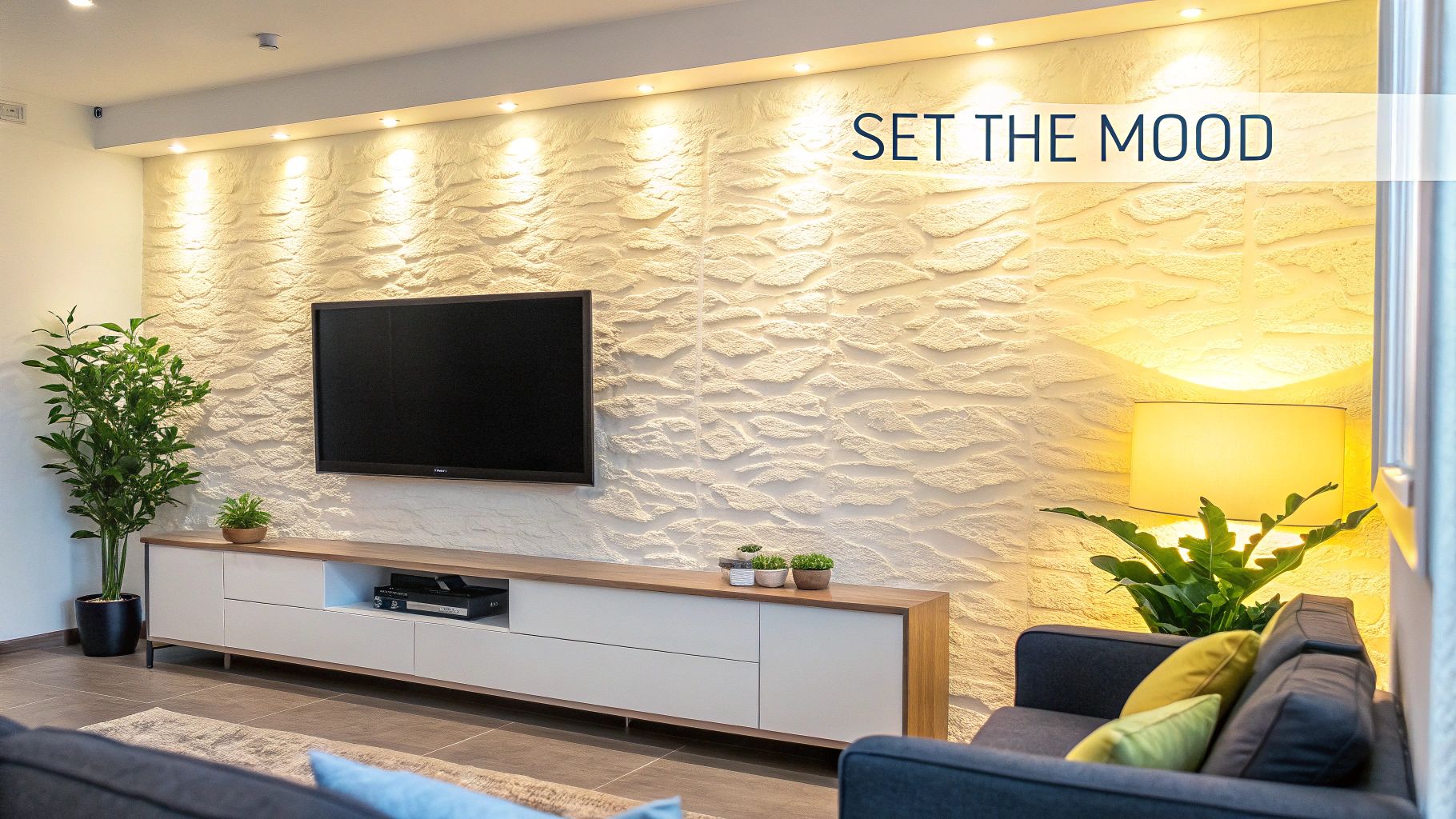
Lighting is the element that elevates a TV feature wall from a piece of furniture to a dramatic centrepiece. It creates mood, highlights textures, and reduces eye strain during movie nights. Effective lighting is about layering different sources to achieve a rich, inviting atmosphere.
Popular Lighting Techniques for Impact
Based on what our clients in Singapore request most, these techniques consistently deliver a high-end, professionally designed look.
LED Backlighting (Cove Lighting) is the most popular request. Placing LED strips behind the main TV panel or a floating console creates a soft halo of light, giving the entire structure a "floating" effect. It’s a modern touch that adds depth and sophistication.
Wall-Washing with Downlights is another powerful technique. By installing recessed downlights in the ceiling a short distance from the wall, you create an even cascade of light that illuminates the surface. This is particularly effective for showcasing textured materials like fluted panels or stone-finish laminates, as it accentuates the subtle shadows and depth.
A common mistake is aiming lights directly at the TV screen. Effective lighting for a TV wall should always be indirect. It highlights the wall itself, creating a gentle backdrop that reduces eye strain and makes the on-screen picture appear richer.
Choosing the Right Light Temperature and Controls
The technical details are just as important as the placement. Colour temperature, measured in Kelvins (K), sets the room's mood.
- Warm White (2700K - 3000K): This is our standard recommendation for living rooms. It produces a cosy, inviting glow perfect for relaxation.
- Cool White (4000K - 5000K): This brighter, more energising light is better suited for kitchens and home offices, not living areas.
Finally, the single most important feature for your lighting plan is a dimmer. Installing dimmers is non-negotiable for achieving full control. It allows you to adjust the intensity from bright and functional for cleaning, down to a soft, ambient glow for movie nights. This small investment provides maximum flexibility.
This focus on creating personalised, stylish living spaces is a huge trend. In fact, the home décor market in Singapore is projected to hit US$344.76 million in 2025, driven by homeowners wanting modern and contemporary designs. You can read more about Singapore's growing home decor market on Statista.
Step 5: Styling and Finishing Your Design
With the construction, materials, and lighting in place, it’s time for the final step: styling. This is where you inject personality, turning a well-built structure into the true heart of your living room.
First, let's address the TV itself. Choosing the right TV size is crucial. A screen that is too large can overwhelm the feature wall, making a sleek design feel cluttered. Conversely, a TV that is too small can look lost and diminish the wall's impact.
A practical guideline is the "thirds" principle. Aim for the TV's width to occupy between one-third to one-half of the feature wall's total width. This creates a natural visual balance and leaves adequate space for styling.
Accessorising with Intent
The most common styling mistake is feeling the need to fill every empty surface. Less is more. The goal is to enhance the design, not add clutter. Select a few key pieces that add character and texture.
Here are some practical examples:
- Sculptural Objects: A single, well-crafted ceramic vase or a striking metal object on a floating shelf adds an artistic touch.
- Greenery: A small potted plant like a snake plant or a cascading pothos brings life and an organic element to the design. They require minimal maintenance.
- Meaningful Decor: Instead of generic prints, use items that are personal to you. A framed photo or a small piece of art placed asymmetrically creates a more interesting composition.
Creating a Cohesive Living Room
Your TV feature wall is the anchor of your living room; it shouldn't exist in isolation. To achieve a polished, professionally designed look, its colours and textures should connect with the rest of the room.
Pull key colours from the feature wall into your soft furnishings. If your wall has a laminate with a subtle grey vein, echo that grey in your sofa cushions or a throw blanket. If you used warm, wood-toned fluted panels, match those tones in the legs of your coffee table or side tables. This repetition creates a strong sense of cohesion.
This trend towards clean, integrated designs is growing in Singapore, partly because modern construction makes it more accessible. A full custom carpentry unit can cost over S$3,000. In contrast, a stylish TV partition wall can often be constructed for under S$1,000. These are typically built with lightweight drywall over a metal frame, which reduces labour costs while offering great design flexibility. It’s an increasingly popular way for homeowners to create a high-impact focal point without a high budget. You can find more insights on these cost-effective TV partition walls in Singapore.
Your rug is another powerful tool for tying the room together. It should complement both your sofa and the feature wall. A soft, textured rug can add warmth to a sleek, modern wall, while a geometric pattern can amplify its contemporary lines. By linking these three elements—the wall, the sofa, and the rug—you create a unified and inviting space.
Your Top TV Feature Wall Questions Answered
We've designed and built countless TV feature walls for Singaporean homeowners. Here are our answers to the most common questions we receive.
How Much Should I Budget for a TV Feature Wall in Singapore?
The cost depends on three main factors: size, materials, and design complexity (including custom carpentry and electrical work).
As a general guide for a standard-sized living room wall:
- Simple Paint/Plaster Finish: S$800 - S$1,500. This typically involves building a simple drywall partition for a clean, flat surface and a professional paint finish.
- Laminates & Fluted Panels: S$2,500 - S$5,000+. This range covers custom carpentry with popular materials and integrated storage like a floating console.
- Sintered Stone or Marble: S$6,000 and above. These premium materials require specialised fabrication and installation, which increases the cost significantly.
Pro Tip: Always budget for electrical work separately. Adding power points, installing LED lighting, and concealing cables require a licensed electrician, and this is typically quoted as a separate item from the feature wall construction.
What’s the Best Height to Mount a TV?
The rule of thumb is to mount the TV so that the centre of the screen is at eye level when you are seated. This prevents neck strain.
For most standard sofa heights in Singapore, this places the TV's centre point between 100cm to 110cm (approx. 40-43 inches) from the floor.
To find the perfect height for your home, sit on your sofa and have someone hold a piece of masking tape on the wall. Adjust it up or down until it feels natural to your line of sight. This simple test ensures years of comfortable viewing.
Can I Build a Feature Wall in My HDB or Condo?
Yes, building a TV feature wall is a very common renovation in HDB flats and condos. Most feature walls are cosmetic additions built onto existing walls and generally do not require special permits from HDB or your condo's MCST.
However, the critical rule, especially for HDBs, is that you must not hack, alter, or drill into any structural walls without obtaining the proper approvals. For condos, always check your Management Corporation Strata Title (MCST) renovation guidelines before work begins. Working with an experienced interior designer ensures all regulations are followed.
How Can I Completely Hide All the TV Wires?
The most effective method is to plan for cable concealment during the construction phase. We build conduits (hollow channels) directly into the feature wall's structure.
These conduits create a hidden pathway from behind the TV down to your media console, allowing all HDMI, power, and audio cables to be fed through the wall, making them completely invisible. If you are working with an existing solid wall, a slim decorative panel can be built in front of it to house the conduits.
Actionable Advice: We always recommend installing one or two extra, empty conduits. This is a small, low-cost step during construction that makes it incredibly easy to add a new device in the future without damaging your wall.
At KIVO, we believe a well-designed TV feature wall is more than just a backdrop—it's the heart of the living room. Our team brings decades of artisan experience to every project, ensuring your vision is brought to life with flawless execution.
Ready to transform your space? Visit us at kivo.com.sg to browse our portfolio and schedule a chat.