Let's be direct: choosing wall shelves in Singapore isn't just about finding more storage. In our HDB flats and condos where every centimetre is prime real estate, it’s a strategic design move. It's about transforming empty vertical space into something that is both functional and a true reflection of your style.
A Practical Framework for Selecting Wall Shelves
So, where do you begin? Selecting the right shelves comes down to getting four things right: function, aesthetics, space, and budget. Nail this balance, and you have the foundation for a brilliant design. This is the exact process we walk our clients through to ensure the final result works for their lifestyle and genuinely elevates their home.
Using this framework helps you sidestep common mistakes, like choosing shelves that look stunning but can't support your book collection, or installing a massive unit that overwhelms a small room.
Defining Your Shelving Needs
Before considering styles, let's talk function. What primary job must these shelves perform? Your answer here dictates every other decision, from the material you choose to the mounting system required.
- Display: Is this a stage for treasured collectibles, family photos, or art? For this, lighter, minimalist options like floating shelves or picture ledges work perfectly. Their purpose is to showcase, not store.
- Storage: Do you have a heavy book collection, kitchenware, or home office files? Now we're talking about load-bearing capacity. You'll need robust materials like high-grade plywood or metal and a secure mounting system.
- Hybrid Use: Need a bit of both? A modular system is excellent for this, offering a mix of open shelves for display and closed sections to hide clutter.
Actionable Example: We recently worked with a client who had an extensive vinyl record collection. They needed shelves that were not only strong but also deep enough to house the records without overhang. An off-the-shelf unit wouldn't work. We designed a custom floor-to-ceiling unit using 18mm thick plywood with specific 35cm deep shelves—a practical solution tailored to their exact need.
Matching Shelves to Your Interior Style
Your shelves should feel like an integral part of the room, not an afterthought. The style must blend seamlessly with your existing decor, whether it's clean Scandinavian, edgy industrial, or sleek contemporary. If you're aiming for a modern look, it's worth exploring guides on choosing and styling a contemporary shelf unit for deeper insights.
A well-chosen shelf doesn't just hold things; it holds the room together. It can act as a subtle backdrop or a dramatic focal point, depending on the material, finish, and what you place upon it.
Consider the atmosphere different materials create. Raw, solid wood shelves can bring warmth to a minimalist space. In contrast, sleek, powder-coated metal shelves can introduce an industrial vibe. The goal is a cohesive look that feels intentional and elevates the entire room.
Getting to Know Your Wall Shelf Types and Styles
When you're looking for wall shelves in Singapore, it’s about picking the right style for our compact homes. Whether it's a sleek condo in Orchard or a cosy HDB in Tampines, the goal is the same: maximise function without sacrificing floor space. Let's review the most popular options we install for our clients and the design problems each one solves.
This focus on vertical space is a direct response to city living. In a place where the average HDB flat is just 90 square metres, wall shelves are a necessity. This trend is regional; the Asia-Pacific region accounts for a significant 33% of the global shelving market. Locally, Singapore's furniture market is projected to reach US$932.41 million by 2025, with wall-mounted solutions being a major driver. For a broader perspective, you can explore this market report on global shelving unit trends.
Floating Shelves: The Minimalist Favourite
For a clean, modern aesthetic, floating shelves are a top choice. The concealed hardware creates the illusion that the shelf emerges directly from the wall, resulting in a light, uncluttered appearance. They are a staple in contemporary and Scandinavian interiors.
We often install them in living rooms above a TV console to display a few select decor pieces, or in kitchens for easy access to spices and oils. Because there are no visible brackets, the focus is on the items displayed, not the shelf itself.
Actionable Examples:
- Living Room: A single, long floating shelf in a dark wood laminate creates a strong horizontal line above a low media unit, anchoring the entire wall.
- Bedroom: A series of shorter, staggered shelves next to a vanity can transform perfumes and skincare products from clutter into a stylish display.
Modular Shelving: The Flexible Solution
For those whose needs evolve, modular shelving is a lifesaver. Think of it as customisable storage. These systems consist of individual components—boxes, shelves, and sometimes small cabinets—that you can arrange and rearrange as required.
This adaptability is perfect for home offices that double as guest rooms, children's rooms that need to adapt as they grow, or any multi-functional space. We've designed systems for clients who started with a simple bookshelf and later added components to accommodate a growing plant collection or work files.
Modular systems empower you to be the designer. They offer a level of personalisation that fixed shelves cannot, allowing your walls to evolve with your life.
Corner Shelves: The Space Savers
Awkward corners are often underutilised, but they hold significant potential. Corner wall shelves are specifically designed to revitalise these spots, turning them into practical storage or display nooks. They are particularly effective in small bathrooms, tight entryways, or the corner of a study.
By stacking a few tiered corner shelves, you can create a mini-library or a vertical garden without consuming any floor space. It's a simple but highly effective strategy for making every part of your home functional.
Actionable Examples:
- Industrial: Pair black metal frames with rough, reclaimed wood planks for a rugged look.
- Minimalist: Choose sleek, white floating corner shelves that blend seamlessly into the wall.
- Scandinavian: Opt for light-coloured wood with simple, clean lines for a warm, natural feel.
A Practical Guide to Materials and Finishes
Choosing a material for your wall shelves in Singapore goes beyond aesthetics; it's a critical decision for durability. Our high humidity can cause certain materials to warp, rust, or degrade. Selecting the right material from the outset ensures your shelves will be a lasting feature, not a temporary fix.
The material dictates the shelf's strength, maintenance requirements, and the overall style it brings to your space. A heavy-duty metal shelf might be perfect for a garage but would feel out of place in a serene, Muji-inspired bedroom. Let's break down the most common options we work with, focusing on their practical pros and cons for our local climate.
The Warmth and Strength of Wood
Wood is a timeless choice, bringing a natural texture and warmth that is hard to replicate. However, not all woods perform equally in Singapore's humidity.
Solid Wood (e.g., Teak, Oak): Known for its durability and beautiful grain, solid wood is a premium option. Teak, with its natural oils, is highly resistant to moisture and pests. The trade-off is maintenance; it requires occasional oiling to prevent it from drying out or discolouring. It's an investment in both cost and care.
Engineered Wood (e.g., Plywood, MDF): This is the workhorse of custom carpentry. High-quality, moisture-resistant plywood is incredibly strong and far less prone to warping than many solid woods. When finished with a high-pressure laminate, it becomes highly resistant to scratches, heat, and moisture, making it a fantastic, low-maintenance choice for almost any application.
Our Recommendation: For most homes, we recommend high-quality, moisture-resistant plywood with a quality laminate finish. It provides the best balance of durability, design flexibility, and value for creating bespoke wall shelves in Singapore.
Sleek and Modern Metals
For an industrial or contemporary look, metal offers clean lines and impressive strength. Its slim profile allows for designs that feel light and open, even when supporting significant weight.
Powder-coated steel or aluminium are the best options. The powder-coating process creates a tough, uniform finish that is far more durable than standard paint. It provides a robust barrier against scratches and, crucially, prevents rust—a persistent issue for untreated metals in our climate.
Metal shelves excel at creating a "floating" look. Their inherent strength allows them to be much thinner and less bulky than wood, making them ideal for minimalist designs or for showcasing items without the shelf itself becoming the focal point.
Actionable Example: A set of thin, matte black powder-coated shelves against a white wall can create a striking, gallery-like feel for displaying art or ceramics. Plus, they are incredibly easy to clean.
Other Noteworthy Materials
While wood and metal are the mainstays, a few other materials offer unique benefits for specific applications.
Tempered Glass: Glass shelves create an airy, unobstructed feel. They are perfect for bathrooms, where moisture is a constant, or inside display cabinets where you want light to pass through to every level. Their main drawback is that they show fingerprints and dust easily, requiring frequent cleaning.
Bamboo: As a sustainable option, bamboo is gaining popularity. It’s technically a grass but is harder than many woods and is naturally resistant to moisture. Its light, natural finish fits beautifully with Scandinavian or eco-conscious designs, offering a stylish and environmentally friendly alternative.
Custom Carpentry vs Off-the-Shelf Shelving
One of the biggest decisions for any homeowner is choosing between custom carpentry and a ready-made, off-the-shelf solution. There's no single right answer—the best choice depends on your specific needs, timeline, and budget.
This decision often sets the tone for the entire room, so it's worth careful consideration.
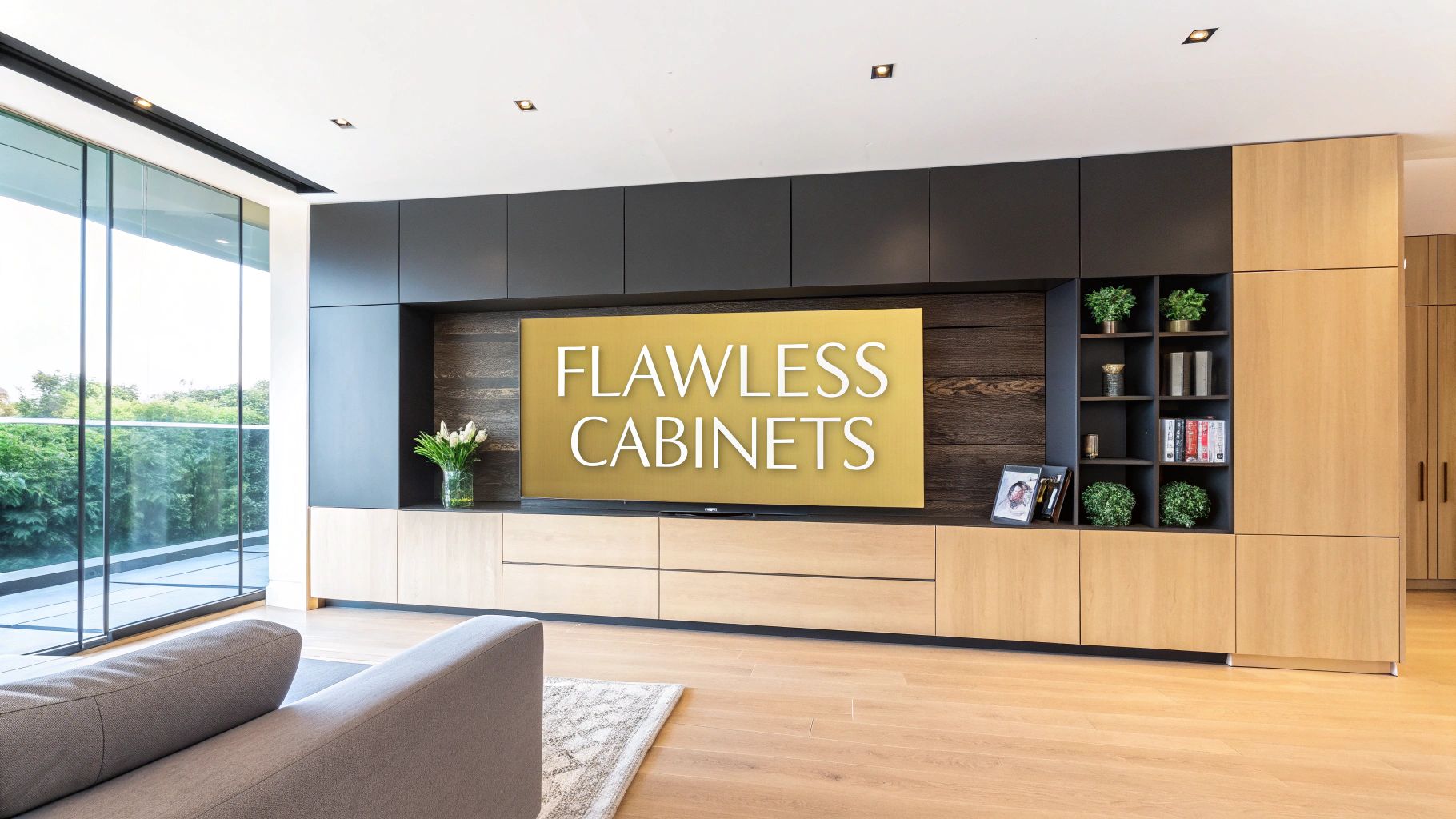
Custom carpentry is about creating something that fits your space perfectly. It’s the ideal solution for awkward areas—a sloped ceiling in an HDB loft, or a nook next to a structural pillar. We often use bespoke pieces to build seamless, floor-to-ceiling feature walls or to match the finish of existing furniture for a truly cohesive look.
On the other hand, off-the-shelf shelving options offer speed and affordability. They are a fantastic choice for renters who cannot make permanent changes, or for homeowners looking for a quick, straightforward update without the commitment of built-ins.
Understanding the Key Differences
The process from concept to completion is vastly different for these two approaches. Custom work is a collaborative process involving design consultations, precise on-site measurements, workshop fabrication, and professional installation. It’s a multi-step project built from the ground up, just for you.
Ready-made shelves offer instant gratification. You see the exact product, buy it, and can often have it installed the same day.
A Head-to-Head Comparison
To clarify the decision, let's compare these two approaches side-by-side. Thinking through each factor will help you determine what's most important for your home.
Custom Carpentry vs Off-the-Shelf Wall Shelves
This table breaks down the main differences to help you weigh your options for your Singapore home.
| Factor | Custom Carpentry (Bespoke) | Off-the-Shelf (Ready-Made) |
|---|---|---|
| Design Flexibility | Limitless. Every detail—size, material, finish, and shape—is tailored to your exact needs and space. | Limited. You’re restricted to the manufacturer's available sizes, colours, and materials. |
| Cost | Higher initial investment due to skilled labour, design work, and customised materials. | More budget-friendly. Mass production keeps the costs significantly lower. |
| Lead Time | Longer. Typically involves a few weeks for design consultation, fabrication, and installation. | Immediate. Can be purchased and installed within days, sometimes even on the same day. |
| Fit and Finish | A perfect fit. Designed to integrate seamlessly with your walls and architecture, leaving no awkward gaps. | Standardised fit. May not fully utilise the space, often leaving gaps at the top or sides. |
| Durability | Generally higher. Built with quality materials like high-grade plywood and robust fittings. | Varies widely. Durability depends on the brand and price, ranging from flimsy to fairly solid. |
Ultimately, the choice hinges on whether you prioritise a perfect, personalised fit or speed and cost-effectiveness.
When to Choose Custom Carpentry
Investing in custom carpentry for your wall shelves makes the most sense in a few key scenarios. If you have an unconventional space where standard furniture simply won't fit, bespoke is the only practical solution. It is also the clear winner when you want your shelving to be a standout architectural feature.
Actionable Example: We recently worked with a client who wanted a library wall to accommodate an extensive collection of oversized art books and sculptures. A ready-made unit would have left them with wasted space and shelves that were too shallow.
Custom carpentry allows you to transform a functional requirement into a deliberate design statement. It ensures every centimetre is working for you, both aesthetically and practically—something that’s essential in compact Singaporean homes.
We designed a floor-to-ceiling unit with varied shelf heights and integrated LED lighting, turning their collection into a stunning focal point. That level of personalisation is only achievable with custom work.
When Off-the-Shelf Makes Sense
Off-the-shelf shelving is the undisputed champion of convenience and value. It’s the perfect solution for renters who cannot make permanent alterations or for anyone working with a tight budget or timeline.
It’s also a great way to test a storage idea before committing to something permanent. Need a simple set of shelves for a child's room or a small home office? A modular system from a retail store can be assembled in an afternoon. The key is to manage expectations—it won't offer a perfect, built-in look, but it will solve an immediate storage problem quickly and efficiently.
Ensuring Safe and Secure Shelf Installation
A beautifully styled shelf is useless—and dangerous—if it isn't securely anchored to the wall. Good design must meet solid engineering. Proper installation is a critical step that guarantees your shelves are stable, safe, and won't damage your home.
In Singapore, the type of wall you’re working with dictates the entire installation process. Most homes, from HDB flats to condos, are built with a mix of different wall types, and each requires a specific approach.
Understanding Singaporean Wall Types
A successful installation starts with knowing what's behind the paint. These are the two most common wall types in local homes:
- Reinforced Concrete Walls: These are the structural walls of most HDBs and condos. They are incredibly strong but require a powerful hammer drill and specialised concrete fasteners. Using standard screws is ineffective.
- Drywall or Partition Walls: Used to divide interior spaces, these non-structural walls are made of plasterboard over a light metal frame. They are easier to drill into but cannot support heavy loads without specific anchors, like toggle bolts, to distribute the weight.
The biggest mistake we see is a mismatch between the fastener and the wall. Using a flimsy plastic wall plug in a partition wall is a recipe for disaster. It can easily pull out under even a moderate load, bringing down your shelf, your belongings, and a chunk of your wall with it.
Load-Bearing Capacity Is Not Negotiable
Before drilling, you must consider the load-bearing capacity—how much weight your shelf can safely hold. This is a combination of the shelf's material, the strength of the brackets, the quality of the fasteners, and the integrity of the wall itself.
A heavy solid wood shelf for a book collection has vastly different requirements than a lightweight ledge for photo frames. Overloading a shelf, especially on a partition wall, is a serious safety risk. We always calculate the intended load and select mounting hardware that exceeds that number to ensure a robust safety margin.
This focus on secure, space-saving solutions is vital. Data shows 75% of Singaporean households prefer wall-mounted storage to save floor space, driving demand for safe installations. Wall shelves are also key in the roughly 70,000 HDB units upgraded each year, helping homeowners meet housing board guidelines. For more detail, you can explore research on regional wall shelf market dynamics.
Essential Safety Tips for Installation
Beyond the right hardware, a professional installation involves crucial safety checks.
- Locate Utilities Before You Drill: Always use a multi-scanner to check for hidden electrical wiring, water pipes, or metal conduits. Hitting a live wire is a severe hazard.
- Adhere to HDB Guidelines: HDB has strict rules about modifying structural elements. You cannot drill into reinforced concrete beams or columns without approval. When in doubt, consult your building plans.
- Use the Right Tools: A spirit level is non-negotiable for ensuring your shelves are perfectly horizontal. A reliable hammer drill for concrete and the correct screw anchors for drywall are essential for a secure, professional finish.
Ensuring your wall shelves in Singapore are installed correctly is the final piece of the puzzle, turning a design concept into a safe and lasting feature in your home.
How to Style Your Wall Shelves Like a Designer
With your shelves securely installed, it's time for styling. This is where you transform a simple storage ledge into a curated display that injects your personality into the room. It’s an art with simple, actionable principles. We will move beyond just placing items and start arranging with intention.
The goal is to create visual balance and tell a story. You want the eye to travel naturally across the display, not get lost in clutter. Think of each shelf as a mini canvas.
The Foundation Principles of Styling
Before placing anything, let's review the core rules designers use to create beautiful, effortless-looking arrangements. These techniques create harmony and prevent the display from looking random.
- The Rule of Thirds: Avoid placing your main object in the dead centre. Instead, imagine your shelf divided by a 3x3 grid. Place key items where the imaginary lines intersect for a more dynamic composition.
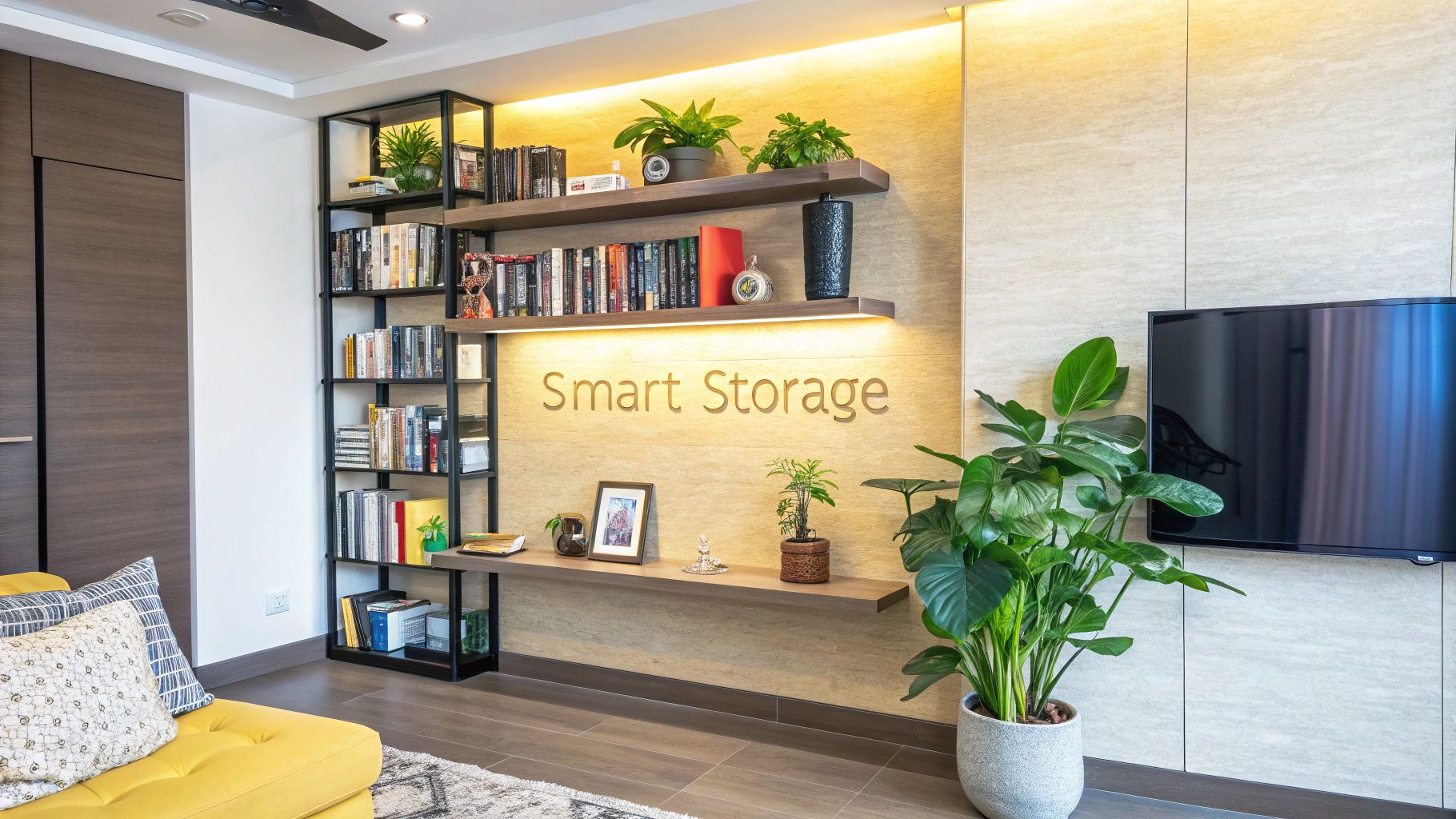
- Layering with Height and Depth: This is crucial. A shelf where everything is the same height looks flat. Mix it up. Place tall vases next to shorter decorative boxes, and position smaller items slightly in front of larger ones to create depth.
- Embrace Negative Space: Not every centimetre needs to be filled. This "breathing room" is as important as the objects themselves. It prevents a cluttered look and allows each piece to stand out.
These principles form the backbone of a balanced, professionally curated arrangement.
A Practical Formula for Arranging Items
With those principles in mind, you can begin building your display. We often provide clients with a simple, repeatable formula that works every time.
A well-styled shelf is a balanced mix of form, function, and personality. It should reflect who you are, blending personal mementos with aesthetically pleasing objects and a touch of nature.
Here’s a step-by-step approach to get your shelves looking sharp:
- Start with Anchor Pieces: Place your largest items first—a tall vase, a stack of art books, or a prominent sculpture. Position them across your shelves using the rule of thirds.
- Add Books with Variation: Don’t just line books up vertically. Mix it up. Stand some upright (use bookends) and stack others horizontally. A horizontal stack also creates a platform to elevate a smaller decorative object.
- Incorporate Natural Elements: Add life and texture with plants. A trailing pothos, a small succulent, or a vase with fresh eucalyptus can soften hard lines and add a touch of green.
- Weave in Personal Mementos: This makes the shelf yours. Add framed photos, travel souvenirs, or an inherited trinket. Group smaller items on a decorative tray or in a small box so they don’t get lost.
- Finish with Texture and Shine: Add objects made from different materials for the final layer. A metallic photo frame, a smooth ceramic bowl, or a glass paperweight can catch the light and add visual interest to complete the look.
Still Got Questions About Wall Shelves?
Let’s wrap up by addressing common questions we hear from clients in Singapore. Sorting these out early makes the design process much smoother.
One of the first questions is always about cost. For custom carpentry, a realistic budget is between S$150 to S$400 per foot run. The final price depends on the materials, design complexity, and finish selected.
Online shopping has certainly made off-the-shelf options more accessible. E-commerce is a huge part of the furniture market, which is projected to hit US$932.41 million by 2025. This digital shift has been a game-changer for homeowners, especially for the 1.2 million households in HDB flats where compact designs are essential. You can find more insights into Singapore's furniture market trends on Statista.com.
HDB Rules and Other Common Worries
Beyond cost, clients often ask about HDB regulations and maintenance in our humid climate. Knowing the basics will keep your installation safe, compliant, and looking good.
- HDB Do's and Don'ts: The golden rule is: do not drill into or modify any structural walls, beams, or columns without approval. If you are unsure which walls are structural, check your HDB floor plan or consult a professional.
- Keeping Mould at Bay: Mould is a valid concern. The best prevention is choosing moisture-resistant materials from the start, like powder-coated metal or high-quality laminates. Ensuring good air circulation around your shelves is also a simple but effective measure.
We often get asked: "Can I mount a heavy collection of books on a partition wall?" The short answer is no, it's not recommended. Those walls are not designed to bear that kind of sustained load.
For heavy items, there are safer alternatives. You could use reinforced shelving that distributes the weight more effectively or opt for floor-supported units that don't put stress on the wall. These solutions provide the necessary strength without compromising your home's structural integrity.
Ready to turn those empty walls into something beautiful and functional? The team at KIVO brings together decades of design expertise and artisan skill to create shelving that’s made just for you. Start your design journey with us at kivo.com.sg today.