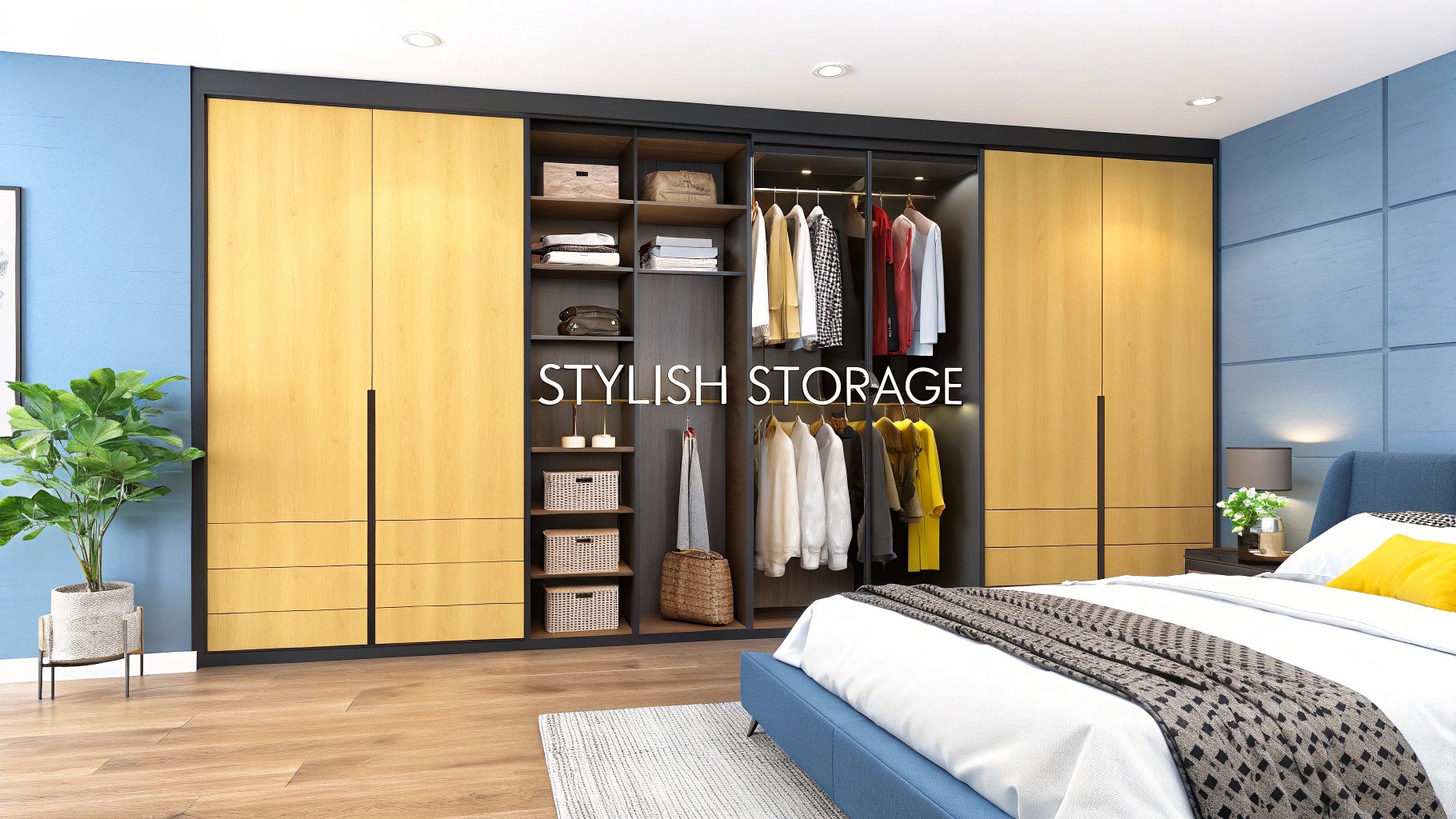
Choosing the right wardrobe isn't just a minor detail—it's one of the most important decisions you'll make for your bedroom's design and daily rhythm. This isn't just a box to hang clothes in; it’s a core piece of furniture that defines the room's entire feel and how well it works for you. A great wardrobe perfectly marries your storage needs with the reality of your space, creating a calm, organised retreat.
Finding the Perfect Wardrobe for Your Bedroom
This guide goes beyond just looks to tackle the real-world challenges of living in Singapore. We’re going to break down everything you need to know about choosing the perfect wardrobes for the bedroom, so you can make a smart decision that you’ll love for years. Get it right, and you bring both order and style into your most personal space.
The growing importance of this decision is easy to see in the numbers. With the retail furniture market expected to jump from USD 2.17 billion in 2024 to an estimated USD 3.82 billion by 2033, it's clear that homeowners are investing more in quality pieces that turn everyday living into something special.
Balancing Space and Storage Needs
In Singapore, where every square metre is precious, the biggest hurdle is finding that sweet spot between available space and your actual storage needs. It doesn't matter if you're in an HDB flat or a condo; the aim is always to maximise every inch without making the room feel cramped. A practical way to start is by seeing your wardrobe not as a standalone item, but as an integrated part of your room's architecture.
Before you do anything else, take a moment to audit what you actually need to store.
- Formal Wear: Do you have long dresses, suits, or coats that need full-length hanging space? A client of ours needed a dedicated 1.8m high section for his ceremonial uniforms, a detail we only uncovered by asking.
- Casual Attire: Is your wardrobe mostly folded clothes like t-shirts and jeans? If so, you'll need more shelves and drawers. Think about drawer depth—shallow drawers for tees, deeper ones for bulky sweaters.
- Accessories: What about that growing collection of bags, shoes, ties, or watches? They'll need their own dedicated spots—perhaps vertical dividers for clutches or soft-lined trays for watches.
- Other Items: Will this wardrobe also need to hide away things like bedding, luggage, or other bulky items? We often design a top-level compartment specifically for luggage, making use of hard-to-reach vertical space.
Figuring this out is the essential first step towards a wardrobe that actually works for you. As you get started, understanding the essential features of bedroom furniture storage can give you a great foundation to build on.
The Three Main Types of Wardrobes
When it comes down to it, your choice will likely fall into one of three main categories. Each has its own set of pros and cons depending on your space, budget, and how long you plan to stay.
A wardrobe should do more than just store things; it should make your daily routine smoother. The right design makes getting ready feel effortless because everything has its own place, turning a practical necessity into a source of calm.
Let's dive into the three main players:
- Built-In Wardrobes: These are custom-made to fit a specific nook or wall, squeezing out every last bit of storage potential and creating a clean, seamless look.
- Freestanding Wardrobes: Think of these as standalone pieces of furniture. They’re versatile, movable, and come in a huge range of styles and sizes.
- Walk-In Wardrobes: The dream option for many, this is basically a small room dedicated entirely to your clothes and accessories, offering the ultimate in organisation.
Each of these types can be customised to create a space that’s a true reflection of you. In the next few sections, we'll give you all the details you need to pick the perfect one for your bedroom.
Built-In vs Freestanding vs Walk-In Wardrobes
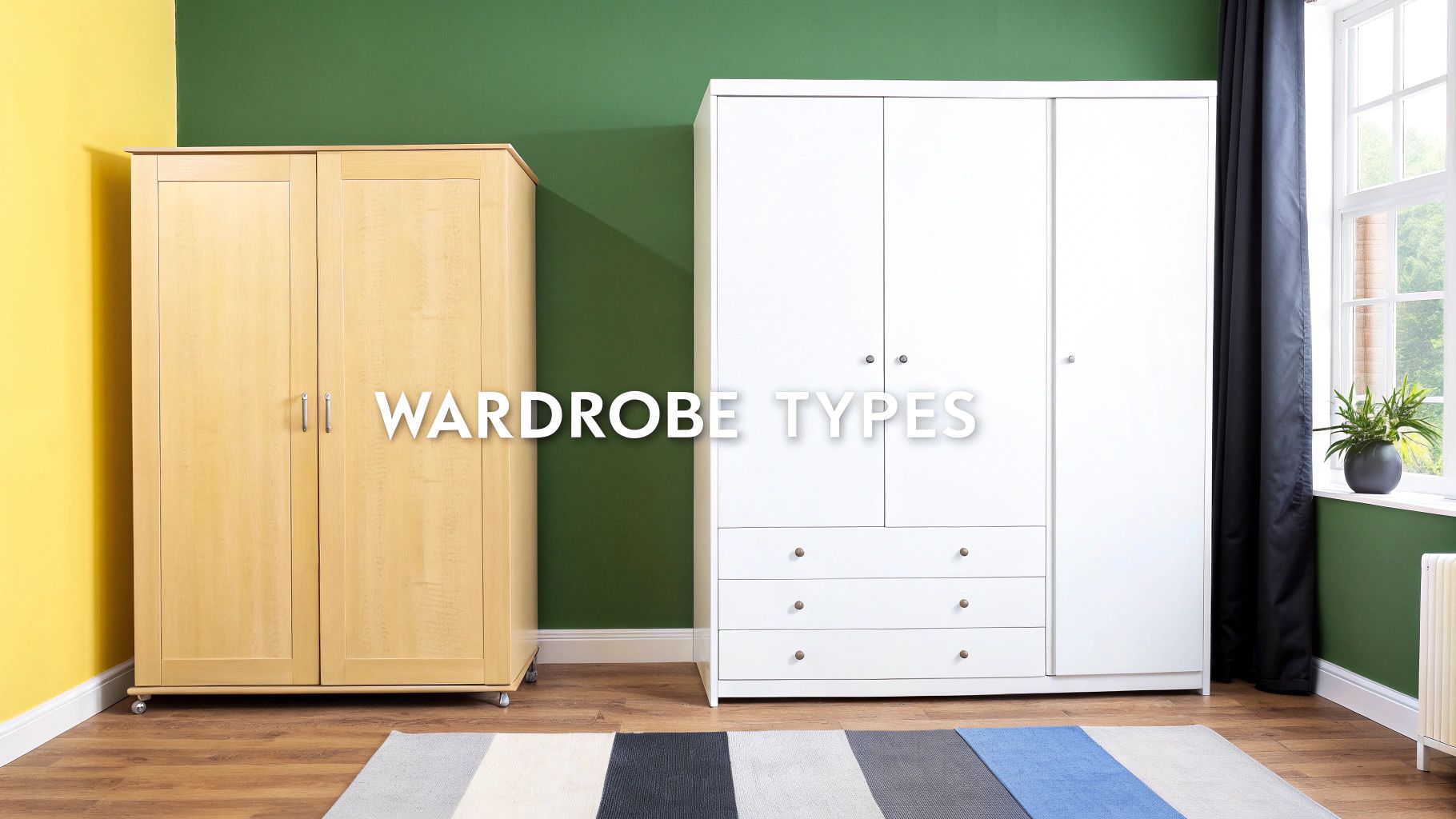
The first big decision on your wardrobe journey is choosing the right type: built-in, freestanding, or walk-in. Each one has a completely different take on organisation, style, and how it uses your space. Getting this choice right depends on your home’s layout, your lifestyle, and what you see for yourself in the long run.
It's clear that well-designed storage is no longer an afterthought. In fact, the Closets segment in Singapore is projected to be worth a staggering US$81.88 million by 2026. This isn't just about buying furniture; it's an investment in creating calm, functional, and beautiful spaces. You can learn more about these trends from Singapore's bedroom furniture market data on Statista.
Let’s break down the practical differences to find the perfect fit for your Singapore home.
The Space-Saving Champion: Built-In Wardrobes
Think of a built-in wardrobe as a piece of custom architecture for your bedroom. Also known as fitted wardrobes, they are designed and constructed to slot perfectly into a specific nook or wall. They typically stretch from floor to ceiling and wall to wall, which means no awkward gaps for dust bunnies to hide.
This seamless, integrated look makes them a huge favourite in HDBs and condos, where making every centimetre count is the name of the game. Because they are custom-made, you get total control over the internal layout, materials, and door style, ensuring it feels like it was always meant to be there.
Advantages of Built-In Wardrobes:
- Maximum Space Utilisation: They use every last bit of vertical and horizontal space, giving you far more storage than a freestanding piece in the same footprint.
- Tailored Interior: You can map out the inside to perfectly fit your stuff—with special spots for long dresses, shoes, accessories, and folded clothes.
- Seamless Look: A built-in wardrobe looks like an intentional part of the room’s design, creating a clean, high-end, and uncluttered feel.
The Flexible Alternative: Freestanding Wardrobes
Freestanding wardrobes are the classic, standalone pieces of furniture you can buy off-the-shelf or from a furniture maker. They come in a massive range of styles, sizes, and materials, from charming vintage armoires to sleek, modern designs.
Their biggest selling point is flexibility. If you move or just feel like redecorating, you can take your wardrobe with you or simply shift it to another wall. This makes them a great option for renters or anyone who loves to switch up their room’s layout. The downside? They rarely fit a space perfectly, often leaving unused gaps at the top or sides.
A key consideration for homeowners is permanence. A built-in wardrobe is a permanent fixture that adds value to your property, while a freestanding one is a piece of furniture you own.
The Ultimate Luxury: Walk-In Wardrobes
A walk-in wardrobe isn't just a piece of furniture—it’s a small, dedicated room for your clothing and accessories. It's the absolute peak of luxury and organisation, giving you an unmatched amount of space where you can see all your belongings at a single glance.
It transforms the daily chore of getting dressed into a moment of calm and order. Of course, this option is usually only possible in larger homes or for those willing to sacrifice a spare room. For example, we recently transformed a small, underused study next to a master bedroom into a stunning walk-in closet for a client. By taking down a non-structural wall, we created a luxurious dressing area that completely changed the feel of the entire master suite.
While it's a significant investment, a well-designed walk-in wardrobe provides an incredible level of organisation and adds serious appeal to a property.
To make the choice a little clearer, here’s a quick comparison of the three main types of wardrobes.
Wardrobe Type Comparison at a Glance
| Feature | Built-in Wardrobe | Freestanding Wardrobe | Walk-in Wardrobe |
|---|---|---|---|
| Space Utilisation | Excellent; uses all available space floor-to-ceiling | Moderate; often leaves gaps | Best; dedicated room for storage |
| Customisation | Fully customisable interior and exterior | Limited to available models | Fully customisable layout and fittings |
| Flexibility | Permanent fixture; cannot be moved | Highly flexible; can be moved or taken when you move | Permanent room conversion |
| Installation | Professional installation required | Minimal to no installation needed | Requires major construction/renovation |
| Cost | Mid to high | Low to high, depending on quality | Highest initial investment |
| Best For | HDBs, condos, and homeowners wanting a seamless, integrated look | Renters, budget-conscious buyers, and those who like to redecorate | Larger homes or homeowners prioritising luxury and organisation |
Ultimately, whether you choose the seamless efficiency of a built-in, the easy flexibility of a freestanding, or the pure luxury of a walk-in, the goal is the same: to create a space that works perfectly for you.
Choosing Materials and Finishes That Last
The materials and finishes you pick for your wardrobe do more than just define its look—they determine how well it will stand up to the test of time. Think of your wardrobe as a long-term investment. The right choices will ensure it survives daily use and Singapore's humid climate, looking just as good in ten years as it does today. It’s all about striking that perfect balance between beautiful aesthetics and solid, reliable performance.
This is where we get into the nuts and bolts of your wardrobe's structure. The core material is the foundation, influencing everything from strength and weight to how it handles moisture. Based on our projects, what homeowners really want are materials that are not just stylish, but practical and built to last.
Core Materials: The Building Blocks of Your Wardrobe
Picking the right base material is your first big decision. Each option comes with its own set of strengths, making it a better fit for different needs, budgets, and styles.
- Plywood: Let's be honest, this is our go-to for custom carpentry here in Singapore. Plywood is made by gluing together thin layers of wood veneer, which creates an incredibly strong board that’s highly resistant to warping in our humid weather. It also holds screws and hardware like a champ, making it the perfect choice for the wardrobe's carcass (the main box structure).
- Solid Wood: Nothing quite matches the timeless warmth and character of solid woods like teak, oak, or walnut. It’s incredibly durable and can be repaired or refinished down the road. The catch? It’s the priciest option and can react to big swings in humidity, which is something we always have to consider in our climate.
- MDF (Medium-Density Fibreboard): MDF is an engineered product made from wood fibres and resin. Its biggest advantage is its perfectly smooth surface, which provides an amazing canvas for paint or a high-gloss finish. While it's easier on the wallet, it's heavier than plywood and doesn't handle moisture as well, so we generally reserve it for door fronts rather than the main structure.
The internal frame of your wardrobe absolutely has to be its strongest part. That's why we almost always recommend a high-quality plywood for the carcass. It gives you the structural integrity needed to hold heavy clothes and stand firm against humidity for decades to come.
Finishes: Defining Your Style and Durability
The finish is the part of your wardrobe you see and touch every single day. It sets the tone for the entire room's aesthetic while also acting as the first line of defence against wear and tear.
Laminates (High-Pressure Laminates or HPL): This is, without a doubt, the most popular choice among our clients in Singapore, and for very good reason. Laminates are multi-layered sheets fused together under intense pressure, creating a surface that is:
- Extremely Durable: They’re fantastic at resisting scratches, stains, and even heat.
- Moisture Resistant: This is a non-negotiable feature for Singapore’s climate.
- Low Maintenance: A simple wipe-down with a damp cloth is all it takes.
- Huge Design Variety: They come in thousands of colours and textures—from hyper-realistic wood grains to sleek matte solids and even finishes that mimic fabric or stone.
Wood Veneer: For anyone who loves the authentic, premium look of solid wood but not the price tag, veneer is a brilliant alternative. It’s a paper-thin slice of real wood applied over a stable base like plywood. This gives you the genuine grain and warmth of natural wood, but with the structural stability of an engineered core. It just feels more upscale and organic than a laminate.
Paint or Lacquer: A painted finish opens up a world of limitless colour options. You can achieve a very specific look, whether it’s a classic, soft matte or a slick, modern high-gloss. A glossy finish is particularly good for bouncing light around and making a smaller bedroom feel bigger and brighter. The trade-off is that painted surfaces can be more prone to chipping than laminates, so they might need a bit more TLC over the years.
Designing Your Wardrobe's Interior Layout
A beautiful wardrobe exterior is one thing, but it’s the interior layout that truly simplifies your life. A thoughtfully designed inside is much more than just a hanging rod and a few shelves; it’s about creating a personalised system where everything has its own designated, easy-to-reach home. This is how you go from a cluttered mess to a streamlined space that makes your morning routine effortless.
The real goal is to map out a layout that works intuitively for you. People often think more space automatically means better organisation, but the truth is, it’s about making smart use of the space you have. The difference between chaos and calm almost always comes down to clever internal planning.
Starting With a Wardrobe Audit
Before you can design the perfect interior, you need to get real about what you actually own. We call this a 'wardrobe audit', and it’s a simple but crucial first step to figuring out your true storage needs. This isn't about decluttering just yet—it's purely about taking inventory.
Start by grouping your belongings into categories. This simple exercise gives you a visual blueprint of what your new wardrobe needs to accommodate.
- Hanging Items: Separate them by length. How many long coats or dresses do you have versus shorter items like shirts and blouses? This tells you if you need full-length hanging space or if you can double up with two shorter rails.
- Folded Items: Get a count of your bulky knitwear, t-shirts, and jeans. This will determine how much shelving or deep drawer space is required.
- Shoes and Accessories: Tally up your shoes, bags, belts, scarves, and watches. These smaller items are usually the biggest culprits of clutter and get the most benefit from specialised compartments.
- Bulky Goods: Do you need to stash luggage, extra bedding, or seasonal items? Planning for these from the start stops them from ending up on the floor.
Once you have a clear inventory, you can start allocating space much more efficiently.
Smart Storage Solutions Beyond the Basics
With your audit complete, it’s time to look at the clever components that make modern wardrobes for the bedroom so effective. When you move beyond a one-size-fits-all approach, you can tailor every section to your specific lifestyle.
Think about mixing and matching some of these solutions:
- Adjustable Shelving: Absolutely essential for adapting to your changing needs, whether it's stacks of sweaters one season or storage boxes the next.
- Pull-Out Trays and Racks: A game-changer for trousers, shoes, or accessories. They let you see everything at a glance without having to dig through messy piles. A client recently requested a pull-out rack specifically for her collection of shawls.
- Dedicated Compartments: Small, partitioned drawers are brilliant for organising ties, watches, jewellery, and belts.
- Integrated Features: We’ve designed wardrobes with hidden, fold-down ironing boards, pull-out mirrors, and even built-in laundry hampers to save precious floor space.
A well-designed interior layout anticipates your needs. It’s not just about storage; it's about creating a smooth, logical flow that makes finding what you need second nature, saving you precious time every single day.
For those wanting to take efficiency to the next level, learning how to build a personalised closet organizer can offer fantastic ideas for your wardrobe's interior. This is what customisation is all about—turning a standard storage unit into a truly personal part of your home. By thoughtfully planning the inside, you ensure your new wardrobe is as intelligent as it is beautiful.
How to Size and Place Your Wardrobe Correctly
Getting the size and placement of your wardrobe right is what separates a seamless design from a bulky afterthought. This isn't just about making furniture fit; it's about making your bedroom flow. When done correctly, the wardrobe feels like a natural part of the room, enhancing your daily routine instead of getting in the way.
This focus on thoughtful integration is becoming more common. Homeowners in Singapore are increasingly investing in functional, beautiful spaces. In fact, market analysis shows that from 2020 to 2024, per capita spending on bedroom furniture grew steadily alongside incomes and urbanisation. You can explore the Singapore bedroom furniture market trends on MarketResearch.com. This trend points to a clear desire for well-planned, high-quality homes.
Essential Measurements for a Perfect Fit
Before you fall in love with a design, you need to get the measurements right. Being off by even a few centimetres can mean doors that won't open properly or a wardrobe that completely overwhelms the room. So, grab your measuring tape and let's get precise.
Key Bedroom Measurements:
- Ceiling Height: Measure this in a few different spots. Ceilings are rarely perfectly level, and for a built-in wardrobe, this ensures you get that true floor-to-ceiling fit without any awkward gaps.
- Wall Width and Depth: Get the total wall space available, but also figure out the maximum depth the wardrobe can be without blocking walkways or making the room feel cramped. The standard depth is 60cm, which allows hangers to sit straight.
- Door and Window Locations: Note down exactly where doors and windows are, including their frames. Don't forget to measure how far they swing open—a classic mistake is placing a wardrobe where it blocks a door from opening fully.
A critical measurement that people often forget is clearance. As a rule of thumb, we recommend leaving at least 75cm to 90cm of clear walkway space around your bed and in front of the wardrobe. This ensures you can move around comfortably without squeezing past furniture.
Ergonomics: The Science of Comfortable Access
Beyond just fitting in the room, your wardrobe needs to be easy to use. That's where ergonomics comes in. A well-designed interior thinks about your reach and posture, making it effortless to grab what you need.
Practical Ergonomic Guidelines:
- Hanging Rail Height: Your main hanging rail should sit somewhere between 170cm and 190cm from the floor for easy access. If you're planning a double-hang system for shirts and trousers, the lower rail typically goes around 90cm.
- Shelf Depth: Keep your shelves between 35cm and 45cm deep. Anything deeper and items get lost in the back, destined to be forgotten until your next big clean-out.
- Drawer Height: The drawers you use most should be placed between your waist and shoulder height. This is the sweet spot for accessibility, saving you from constant bending or stretching.
Strategic Placement for Function and Flow
Where you put your wardrobe can completely change the feel of your bedroom. It can be a discreet storage workhorse or a stunning design statement.
In a smaller bedroom, placing a wardrobe with mirrored doors opposite a window is a brilliant trick. It bounces natural light around and creates an illusion of a much larger space. For a spacious master bedroom, you could turn a beautifully finished wardrobe into a focal point that anchors the room's entire design.
We always map out the room's main traffic path—from the door to the bed, and to the bathroom—to make sure the wardrobe’s placement enhances this natural flow rather than getting in the way.
Bringing Your Custom Wardrobe Vision to Life
This is where the magic happens—where your ideas and inspiration get turned into something real and beautiful. Creating a bespoke wardrobe isn't just a transaction; it’s a collaborative journey that starts with a simple chat and ends with a flawless piece of custom carpentry in your home.
It’s a careful, deliberate process. The goal isn't just to build a piece of furniture, but to create something that’s a perfect extension of your lifestyle and taste.
We always kick things off with a detailed consultation. This is much more than just getting out the measuring tape. We dive deep into your daily routine, talk about your storage frustrations, and really listen to what you want your room to feel like. Maybe you need special compartments for a watch collection or want to cleverly hide a vanity table inside—we want to know all of it.
Visualising Your Perfect Wardrobe
Let's be honest, one of the biggest worries for any homeowner is trying to picture how the final piece will actually look in the room. To take all that guesswork and anxiety out of the equation, we use powerful 3D visualisation tools. This tech is a game-changer in our design process. It lets you see a photorealistic render of your new wardrobe before we've even cut a single piece of wood.
This step means you can:
- Explore Finishes: See exactly how that dark wood laminate looks against your wall colour or how a certain veneer pairs with your flooring.
- Refine the Layout: Virtually swing open the doors and pull out the drawers. Does the internal layout really work for you? Now’s the time to tweak it.
- Approve Every Detail: Confidently sign off on everything from the style of the handles to where the lights will go. No nasty surprises on installation day.
This digital blueprint gets us all on the same page and gives you complete confidence that what you see is what you’ll get. It closes the gap between imagination and reality, making the whole process transparent and fun.
The Art of Custom Carpentry
Once you’ve given the final design your seal of approval, our skilled carpenters get to work. This is where a real commitment to craftsmanship makes all the difference. Every single part of your wardrobe is precision-cut and assembled right here in our workshop, giving us total control over quality from start to finish.
We believe the excellence is in the details. That means every joint is snug, every edge is perfectly finished, and every handle is installed with precision. For instance, we recently crafted wardrobes for the bedroom of a client in a conservation shophouse. They wanted something modern that still paid respect to the building’s heritage. We sourced the perfect wood-grain laminate and matched it with minimalist black handles, creating a wardrobe that felt both contemporary and timeless.
The true value of bespoke carpentry lies in its ability to solve unique challenges. It’s about creating a wardrobe that not only fits your space perfectly but also fits your life perfectly, down to the smallest detail.
This dedication is what elevates a good design to a great one. You’ll feel it in the smooth glide of a soft-closing drawer and the solid thud of a well-hung door. These are the markers of true quality, ensuring your new wardrobe will not only look stunning but will also stand the test of time.
Your Top Wardrobe Questions, Answered
Planning for a new wardrobe is a big deal, and naturally, you’ll have questions. We get it. A wardrobe isn't just a piece of furniture; it's a significant investment in your home's functionality and style.
Drawing from years of hands-on experience in custom carpentry here in Singapore, we’ve put together answers to the most common questions we hear from homeowners just like you. Getting clear, practical answers upfront means you can move forward with confidence.
What Is the Typical Cost for a Custom Built-In Wardrobe in Singapore?
The final price tag for a custom built-in wardrobe really depends on a few key things: its size, the materials you choose, the complexity of the internal fittings, and the finishes.
As a general ballpark figure, homeowners in Singapore can expect to invest between SGD $250 to $500 per foot run (pfr).
So, for a standard 6-foot, full-height wardrobe, you might be looking at a range of $1,500 to $3,000. Of course, opting for premium materials like real wood veneers, adding specialised hardware like soft-closing mechanisms, or designing intricate internal organisers will nudge the price toward the higher end of that scale. We always provide a transparent, itemised quote after our first design chat, so there are no surprises.
How Long Does It Take to Build and Install a Custom Wardrobe?
From the moment you give the design the green light to the final installation, the whole process typically takes about 4 to 6 weeks. This timeline allows us to get every detail just right, without rushing.
Here’s a quick breakdown of what happens during that time:
- We start by taking meticulous, precise measurements of your space.
- Next, our design team creates detailed 3D models for you to review and approve.
- Once you're happy, fabrication begins in our local workshop.
- Finally, we schedule a convenient time for the on-site installation.
The installation itself is surprisingly quick, usually taking just 1 to 3 days, depending on how big and complex your wardrobe is. We work closely with you to map out a clear timeline and keep any disruption to your home to an absolute minimum.
Should I Choose Hinged or Sliding Doors for My Wardrobe?
This is one of the most practical decisions you'll make, and the best choice really comes down to your room's layout and your personal taste.
Sliding doors are fantastic space-savers. If you have a smaller bedroom or the wardrobe is in a tight spot (like near the bed), they are the perfect solution because they don't need any room to swing open. They also lend a clean, modern look to the space.
Hinged doors, on the other hand, have a classic appeal and give you the huge advantage of seeing your entire wardrobe at once when they're open. This makes finding what you need a breeze. They often fit beautifully with more traditional or transitional bedroom designs. During our design consultation, we’ll assess your space and daily routine to help you pick the option that makes the most sense.
The right door type is about more than just looks; it's about making your daily routine smoother. A sliding door can make a cramped walkway feel spacious, while hinged doors offer unparalleled access to everything inside at a glance.
Ready to create the perfect wardrobe that’s designed just for you? At KIVO, our team combines expert craftsmanship with thoughtful design to build storage solutions that are as beautiful as they are functional. Let us help you transform your bedroom into an organised, stylish sanctuary.
Discover our custom carpentry and interior design services by visiting us at https://kivo.com.sg.