Choosing the right wood for your kitchen cabinets is the most critical decision in a renovation. It dictates the look, feel, and lifespan of your entire kitchen. The choice isn't just about aesthetics; it’s about selecting a material that can withstand Singapore's humidity and the demands of daily life. The two main options are timeless solid hardwoods and high-performance engineered woods. Making an informed decision here is the key to a kitchen that is both beautiful and built to last.
Foundation of Choice: Solid vs Engineered Wood
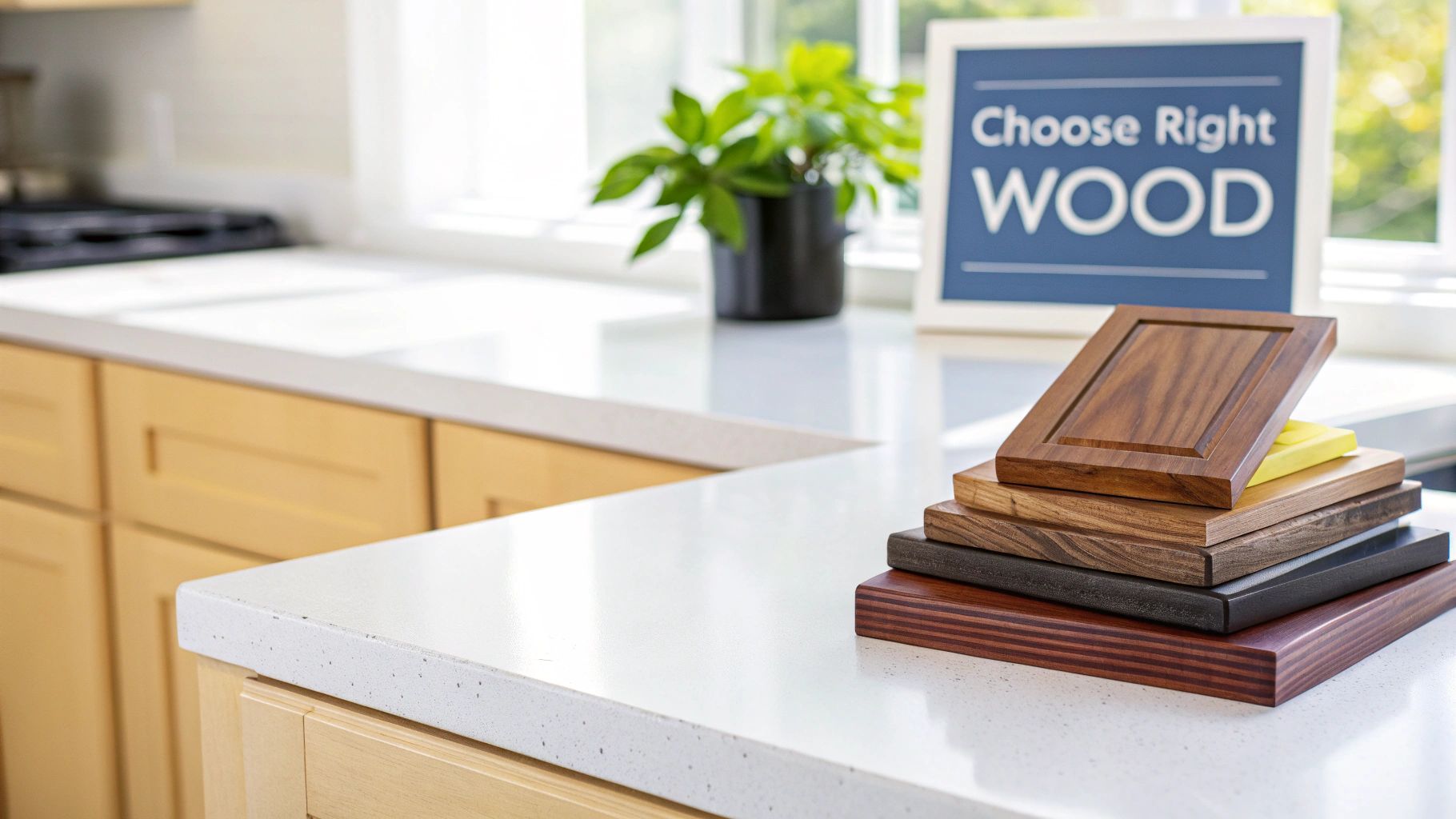
Before settling on a specific grain or finish, it's essential to understand the functional differences between solid and engineered wood. This choice impacts everything from your kitchen's final appearance to its structural integrity and budget. One isn't inherently "better" than the other; the right choice depends on your home, lifestyle, and our local climate.
Solid wood is milled directly from trees, offering authentic, unique grain patterns that cannot be replicated. Engineered wood, on the other hand, is a composite material made from wood fibres, veneers, and adhesives pressed into stable panels. This manufacturing process gives it significant performance advantages in specific applications.
Key Performance Differences
Let's break down the practicalities. Solid wood is a natural material that expands and contracts with changes in temperature and humidity. While hardwoods are incredibly dense and tough, this movement can be problematic in Singapore's consistently humid environment. Over time, it can lead to slight warping or joint separation if not properly managed.
In contrast, high-quality engineered woods like plywood are designed for stability. They are constructed in layers, with the grain of each layer running perpendicular to the next. This cross-lamination provides exceptional dimensional stability, making them highly resistant to warping, shrinking, or swelling. This reliability is why we exclusively use high-grade plywood for cabinet boxes (carcasses). If you want to explore more on this topic, check out Timbercloud's Blog for further insights.
The smartest designs often use a hybrid approach: exceptionally stable engineered wood for the cabinet carcasses and stunning solid wood for the doors and frames. This gives you the best of both worlds—durability where it counts and aesthetic beauty where it's most visible.
A Clear Comparison
To make the choice clear, here’s a straightforward comparison based on what matters for kitchen cabinets in Singapore:
| Feature | Solid Hardwood | Engineered Wood (High-Grade Plywood) |
|---|---|---|
| Aesthetic Appeal | Unmatched natural beauty, unique grain patterns, and rich colour. | Consistent appearance; can be finished with real wood veneer for a similar look. |
| Stability | Prone to natural expansion and contraction with humidity changes. | Highly stable and resistant to warping, shrinking, and swelling. Ideal for Singapore. |
| Durability | Extremely durable and can be sanded and refinished multiple times. | Very durable, especially moisture-resistant (MR) and marine-grade options. |
| Cost | Generally higher due to material and processing costs. | More cost-effective, providing excellent value for structural components. |
| Best Application | Cabinet doors, drawer fronts, and face frames where visual impact is key. | Cabinet boxes (carcasses), shelves, and substrates for laminate or paint. |
Ultimately, a high-performing kitchen comes from a strategic combination of both materials, leveraging the strengths of each to create a final product that is beautiful and truly built to last.
A Guide to Solid Hardwoods
When it comes to the visible parts of your cabinetry, like doors and drawer fronts, nothing matches the timeless character of solid wood. Each plank has unique grains, knots, and colour variations that give your kitchen a distinct personality. However, the choice isn't just about looks; it’s about selecting a hardwood that can withstand our humid climate without issues. Let's review the top contenders we recommend to our clients.
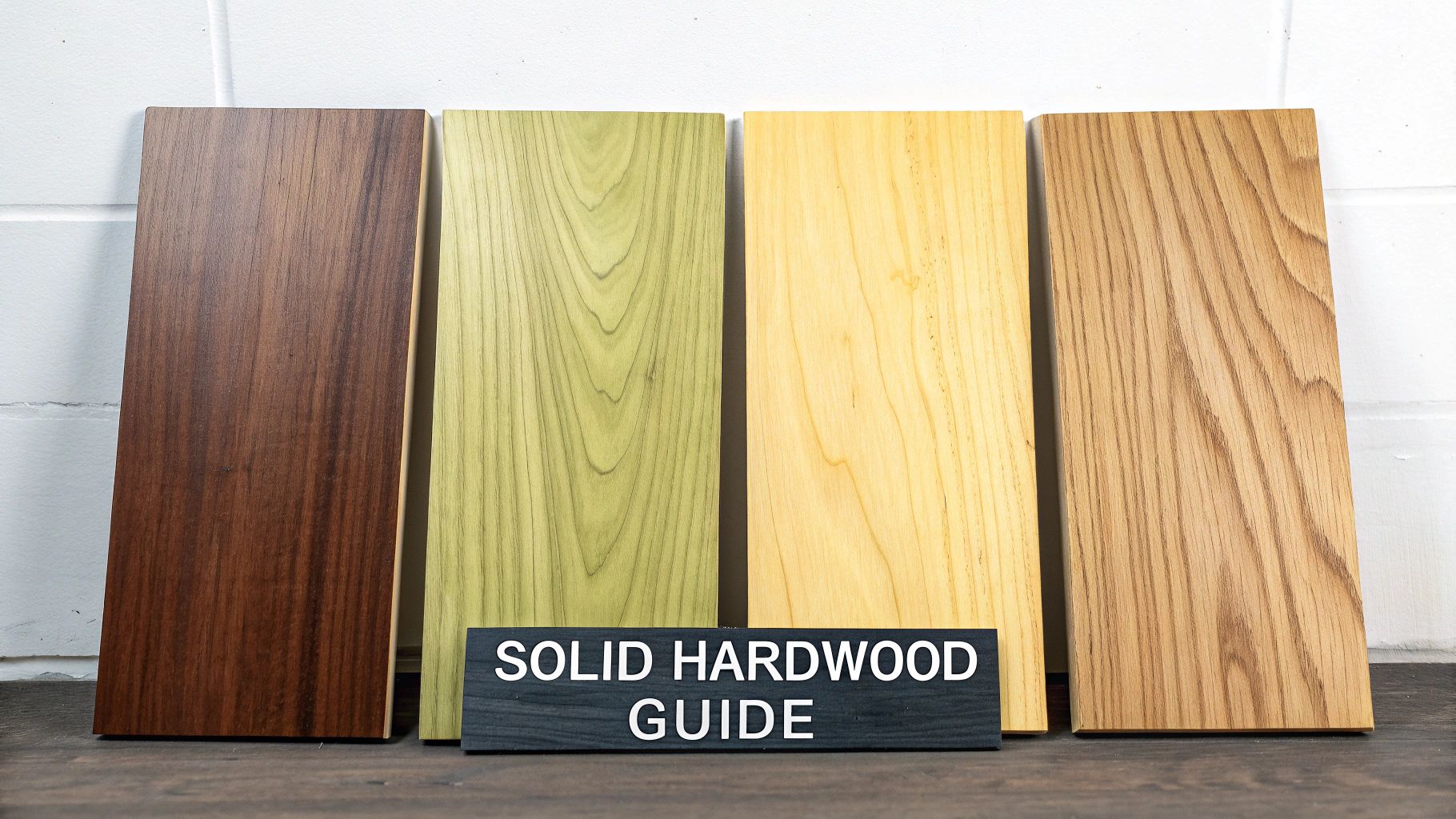
Oak: The Resilient Classic
Oak is a powerhouse known for its strength and prominent grain pattern. While Red Oak has warmer undertones, we almost exclusively specify White Oak for kitchens in Singapore. Its closed-grain structure makes it naturally more resistant to moisture, a crucial feature in our climate.
The pronounced grain gives oak a rich, tactile quality, perfect for classic, farmhouse, or rustic designs. With a Janka hardness rating of around 1,360, it’s tough enough to handle the daily wear and tear of a busy family kitchen.
Maple: The Smooth Modernist
For a clean, uniform finish, Maple is the ideal choice. It has a very fine, subtle grain and a creamy, light colour, providing a perfect canvas for paint. We frequently use it in contemporary BTO flats where a seamless, polished look is desired. Its non-porous surface accepts paint beautifully, resulting in a smooth, even finish.
Maple is exceptionally durable, even harder than Oak, with a Janka rating of 1,450. This makes it a fantastic workhorse for high-traffic kitchens. A practical point to note: its dense nature can make staining look blotchy if not handled by an experienced professional.
Based on client feedback, Maple truly excels under a professional spray-painted finish. Its smooth surface allows for a flawless, factory-like coating that highlights the precision of the cabinetry without the distraction of a heavy wood grain. This is a look many homeowners are seeking now for a clean, modern aesthetic.
Cherry: The Elegant Chameleon
Cherry wood offers a sophisticated, smooth, closed-grain texture and luxurious warmth. It begins as a light, pinkish-brown and deepens over time to a rich, reddish-brown patina when exposed to light. This natural ageing process is one of its most desirable traits, adding character to traditional and transitional kitchens.
While softer than Oak or Maple (Janka rating of about 950), Cherry is still durable enough for cabinetry. Its main appeal is its aesthetic elegance. The way it ages means your kitchen will gain more character over the years.
Walnut: The Luxurious Statement
For a touch of pure luxury, Walnut is unmatched. Its deep, chocolate-brown colour, often streaked with beautiful grain patterns and purplish undertones, makes a bold statement. It's the perfect choice for a stunning kitchen island or a feature wall of cabinets.
At a Janka rating of 1,010, Walnut is a softer hardwood and more prone to dents. We recommend it for clients who prioritise its visual drama and are prepared to be a bit more mindful. In our experience, pairing Walnut with brass or gold hardware creates an opulent and timeless design that many clients request for high-end homes.
The demand for these premium woods reflects a broader trend. Singapore's household furniture and kitchen cabinet market is growing, with wood comprising 60-65% of materials in new kitchens. The aesthetic appeal of wood is a major draw, especially in open-concept HDBs and condos. Well-built wooden cabinets can last 15-20 years in our climate, a significant advantage over the typical 10-year lifespan of standard laminates. This longevity is why wood is the material of choice for 75% of premium installations. You can dive deeper into these trends on researchandmarkets.com.
Solid Hardwood At-A-Glance Comparison
This table provides a quick overview of the most popular solid woods we use, focusing on key traits for kitchen cabinets in Singapore.
| Wood Type | Hardness (Janka) | Grain Pattern | Best For Style | Humidity Resistance |
|---|---|---|---|---|
| White Oak | 1,360 | Strong, prominent lines | Classic, Rustic, Farmhouse | Very Good |
| Maple | 1,450 | Fine, subtle, uniform | Modern, Contemporary, Minimalist | Good |
| Cherry | 950 | Smooth, closed grain | Traditional, Transitional | Moderate |
| Walnut | 1,010 | Rich, straight to wavy | Luxury, Mid-Century Modern | Good |
Choosing the right solid wood involves balancing the look you love with the practical demands of your lifestyle. Each of these options can transform your kitchen from a functional space into the true heart of your home.
Engineered Woods: The Smart Choice for Modern Kitchens
While solid hardwoods offer classic appeal, engineered woods are often the smarter, more practical choice for kitchens in Singapore. They provide a powerful combination of stability, design flexibility, and value perfectly suited to modern living. These materials are not "cheaper alternatives"; they are sophisticated products engineered for high performance.
Understanding the difference between Plywood, Medium-Density Fibreboard (MDF), and Particle Board is crucial for a high-quality, long-lasting kitchen.
Plywood: The Foundation of Stability
High-quality plywood is the unsung hero of any durable kitchen. It’s made from thin layers of wood veneer, or "plies," glued together with the grain of each layer rotated up to 90 degrees. This cross-laminated structure is the secret to its incredible strength and dimensional stability.
This construction makes plywood highly resistant to the warping, shrinking, and swelling caused by Singapore’s humidity. For cabinet carcasses—the boxes themselves—we insist on moisture-resistant (MR) or marine-grade plywood. It provides a rock-solid foundation that’s built to last.
MDF: The Canvas for a Flawless Finish
Medium-Density Fibreboard (MDF) is the key to achieving a perfectly smooth, seamless cabinet finish. It's made by breaking down wood residuals into fine fibres, mixing them with wax and resin, and pressing them into dense, uniform panels. The result is a completely smooth surface with no wood grain.
This consistency makes MDF the ideal base for a perfect finish. If you desire a sleek, high-gloss lacquer, a bold painted colour, or a seamless laminate, MDF provides a flawless canvas. It’s our go-to for contemporary cabinet doors where a pristine, uniform appearance is essential.
We always specify MDF for door fronts in projects aiming for a minimalist or ultra-modern aesthetic. Its stability ensures that any routed details remain crisp, and the smooth surface allows for a glass-like paint finish that elevates the entire kitchen.
Particle Board: Strategic and Cost-Effective
Particle Board, or chipboard, is made from wood chips and sawdust bonded with resin. It is the most economical engineered wood. While it has a role, we do not recommend it for structural parts in a high-quality kitchen.
Standard particle board lacks the strength and moisture resistance needed for cabinet carcasses. However, higher-density versions can be used strategically for non-structural elements like drawer bottoms or backing panels in dry areas to manage project costs effectively.
The shift towards engineered materials is supported by market data. The Singapore cabinet market saw imports climb by 9.31% from 2023 to 2024. With high-density housing demanding efficient designs, it's logical that 90% of imported wood is engineered for better humidity resistance. Yet, homeowners still desire warmth; surveys show 68% of homeowners prefer natural finishes over synthetics, especially in smaller kitchens. You can dive deeper into the Singapore's cabinet market outlook to explore these dynamics.
A Practical Comparison: When to Use What
To simplify, here’s how we apply these materials in a typical project:
- For Cabinet Carcasses (The Box): Plywood is the only reliable choice. Its structural integrity and moisture resistance ensure your cabinets remain square and stable for decades.
- For Painted or Laminated Doors: MDF is the best option. Its perfectly smooth surface guarantees a flawless finish with no risk of wood grain showing through.
- For a Natural Wood Look: Plywood with a real wood veneer offers the best of both worlds—the stability of an engineered core with the authentic beauty of solid wood.
Choosing the right engineered wood is about intelligent design, not cutting corners. By leveraging the specific strengths of each material, we build kitchens that are not only beautiful but also exceptionally durable and perfectly suited to our local climate.
Selecting Finishes That Protect and Enhance
The wood you choose for your cabinets is only half the equation. The finish is your kitchen's first line of defence against moisture, heat, grease, and daily wear. It's more than just a colour; it’s a protective shield that determines how your cabinetry will look and perform for years.
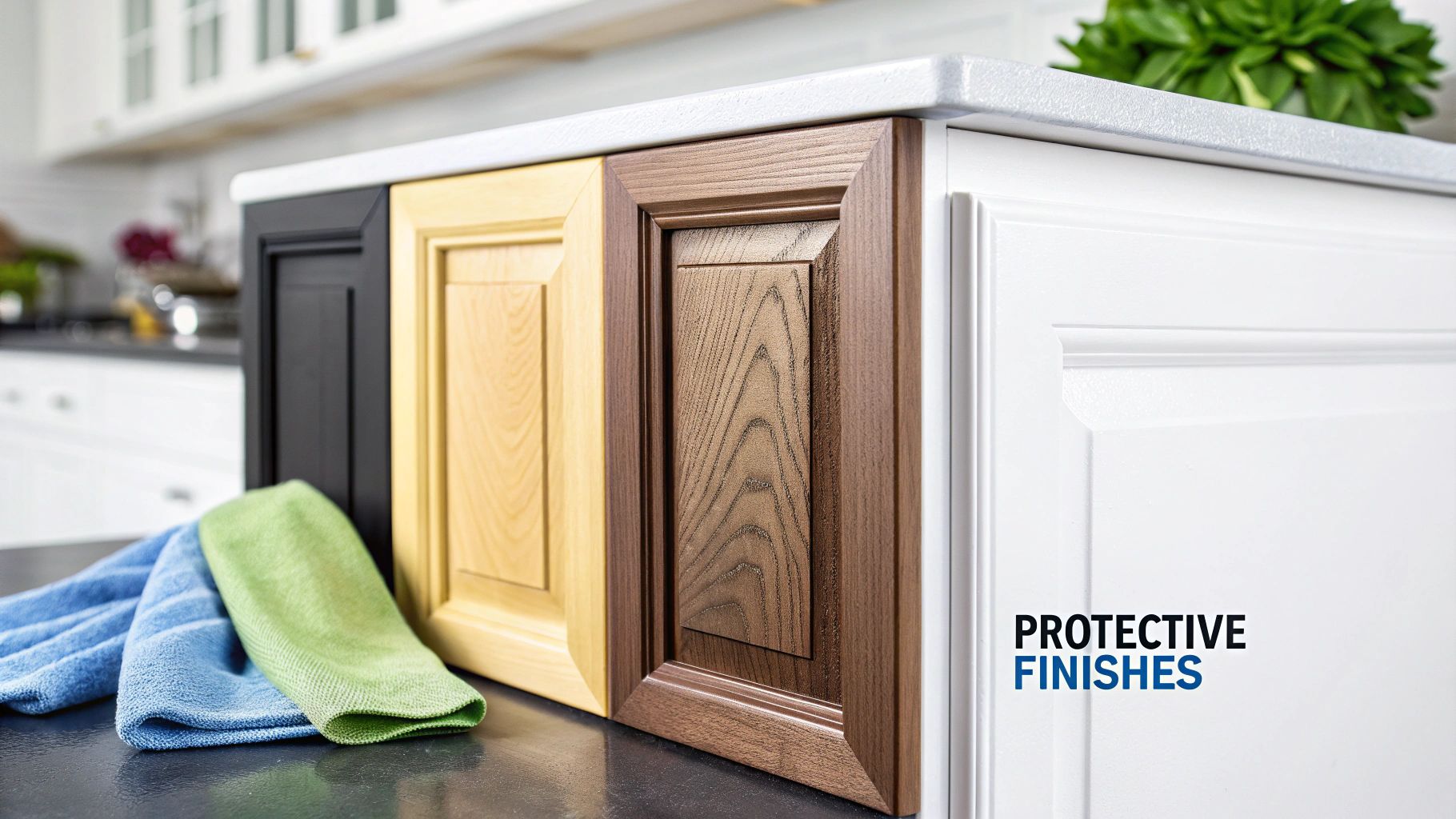
A great finish should enhance the wood's natural beauty while providing a durable, easy-to-clean surface. Let’s look at the most effective options for a busy, modern kitchen.
Comparing High-Performance Finishes
Not all finishes are created equal. The choice depends on the desired look, the type of wood, and the level of protection needed.
Polyurethane
This hard-wearing varnish offers excellent resistance to scratches, chemicals, and moisture. It creates a tough, plastic-like film over the wood.
- Best For: High-traffic areas and woods like Oak that need robust protection without hiding the grain. Oil-based polyurethane provides a warm, amber tone, while water-based options dry clear and have lower VOCs.
Lacquer
Known for its fast-drying properties and ability to produce a high-gloss, pristine surface, lacquer is a classic choice for a modern look. It’s applied in thin layers, allowing for a range of sheens from matte to mirror-like.
- Best For: MDF or fine-grained woods like Maple where a sleek, uniform painted look is desired. When selecting durable and enhancing finishes for your kitchen, understanding the best paint for cabinet painting is crucial for a flawless result.
A professionally sprayed lacquer finish delivers unmatched smoothness. However, it is less resistant to harsh chemicals and can chip with heavy impact, making it better suited for careful homeowners.
Conversion Varnish
This is a two-part, catalysed finish that creates one of the most durable surfaces available. It offers superior resistance to moisture, chemicals, and physical damage. Its complex application requires professional equipment.
- Best For: Any kitchen demanding maximum durability. It forms an exceptionally tough chemical bond with the wood, making it a premium choice for busy families or passionate cooks.
Practical Maintenance for Lasting Beauty
The right finish requires the right care. Using the wrong cleaning methods can dull the sheen and compromise the protective layer.
Here are some practical tips:
- Lacquered and Varnished Surfaces: Clean with a soft, damp microfibre cloth using a mild soap and water solution. Avoid abrasive cleaners, scouring pads, or harsh chemicals like ammonia, which can strip the finish.
- Oiled Finishes (e.g., Tung Oil on Walnut): These finishes penetrate the wood rather than forming a film on top. They require periodic re-oiling (usually once a year) to nourish the wood and prevent it from drying out. Clean spills immediately and use a cleaner made for oiled wood.
By selecting a finish that aligns with your aesthetic goals and lifestyle, you ensure your cabinetry remains a beautiful and functional centrepiece of your home.
A Practical Guide to Cabinet Costs and Value
Understanding your kitchen cabinet budget involves looking beyond the raw material cost. The final price is a combination of design complexity, construction quality, and the chosen finish. Thinking about cost is really about understanding long-term value.
Investing more upfront in a durable material like solid hardwood or high-grade, moisture-resistant plywood often saves money in the long run. These options are built to last, minimising the need for future repairs or replacements, making them a smart investment for your home.
Breaking Down the Price Factors
The final quote for your cabinetry is based on several key factors:
- Material Choice: This is the biggest cost driver. Premium solid hardwoods like Walnut or Cherry are at a higher price point than Maple or Oak. High-grade, moisture-resistant plywood offers excellent value in the mid-range, while standard MDF and particle board are the most budget-friendly.
- Construction Complexity: A simple shaker-style door is less labour-intensive to produce than an intricately detailed or curved one. Custom features like pull-out pantries, internal drawer organisers, and complex corner units also add to the cost, requiring skilled carpentry and specialised hardware.
- Finish Type: The finish significantly impacts both look and durability, affecting the price. A professionally sprayed, multi-layer lacquer or conversion varnish costs more than a basic stain-and-seal job but provides a much tougher, more resilient surface that justifies the investment.
Comparing Price Ranges and Long-Term Value
To put it in perspective, let's look at the price spectrum. Entry-level options often use laminate over particle board. Mid-range options include MDF doors with quality paint or laminate, and plywood carcasses paired with solid wood or veneered doors—this tier offers a great balance of durability and aesthetics. At the top end, you have cabinetry made entirely from solid hardwood.
The real value isn't just the upfront price. A cabinet that withstands Singapore's humidity and daily wear for twenty years offers far greater value than a cheaper alternative that needs replacing in under a decade.
This focus on durability is why wooden cabinets dominate the local market. In 2024, Singapore's wooden kitchen furniture market was valued at $56 million. The preference for hardwoods like teak and oak is clear, with over 70% of kitchen installations featuring solid wood or high-quality veneered panels chosen for their moisture resistance. You can learn more about the trends in Singapore's kitchen furniture market.
Ultimately, aligning your dream kitchen with a realistic budget is about making strategic choices. By investing wisely in materials and construction, you're not just buying cabinets; you're investing in the lasting quality and functionality of your home's most important space.
Making the Right Choice for Your Home
While technical details are important, the best wood for your kitchen cabinets is the one that fits your life. Based on our experience designing bespoke kitchens across Singapore, the ideal choice is different for every client. The key is to match the material's strengths to what you truly value.
For the High-Traffic Family Kitchen
For families with young children, cabinetry must be resilient. The focus is on maximum durability and easy maintenance to handle spills, knocks, and constant use.
- Our Recommendation: A hybrid approach using high-grade, moisture-resistant (MR) plywood for the cabinet boxes and solid White Oak for the doors.
- Why it Works: Plywood provides unbeatable structural stability in Singapore's humidity, ensuring the core of your kitchen remains sound. White Oak, with its impressive hardness, is tough and forgiving, effectively hiding minor dents and scratches.
For the Passionate Home Cook
Serious cooks need surfaces that withstand heat, moisture, and frequent cleaning. Functionality is paramount, and materials must support an intensive cooking environment.
- Our Recommendation: Marine-grade plywood carcasses paired with Maple door fronts, sealed with a high-performance conversion varnish.
- Why it Works: Marine-grade plywood offers the ultimate protection against moisture. Maple’s hard, smooth surface resists dings, and when coated with a professional-grade conversion varnish, it creates an impermeable, non-porous barrier that is exceptionally easy to clean.
For a seaside condominium we designed in Sentosa, we specified solid teak for the entire kitchen. Its natural oils make it exceptionally resistant to moisture and salt in the air, ensuring the cabinetry would remain stable and beautiful despite the challenging coastal environment.
For the Design-Focused Aesthete
When the kitchen is a design centrepiece, aesthetics take priority. This client seeks a statement look, focusing on luxurious materials, unique grain patterns, and a sophisticated finish.
- Our Recommendation: Plywood carcasses with solid Walnut doors and feature panels, finished in a satin lacquer.
- Why it Works: Walnut delivers instant visual drama with its deep, rich colours and captivating grain. A satin lacquer finish enhances this natural beauty without being overly glossy, creating an elegant, high-end feel perfect for open-concept homes.
Of course, the "right choice" is always personal. For a modern BTO flat where a client wanted a sleek, minimalist look on a specific budget, we took a different path. High-quality plywood with a premium FENIX laminate finish gave them that flawless, super-matte look with anti-fingerprint properties—proving that a smart material combination can achieve a luxury feel without relying solely on solid wood. Ultimately, it all comes down to balancing beauty, budget, and the reality of your daily life.
A Few Common Questions We Hear
Choosing the right wood for your kitchen cabinets can be overwhelming. Here are answers to some of the most common questions we receive from clients to help you make a confident decision.
What Is the Most Durable Wood for Kitchen Cabinets in Singapore?
For solid wood, dense hardwoods like Teak, White Oak, and Maple are the top performers in terms of durability. They have the natural strength to stand up to our high-humidity environment.
For engineered materials, nothing beats high-quality moisture-resistant (MR) or marine-grade plywood. Its cross-grain construction provides incredible dimensional stability, making it the bedrock of a kitchen built to last in Singapore.
Is Solid Wood Always a Better Choice Than Plywood?
Not necessarily; it depends on the application. Solid wood offers authentic beauty and can be refinished multiple times. However, high-grade plywood provides far greater stability against warping from the humidity shifts common here.
A thoughtfully designed kitchen often uses both. We typically recommend plywood for the cabinet boxes (carcasses) due to its structural integrity, and solid wood for doors and frames where its aesthetic value matters most.
How Do I Know if My Cabinet Wood Is Sustainably Sourced?
Look for reputable international certifications. The two most recognised labels are the Forest Stewardship Council (FSC) and the Programme for the Endorsement of Forest Certification (PEFC).
These certifications guarantee that the timber comes from responsibly managed forests. We prioritise working with suppliers who provide certified sustainable materials, ensuring your beautiful kitchen doesn't come at an ecological cost. Your choice of wood for kitchen cabinet materials can be both beautiful and responsible.
Ready to create a kitchen that perfectly balances beauty, function, and durability? The team at KIVO is here to guide you through every choice, ensuring your space is built with artisan excellence and premium materials.