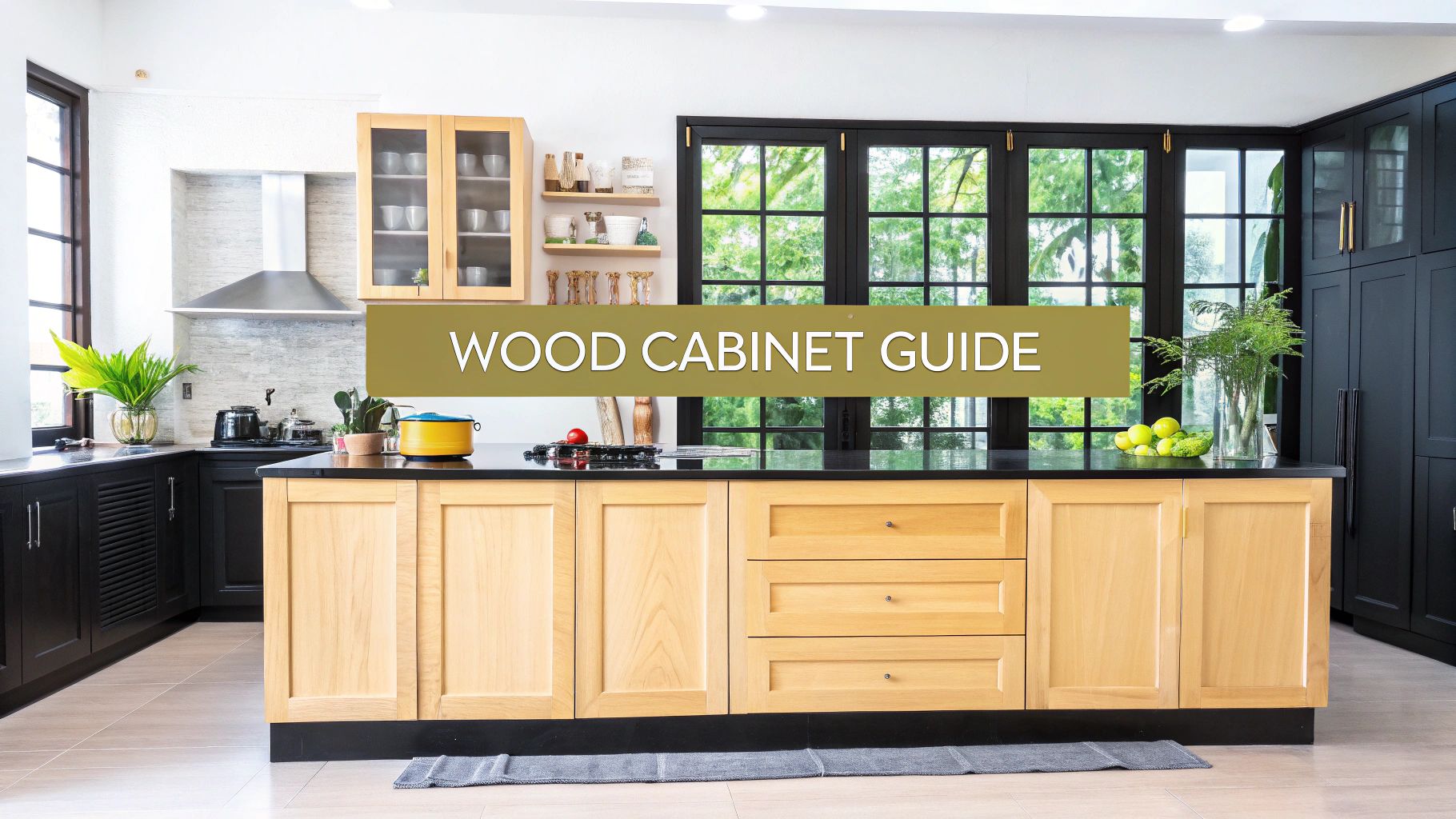
Walk into any thoughtfully designed Singaporean home, and you'll notice the cabinetry is the soul of the kitchen. A wood kitchen cabinet is more than storage; it anchors the space with a natural warmth and timeless character that other materials struggle to match. It's the functional and aesthetic heart of a modern kitchen.
Why Wood Cabinets Remain a Top Choice for Singaporean Kitchens
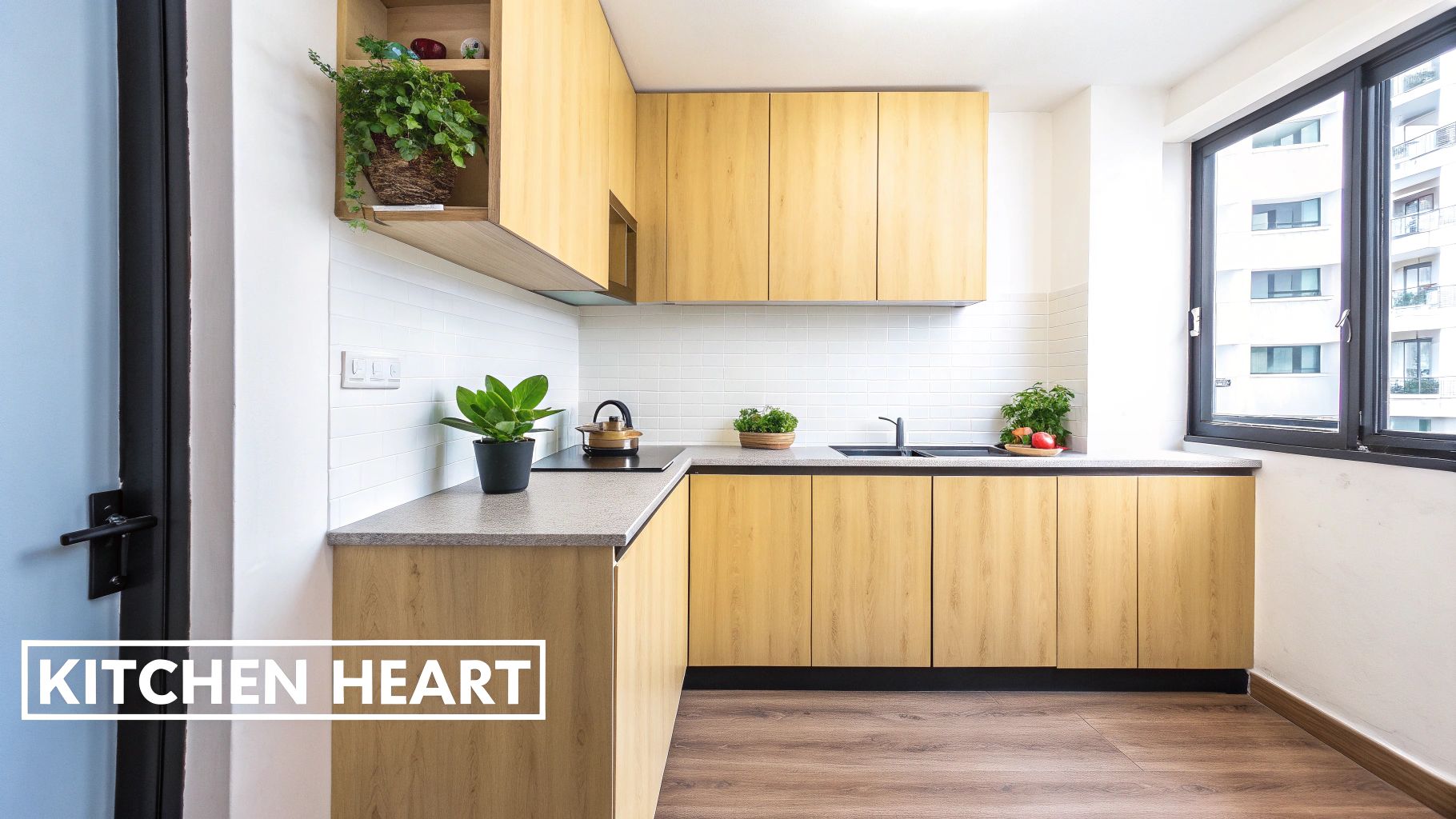
In a city of HDB flats and condos where every square metre counts, wood brings a vital touch of nature indoors. This design choice transforms a purely functional zone into a warm, inviting living area where families gather. The appeal of a wood kitchen cabinet runs deeper than aesthetics; it’s about creating a feeling of permanence and quality.
A Foundation Of Value And Style
The lasting popularity of wooden cabinetry is clear in Singapore’s dynamic property market. The wooden kitchen furniture market is valued at around $56 million, reflecting a consistent preference among homeowners for high-quality, space-efficient cabinetry. You can explore more data on Singapore's furniture market trends to understand its solid position.
From our experience with clients, the trend is clear: people want kitchens that are not only beautiful but also add tangible, long-term value to their property. A well-crafted wood kitchen does exactly that.
A thoughtfully designed wood kitchen is an investment in your home's future. It signals quality to potential buyers and provides daily enjoyment, proving that true style is both beautiful and built to last.
Navigating Your Choices
This guide is built from our hands-on experience helping Singaporean homeowners make choices that matter. We'll walk you through everything from selecting the right timber for our humid climate to understanding the craftsmanship details that separate good from great. Our goal is to provide practical, actionable insights to ensure your kitchen doesn't just look stunning on day one, but performs and inspires for years to come.
Choosing The Right Wood For Singapore's Climate
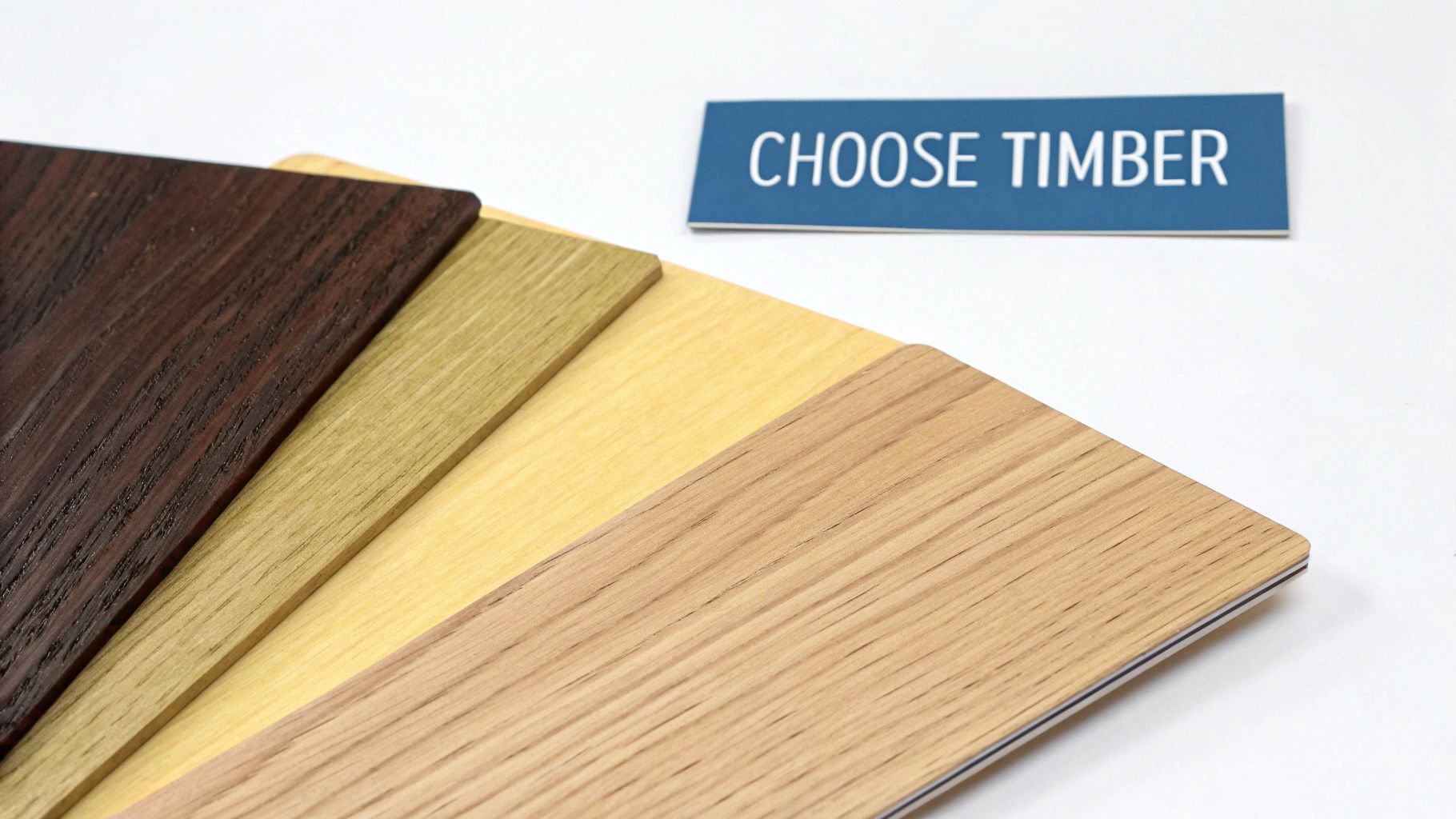
In Singapore, humidity is a constant. This makes selecting the right timber for your kitchen cabinets the single most important decision for longevity. Your cabinets must resist moisture without warping, swelling, or delaminating. It's about choosing a material engineered by nature to thrive in our tropical environment.
Hardwoods Proven To Perform In Humidity
Some timbers are naturally equipped to handle moisture. They are dense, less porous, and often contain oils that act as a built-in defence. We consistently guide our clients towards these proven performers:
- Teak: The gold standard for humid climates. Teak's high content of natural oils and silica makes it incredibly resistant to moisture, rot, and insects. It is a premium choice that ensures stability and beauty for decades.
- Oak: Known for its prominent grain and strength, Oak is a dense, tough hardwood. When properly kiln-dried and sealed, it handles the daily demands of a busy kitchen while resisting humidity.
- Walnut: For a deeper, more luxurious look, Walnut is a fantastic option. It’s a strong, stable wood that delivers a sophisticated aesthetic without compromising on durability in our local climate.
- Nyatoh: A popular and cost-effective local favourite, Nyatoh has a reddish-brown hue and good moisture resistance. It provides the warmth of solid wood at a more accessible price point.
The Strategic Role Of Engineered Wood
There’s a misconception that "100% solid wood" is always best for every part of a cabinet. While solid wood is ideal for doors and frames, high-grade plywood is the smarter, more practical choice for the cabinet's internal structure (the 'carcass').
High-quality, moisture-resistant plywood isn't a 'cheaper' alternative; it's a strategic engineering choice. Its cross-laminated construction provides superior dimensional stability, making it far less likely to warp or expand in Singapore's humidity than a large solid wood panel.
This hybrid approach is the secret to a well-made, climate-ready kitchen cabinet. You get solid wood for visual appeal and strength where it counts, and high-performance plywood for internal stability.
Wood Species Comparison For Singapore Kitchens
This table provides a practical summary to help you align your aesthetic goals with real-world performance.
| Wood Species | Aesthetic & Grain | Durability (Hardness) | Moisture Resistance | Best For |
|---|---|---|---|---|
| Teak | Golden to medium brown with straight grain | High | Excellent | Cabinet doors and countertops for a luxe, highly durable kitchen. |
| Oak | Light brown with distinct, wavy grain | Very High | Good (when sealed) | Classic and Scandinavian kitchens needing a bright, sturdy feel. |
| Walnut | Rich, dark brown with straight or swirled grain | High | Good | Modern and sophisticated designs aiming for a dramatic, high-end look. |
| Nyatoh | Reddish-brown with a fine, even texture | Medium | Good | A cost-effective solid wood option for doors in a warm-toned kitchen. |
By choosing a timber naturally suited to our climate and using materials strategically, your wood kitchen cabinet will be a functional and enduring part of your home for many years to come.
What Quality Cabinet Construction Really Means
A beautiful door can hide poor construction. To ensure your wood kitchen cabinet lasts, you need to look beyond the surface. It’s the hidden details—the joinery, the internal materials, and the assembly—that separate a temporary fix from a long-term investment.
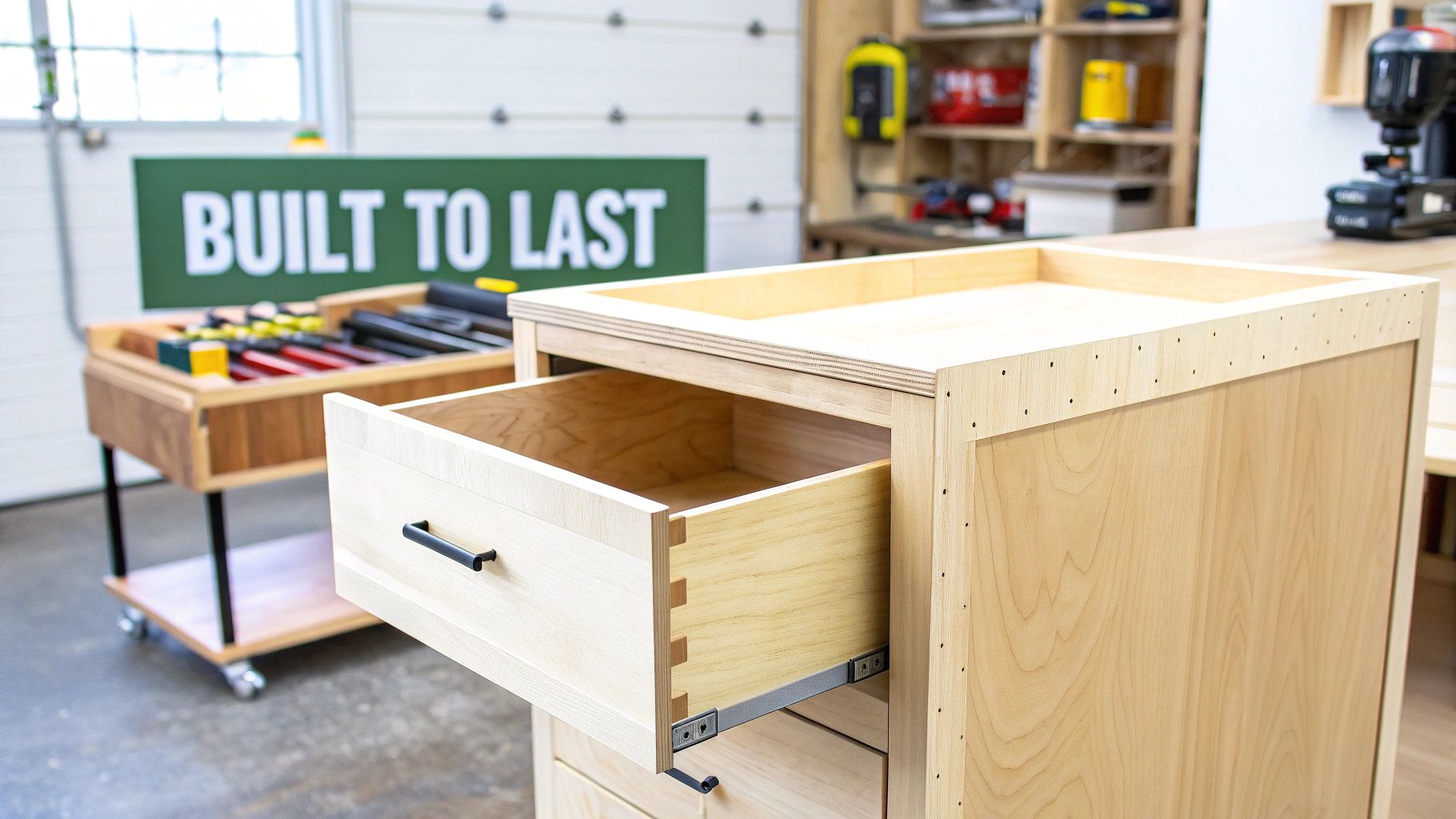
We've seen beautifully finished kitchens show wear far too soon, almost always due to construction shortcuts. Understanding what quality means empowers you to ask the right questions and identify true value.
Framed vs Frameless Construction
The first choice in cabinet construction is style: framed or frameless. Each offers a different look and function, which is critical in Singapore where space is a premium.
- Framed Cabinets: The traditional style. A solid wood face frame (about 1.5 inches wide) is attached to the front of the cabinet box. Doors are mounted to this frame. It provides a robust look but slightly reduces the opening size and interior access.
- Frameless Cabinets: Also known as ‘Euro-style’, this modern approach omits the face frame. Doors attach directly to the cabinet box sides, creating a sleek, seamless look with minimal gaps. This design maximises interior storage, making it a popular choice for compact HDB and condo kitchens.
The Myth Of 100% Solid Wood
It’s a common misconception that cabinets made entirely from solid wood are superior. While solid wood is the top choice for doors and face frames, using it for the entire cabinet box can be problematic in our climate, as large panels are prone to warping.
For the carcass, high-quality, moisture-resistant plywood is the smarter, more stable choice. It's engineered with cross-laminated layers, giving it exceptional structural integrity against humidity-induced expansion and contraction. To understand these materials better, you can explore this complete guide to 9mm plywood sheets.
Think of it this way: a high-performance plywood carcass provides a strong, stable skeleton, while the solid wood doors and frames are the beautiful, durable skin. This combination is the hallmark of a well-built, climate-conscious wood kitchen cabinet.
Why Joinery Is The True Sign Of Quality
How a cabinet is held together is as important as its materials. Good joinery is the clearest sign of craftsmanship and longevity. A practical place to check is the drawer boxes.
Dovetail joints, an interlocking technique, create an incredibly strong mechanical bond that doesn't rely solely on glue or screws. A dovetailed drawer can withstand thousands of openings without failing. In contrast, lower-quality cabinets often use staples or glue, which loosen over time. Insisting on quality joinery guarantees your cabinets will function smoothly for years.
This focus on quality construction is becoming more critical as discerning homeowners invest in premium, custom woodwork that stands the test of time.
Finding Your Style With Finishes And Doors
If construction is the skeleton, then finishes and door styles are your kitchen's personality. This is where your vision comes to life, setting the mood for the entire space.
The Great Debate: Stains Versus Paints
A stain is transparent, while paint is opaque. One reveals the wood's character, the other creates a new one.
A stain soaks into the wood, highlighting its natural grain. This is the perfect choice for showing off the beautiful patterns in woods like oak or the rich tones of walnut. Stains range from clear coats that protect the wood's natural colour to darker shades that add depth.
Paint provides a clean, uniform look with an opaque layer of solid colour. It covers the wood grain, opening up endless colour possibilities to match your home’s palette. It's the go-to for a crisp, contemporary finish or a bold statement.
Choosing between a stain and paint is a choice between celebrating the wood's inherent character or creating a clean canvas for your design's colour story. The right choice is the one that aligns with your home's overall aesthetic.
Based on our client projects, those aiming for a minimalist Scandinavian or Japandi theme often choose light oak cabinets with a clear matte finish. For a more dramatic, modern-luxe feel, a dark walnut with a subtle satin finish is a consistent favourite.
Shaping Your Look With Door Profiles
The profile of your cabinet doors has a massive impact on the final style. Here are a few popular styles we implement in Singaporean homes:
- Shaker Style: A design classic. Its flat centre panel and simple four-piece frame are incredibly versatile. It can feel traditional with a dark stain or modern when painted and paired with sleek handles.
- Flat-Panel (Slab) Doors: Completely flat with no ornamentation, these doors are the foundation for ultra-modern and contemporary kitchens. We often design them with integrated J-pull handles or a push-to-open mechanism for a hardware-free look.
- Beadboard Doors: With distinctive vertical panelling, beadboard doors bring texture and a charming, cottage-like feel. They work beautifully in homes aiming for a cosy, Hamptons, or coastal aesthetic.
Each door style interacts with light and space differently. For example, flat-panel doors in a light colour create clean, unbroken lines that can make a small kitchen feel larger.
Why Custom Cabinets Are A Smarter Investment
Homeowners often ask if custom cabinetry is worth the higher price. The answer is yes, not just for luxury, but for solving practical problems that off-the-shelf options can't, especially in unique Singaporean layouts.
A bespoke wood kitchen cabinet is built to millimetre-perfect precision for your space. This eliminates awkward gaps and filler panels, unlocking every inch of your kitchen's potential.
Maximising Every Bit Of Your Space
Odd corners or strange walls aren't problems; they're design opportunities. We can turn a peculiar nook into a pull-out pantry or build a shallow-depth cabinet for a narrow walkway, adding storage where you thought it was impossible.
This precision is a game-changer in compact HDB and condo kitchens. In our projects, a custom-designed island can become a multitasking hero, blending prep space, a dining spot, and deep storage drawers within a modest footprint. It’s about making your home work for you.
The real value of custom work isn't just that it fits your walls—it's that it fits your lifestyle. You're investing in efficiency, better function, and the daily joy of a space that truly works.
This need for tailored solutions is rising. Singapore's cabinet market saw import growth of 9.31% from 2023 to 2024, linked to rapid urbanisation. New BTOs and redevelopments fuel the demand for perfectly fitted wooden cabinets.
Uncompromising Quality That Lasts
While the upfront cost is higher, the long-term value is where you see the return. You don't have to compromise on:
- Superior Materials: You choose the exact wood, hardware, and finishes, ensuring every component meets your standards.
- Built to Endure: Custom cabinets are built by skilled craftspeople using time-tested joinery, resulting in a far more robust product.
- A Perfect Fit for Your Life: Your kitchen is designed around your specific workflow and storage needs, eliminating the frustrations of a one-size-fits-all solution.
Choosing custom means sidestepping the shorter lifespan of prefabricated units. It’s about creating a kitchen that not only looks incredible but works flawlessly. This investment is one of the key elements of a dreamy kitchen renovation, adding real, enduring value to your property.
Simple Care To Keep Your Wood Cabinets Looking New
Your wood kitchen cabinets are a significant investment. Protecting them is simple—it’s about gentle, consistent care, not hard labour. The goal is to preserve the protective finish that shields the timber from moisture and daily wear.
The biggest mistake is using harsh, abrasive cleaners. Anything with ammonia, bleach, or even citrus oils can strip the protective lacquer, leaving the wood vulnerable. Most of the time, a simple two-step wipe-down is all you need.
Your Go-To Cleaning Method
For day-to-day upkeep, stick to the basics.
- Damp Wipe: Lightly dampen a soft microfibre cloth with warm water. For greasy spots, add a single drop of mild, pH-neutral dish soap. Wring the cloth until it’s just damp, not dripping.
- Dry Buff: Immediately after wiping, use a second clean, dry microfibre cloth to buff away any moisture. This is crucial in Singapore's humid climate to stop water from seeping into seams or grain.
This gentle approach handles 90% of your cleaning needs without compromising your cabinet’s finish.
The most common mistake we see is using an overly wet cloth or letting water sit on the wood. Always wipe dry immediately to maintain the integrity of the finish and prevent long-term damage.
Handling Common Kitchen Spills
Spills happen. The key is to act fast. Whether it’s soy sauce, oil, or curry paste, cleaning it up immediately prevents the stain from setting.
For oily or sticky spills, mix a solution of one part white vinegar to four parts warm water. Lightly dampen a cloth, gently wipe the spot, then wipe clean with a fresh, water-dampened cloth. Always finish with a dry wipe.
Think of the protective finish as your cabinet's first line of defence. By looking after it with these simple habits, you ensure the wood itself stays pristine for years to come.
Answering Your Top Questions About Wood Kitchen Cabinets
Investing in a new wood kitchen brings up many questions. Here are clear, practical answers to the most common queries we receive from Singaporean homeowners.
How Much Should I Budget for Custom Wood Kitchen Cabinets in Singapore?
The final cost depends on wood type, kitchen size, and design complexity.
As a practical guide, a custom wood kitchen for a typical HDB flat usually starts from SGD 8,000 and can go up to SGD 20,000+. This includes high-quality timber, professional design, workshop fabrication, and final installation.
For larger spaces like condominiums or landed properties using premium hardwoods like teak or walnut, the investment typically ranges from SGD 20,000 to SGD 50,000 or more. We provide a detailed, transparent quote after our initial consultation, ensuring the budget aligns with your vision.
Are Solid Wood Cabinets a Good Idea in Singapore’s Humid Climate?
Yes, absolutely—if the right timber is chosen and professionally treated. The key is selecting hardwoods with natural moisture resistance, like Teak, Oak, and Nyatoh.
The success of solid wood in our climate boils down to two things: proper kiln-drying to stabilise the wood, and sealing it with a top-tier, moisture-resistant finish. This prevents warping or swelling over time.
For cabinet interiors (the 'carcass'), we almost always recommend high-grade, moisture-resistant plywood for its superior dimensional stability. We then use solid wood for visible parts like doors and frames. This hybrid approach delivers both durability and beauty.
How Long Does the Whole Process Take, From Design to Installation?
From our first meeting to the finished kitchen, a bespoke cabinet project typically takes 6 to 12 weeks.
- Design & Material Selection (1-2 weeks): We collaborate to finalise the layout, timbers, and finishes.
- Workshop Fabrication (4-8 weeks): Our craftsmen build your cabinets. The timeline depends on design complexity.
- On-site Installation (1-2 weeks): Our team installs the finished cabinetry in your home.
We manage the entire schedule and provide regular updates so you’re always informed.
Can I Get Modern Features Like Smart Storage and Integrated Lighting?
Definitely. This is a major advantage of going custom. We blend modern functionality with the timeless look of wood.
Think soft-closing hinges and drawers, pull-out pantry systems for narrow spaces, and corner solutions that make every inch usable. We also regularly integrate LED lighting to illuminate worktops. Our design process starts with understanding how you use your kitchen, so we can recommend features that will make your space not just beautiful, but incredibly practical.
Ready to create a kitchen that perfectly blends timeless style with modern function? The team at KIVO is here to guide you through every step. Contact us today to start your design journey.